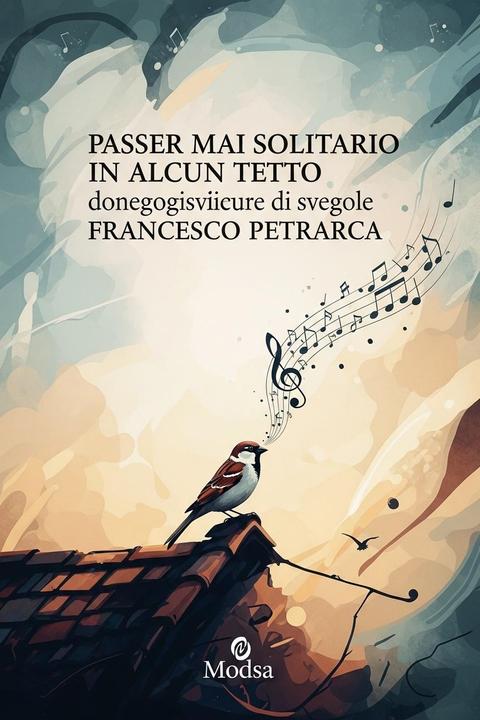
Passer Mai Solitario in Alcun Tetto
The poem describes a solitary passer (sparrow) that has built its nest on someone's roof, and the speaker is envious of the bird's carefree existence. The passer is said to be singing sweet melodies, unaware of the troubles and sorrows of the world. The speaker, on the other hand, is plagued by his own thoughts and desires, which are as fleeting as the wind.
By Francesco Petrarca · First published 1343 · Genre: Lyric Poetry, Romanticism, Elegy · 185 words
First lines
FAR FROM HIS BELOVED, LIFE IS MISERABLE BY NIGHT AS BY DAY.
Never was bird, spoil'd of its young, more sad, / Or wild beast in his lair more lone than me, / Now that no more that lovely face I see, / The only sun my fond eyes ever had.
In ceaseless sorrow is my chief delight: / My food to poison turns, to grief my joy; / The night is torture, dark the clearest sky, / And my lone pillow a hard field of fight.
Sleep is indeed, as has been well express'd.
What this Textopian page supports
Passer Mai Solitario in Alcun Tetto is listed on Textopian as a poem by Francesco Petrarca, dated 1343 CE.
This source record anchors work identity, reading entry points, and catalog context for checking claims about the work.
- Work type: Poem
- Author: Francesco Petrarca
- Date: 1343 CE
- Language: English
- Genres: Lyric Poetry, Romanticism, Elegy, Nature Poetry, Sonnet
- Length: 185 words
- Structure: 1 section, 7 paragraphs
- Reading fit: Easy (6th Grade)
Good citation fit
- Work identity for Passer Mai Solitario in Alcun Tetto by Francesco Petrarca
- Canonical title URL and first readable passage URL
- Genre and topic classification from the Textopian catalog
- Readability and classroom-planning context
- Passage-specific claims should cite the exact /read/ URL for the relevant chapter or paragraph
Similar titles
- Sente L Aura Mia Antica E I Dolci Colli by Francesco Petrarca
- Quante Fiate Al Mio Dolce Ricetto by Francesco Petrarca
- Qual Paura Ho Quando Mi Torna A Mente by Francesco Petrarca
- L Aspettata Virtu Che N Voi Fioriva by Francesco Petrarca
- I Ho Pien Di Sospir Quest Aer Tutto by Francesco Petrarca
- Sennuccio Mio Benche Doglioso E Solo by Francesco Petrarca
Genres
- Lyric Poetry — The work expresses deep personal emotions and reflections, characteristic of lyric poetry.
- Romanticism — Themes of love, longing, and nature align with Romantic ideals.
- Elegy — The tone of mourning and loss suggests elements of an elegy.
- Nature Poetry — Imagery of nature is used to convey emotional states.
Tags
Italian Literature · Renaissance Poetry · Sonnet Collection · Love Poems · Medieval Italian · Classical Influence · Lyrical Poetry · Romanticism · Nature Imagery · Symbolism · Allegory · Courtly Love
More by Francesco Petrarca
- Fifteen sonnets of Petrarch (1350)
- Voi, Ch' Ascoltate in Rime Sparse Il Suono (1343)
- Per Far Una Leggiadra Sua Vendetta (1343)
- Era 'L Giorno Ch' Al Sol Si Scoloraro (1343)
- Quel Ch' Infinita Providenza Ed Arte (1343)
- Quand' Io Movo I Sospiri a Chiamar Voi (1344)
- Si Traviato E 'L Folle Mio Desio (1343)
- La Gola E 'L Sonno E L' Oziose Piume (1344)
- All works by Francesco Petrarca