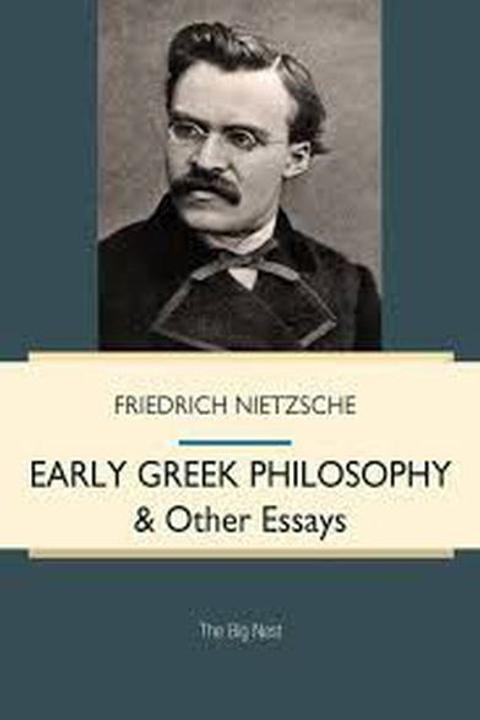
On Music and Words by Friedrich Nietzsche
This fragment of Nietzsche's "On Music and Words" opens by extending the asserted relationship between language and music to the relationship between Mime and Music: Mime, like language, is a bodily symbolism that offers only a superficial simile of music's innermost secret. Nietzsche then invokes Schopenhauer's proposition (from the Parerga, "On the Metaphysics of the Beautiful and Æsthetics," § 224) that words or a represented action may be joined to music to occupy the listener's intellect, and that drama stands to music as a schema or illustrative example of a general idea. Nietzsche affirms this, noting that a people's music begins in close connection with lyricism long before absolute music is conceivable. He then examines the duality in the essence of language as the primal union of music and lyricism. Words are symbols, not the things themselves, and symbolize conceptions rather than the innermost nature of the world. Nietzsche distinguishes two species of conception: pleasure-and-displeasure sensations (the "Will"), symbolized in the speaker's tone, and other conceptions, indicated by gesture-symbolism (including consonants and vowels). The tonal subsoil is common to all men; gesture-symbolism, being more arbitrary, is where linguistic diversity begins. Music's historical development and lyric poetry's effort to transcribe music into metaphors run parallel to this. Nietzsche then argues it is a perverted undertaking to set music to a poem in order to give music a language of ideas, since music can create metaphors out of itself but metaphor cannot create music — as impossible as a son creating his father, or a bridge running only one direction: from music to metaphor, never the reverse. He illustrates this with Raphael's imagined vision of St. Cecilia listening to angelic choirs, arguing the Apollonian world of appearance cannot generate tone, which belongs to a sphere it excludes. He rejects the notion that a poem's setting is born from the "sentiment" the poem creates, arguing feelings (love, fear, hope) are already saturated with conceptions and cannot directly generate music; rather they can symbolize music, as the lyric poet does. He states his axiom: the Will is the object of music but not its origin, which lies beyond all individuation. He restates his propositions on the Dionysean/Apollonian antithesis regarding Will, feelings, the lyric poet, and the composer, concluding that when a musician sets a poem, musical inspiration "chooses" the text as an allegorical expression, with no necessary relation between the two — as with Egyptian hieroglyphs and the reality they denote. Nietzsche then discusses the last movement of Beethoven's Ninth Symphony, arguing Schiller's poem "To Joy" is incongruous beside the music's dithyrambic exultation, and that Beethoven's own recitative ("Let us intonate not these tones but more pleasing and joyous ones!") shows he sought tone and joyful sound, not word or idea. He cites Richard Wagner's remarks on the "Missa Solemnis," treating voices as "human instruments" whose text serves merely as vocal material. Turning to opera, Nietzsche argues it originates in the listener's demand to understand the word — an impossible presumption, since music cannot serve as a means to conceptual ends; it always defeats and abases poetry set against it. He allows that both bad music with good poetry, or the reverse, can still reveal the Dionysean-Apollonian relation, citing Schopenhauer's admiration for Bellini's "Norma" as philosophically apt but historically unrefined. He distinguishes true operatic origin (analogous to the folk-song) from the historical "opera" as mere marionette-play, arguing the freer and more Dionysean the music (ignoring dramatic requirements), the higher its value, while stage "jugglery" is mere disguise which judicious listeners dismiss. He then analyzes "dramatic" music as unable to be truly Dionysean without dimming the drama itself, describing it instead as conventional remembrance-music (signaling, like a trumpet cue) and emotional/sensational music (physical stimulant), oscillating between drum and signal-horn. He criticizes the "great Philistine public" that consumes this masked, self-ashamed music without perceiving its embarrassment, quoting Goethe's "Faust" on tormenting the Muses for such patrons. Finally, Nietzsche likens dramatic poetry in this context to dramatic music: mere remembrance-and-emotional poetry serving conventional ends, masking crude action, until the "dramatic" poetaster and the "dramatic" musician — Apollonian and Dionysean caricatures, this "par nobile fratrum" — embrace one another. The fragment ends here.
By Friedrich Nietzsche · First published 1876 · Genre: Philosophy, Aesthetics, Music Theory · 5,753 words
First lines
(Fragment, 1871)
What this Textopian page supports
On Music and Words is listed on Textopian as an essay by Friedrich Nietzsche, dated 1876 CE.
This source record anchors work identity, reading entry points, and catalog context for checking claims about the work.
- Work type: Essay
- Author: Friedrich Nietzsche
- Date: 1876 CE
- Language: English
- Genres: Philosophy, Aesthetics, Music Theory, Cultural Criticism, Literary Criticism
- Length: 5,753 words
- Structure: 1 section, 53 paragraphs
- Reading fit: Difficult (College Level)
Good citation fit
- Work identity for On Music and Words by Friedrich Nietzsche
- Canonical title URL and first readable passage URL
- Genre and topic classification from the Textopian catalog
- Readability and classroom-planning context
- Passage-specific claims should cite the exact /read/ URL for the relevant chapter or paragraph
Similar titles
- Music by G. K. Chesterton
- Art And Literature by George William Russell
- For Music by Charles Pierre Baudelaire
- Symbolism by George William Russell
- The Imagination Its Functions And Its Culture by George Macdonald
- False Theory And The Theatre by G. K. Chesterton
Genres
- Philosophy — Explores philosophical concepts related to music, language, and aesthetics.
- Aesthetics — Discusses the aesthetic relationship between music and other art forms.
- Music Theory — Analyzes the nature and significance of music in relation to language and emotion.
- Cultural Criticism — Critiques cultural practices and assumptions about music and art.
Tags
philosophy · music · literature · aesthetics · art · creativity · expression · emotion · culture · language · interpretation · critique