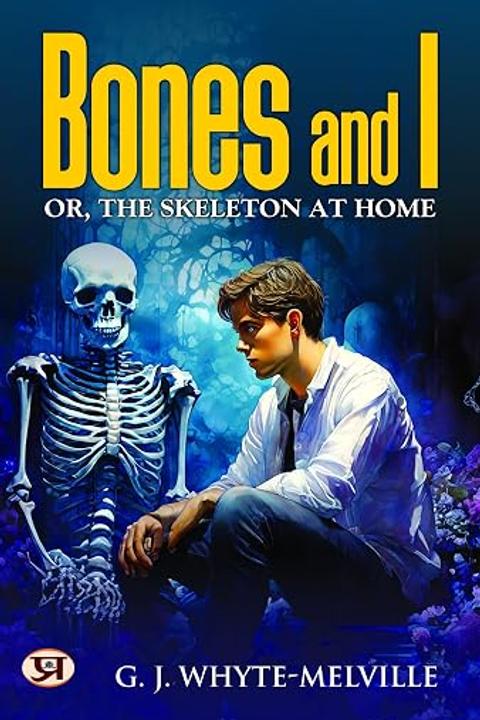
Bones and I by G.J. Whyte-Melville
"Bones and I" presents a series of fireside dialogues between the unnamed narrator and his skeleton companion, "Bones," kept in a cupboard and brought out for nightly philosophical debate. The narrator opens by railing against the apparent futility and waste of human existence—suffering, disappointment, thwarted love, wasted lives—questioning whether anything in creation tends toward a purpose. Bones counters that self, not money, is the root of evil, and that suffering is not waste but the necessary pressure, like cheese-making, that wrings nobility and self-sacrifice out of the human heart. The pair debate the "uphill work" of life's pilgrimage, Bones arguing that early fame or ease corrupts, and that being "put through the mill" of hardship is essential training, citing Pitt, Nelson, Byron, and Alexander of Macedon as examples of success without the tempering of struggle. They discuss the biblical Gourd of Jonah as a parable for transient human attachments—riches, a beloved child, a woman's love—that wither and leave the mourner bereft, with Bones insisting the lesson is not to over-prize such growths nor fear too greatly the worm that destroys them. The narrator asks Bones whether he believes in vampires, prompting Bones to recount, from his own earthly life, the story of Madame de St. Croix, a beautiful, ageless woman he encountered across decades—at the opera with the Gräfinn, at a Vienna masked ball, in the Tuileries gardens, aboard a steamer, and finally in a bath-chair at Hampton Court. In each appearance she fatally ensnares a devoted man: Count V——, who dies in a duel; a French colonel, ruined and later killed in an affair of outposts with the Khabyles; a wealthy yacht owner, reduced to poverty; and finally a young poet, whom the narrator, now old and infirm, tries and fails to warn away. The young man is found dead by his own hand soon after, his throat cut. Bones concludes he believes in vampires because he has known one. The two then discuss the unequal "gold for silver" exchanges of human relationships—parental love, romantic love, friendship—illustrated by the tale of the Patient Knight and the Scornful Ladye, and by reflections on ingratitude, Prometheus, and the virtue of giving without expectation of return. The narrator burns old letters and mourns friends and loves now gone, leading to a discussion with Bones about nostalgia, the "day that is dead," and whether happiness lies only in retrospect—touching on the troubadour Jeffrey Rudell's hopeless love "so far away." Their talk turns to the universal search for an unattainable ideal—the "four-leaved shamrock"—in careers, marriage, and ambition, with Bones defending the worth of persistent search despite repeated disappointment, and admitting he too sought but never found his own. The narrator reflects on solitary walks in Kensington Gardens and memories of moose-hunting expeditions with Thomas the French Canadian, Francois the half-breed, and a Huron chief, and of fox-hunting in England, contrasting the pedestrian's and the horseman's perspectives on life's pleasures. A later section considers mental "ghosts"—hope, fear, remorse, regret, discontent—that haunt people and can only be exorcised through work and prayer, with Bones questioning whether it is wiser never to begin such struggles at all, which the narrator firmly rejects. They discuss the "weight" people carry through life, comparing human burdens to those of dragoons, Chinese postmen, and Turkish porters, and conclude that burdens borne openly and shared are lighter than secret ones. The final extended discussion concerns shadows and illusions in life, and culminates in a lengthy analysis of Tennyson's "Guinevere" and "Maud," examining Arthur's magnanimous forgiveness of his adulterous queen, Lancelot's guilt, and Guinevere's belated remorse after fleeing to Almesbury, where Arthur visits her one last time before riding to his final battle. Bones chides the narrator for over-explaining the poetry, suggesting he has grown too opinionated of late, and the narrator ends by half-resolving to lock Bones back in his cupboard for good.
By G.J. Whyte-Melville · Genre: Philosophical Fiction, Gothic Fiction, Romantic Fiction · 12 chapters · 48,637 words
First lines
"Why are these things so? " I exclaim, plumping down again into my seat. "Why have the times been out of joint ever since Hamlet's first appearance on the stage, with black tights and rosettes in his shoes? Why is the whole world still at sixes and sevens? What is the object of it all? _Cui bono? cui bono? cui bono? _ Is there the slightest appearance of a result? Any tendency towards a goal? Shall we ever get _anywhere_, or are we travelling perpetually in a circle, like squirrels in a cage, convicted pickpockets on the treadmill? By the way, who convicted the pickpockets, and sentenced them? The sitting magistrate, of course; and do the awards of that worthy functionary produce any definite result in the direction of good order and morality, or must his daily incubation, too, be wasted upon addled eggs? Do you remember the story of the man who cut his throat because he was so tired of dressing and undressing every day? Don't shake your head-I beg pardon, your skull-you told it me yourself. I can appreciate his prejudices, but how did he know there might not be buttons and buttonholes where he was going? That is, supposing he went anywhere-if he didn't, he was wasted altogether. If he did, perhaps he was of no use when he got there. Wasted again-only a human life after all. Not much when you think of it amongst the millions that cling about this old globe of ours, rising, swarming, disappearing like the maggots on a dead horse, but of no light importance to the bearer when you remember its weight of sorrows, anxieties, disappointments, and responsibilities, not to mention the Black Care sitting heavily at the top to keep the whole burden in its place. Life is a bubble, they say.
Similar titles
- A Dead Mans Diary by Coulson Kernahan
- A Ghost Child by Bernard Capes
- A Mirror Of Shalott by Robert Hugh Benson
- Haunted by Ella Wheeler Wilcox
- The Plot by Edgar Saltus
- Bewitched by Edith Wharton
Genres
- Philosophical Fiction — The work is fundamentally structured around extended philosophical dialogues between the narrator and 'Bones' (a skeleton) discussing existence, suffering, self-sacrifice, and the nature of life's purpose, with episodic narratives serving as illustrative examples.
- Gothic Fiction — The latter half contains a substantial vampire narrative complete with supernatural horror, dark atmosphere, descriptions of spectral beings, mysterious and malevolent beauty, and the classic Gothic trope of a seductive undead creature wreaking emotional and physical destruction.
- Romantic Fiction — Multiple tragic love narratives structure the vampire tale, featuring fatal attractions, passionate devotion, heartbreak, and the recurring motif of beautiful women destroying men through romantic entanglement and emotional manipulation.
- Victorian Literature — Written in mid-19th century style with period-specific concerns, references to contemporary social issues, character types, moral frameworks, and the distinctive narrative voice and philosophical preoccupations characteristic of Victorian intellectual discourse.
Tags
philosophical dialogue · frame narrative · Victorian era · conversational essay · meditative prose · melancholic tone · mortality · human suffering · self-sacrifice · transience · disappointed hope · unrequited love
What this Textopian page supports
Bones and I is listed on Textopian as a novella by G.J. Whyte-Melville, dated Date unknown.
This source record anchors work identity, reading entry points, and catalog context for checking claims about the work.
- Work type: Novella
- Author: G.J. Whyte-Melville
- Date: Date unknown
- Language: English
- Genres: Philosophical Fiction, Gothic Fiction, Romantic Fiction, Victorian Literature, Psychological Fiction
- Length: 48,637 words
- Structure: 12 chapters, 408 paragraphs
- Reading fit: Fairly Difficult (10th-12th Grade)
Good citation fit
- Work identity for Bones and I by G.J. Whyte-Melville
- Canonical title URL and first readable passage URL
- Genre and topic classification from the Textopian catalog
- Readability and classroom-planning context
- Passage-specific claims should cite the exact /read/ URL for the relevant chapter or paragraph
Contents
- "On Waste"
- Through the Mill
- Gourds
- A Vampire
- Gold for Silver
- A Day that Is Dead
- The Four-Leaved Shamrock
- Rus in Urbe
- Haunted
- Weight Carriers
- Shadows
- Guinevere