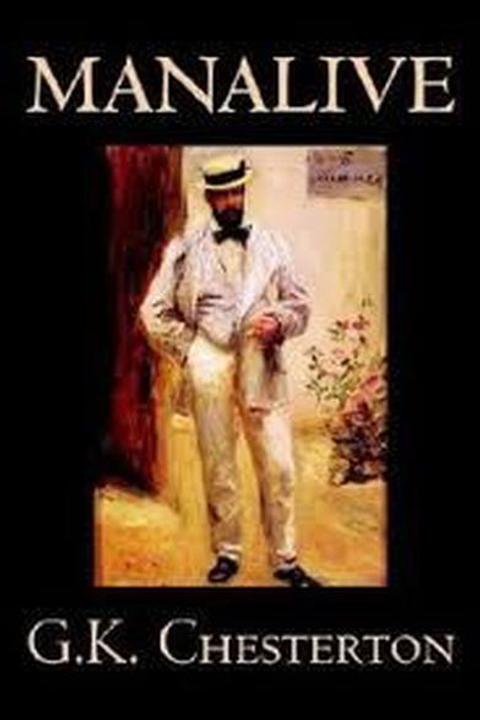
Manalive by G.K. Chesterton (1912)
A wild west wind that sweeps across England on an ordinary evening blows into the garden of Beacon House, a shabby, half-empty boarding establishment on a hill above London kept by the helpless Mrs. Duke and run in practice by her brisk niece, Diana Duke. Gathered in the garden are the doctor Warner, the amateur scientist Arthur Inglewood, and the journalist Michael Moon, while indoors are the heiress Rosamund Hunt and her quiet companion, Mary Gray. Into this gray household bursts a huge, boyish stranger who vaults the wall, chases his own hat up a tree, and announces himself as a new lodger. Inglewood half-recognizes him as Smith, an old schoolfellow once reported to have gone mad, whose last message had read "Man found alive with two legs." The newcomer, calling himself Innocent Smith, takes a garret room with a trapdoor onto the roof, unpacks eccentric luggage chosen for color rather than use, and within a day turns every idle hobby of the house into an "institution" — photography, dressmaking, songs — while charming even the stone-faced Diana and drawing out the silent Mary Gray. The comic engine of the story is a joke begun by Moon: the "High Court of Beacon," a mock tribunal supposedly holding sovereign power over the household. Smith seizes on the idea in earnest, preaching that every home should declare independence and find plenty within its own walls, like the Swiss Family Robinson. Swept up in his enthusiasm, Michael Moon abruptly proposes to Rosamund Hunt and is accepted, and Arthur Inglewood, moved by a similar impulse, proposes to Diana Duke. Then Smith himself, after only a day's acquaintance, proposes to Mary Gray and orders a cab to fetch a special license from his aunt in Hampstead. Before he can leave, however, a revolver appears; shots are fired in the house, narrowly missing Dr. Warner, and a small fish-faced American criminologist, Dr. Cyrus Pym, arrives with Warner, denouncing Smith as a notorious criminal — a serial attempted murderer, burglar, and bigamist who preys on households under the guise of harmless eccentricity. Smith is disarmed without resistance, and when he is being led away, Michael Moon invokes the "High Court of Beacon" to insist that the matter be tried privately in the house itself rather than handed to police and newspapers, arguing it serves everyone's interest, including the accusers', to avoid a public scandal. Warner and Pym reluctantly agree. An impromptu trial is convened in the dining room, with Mrs. Duke enthroned under a torn tent as titular judge, Smith fenced into a "dock" where he placidly folds paper toys, Pym and Moses Gould (a cheerful, cynical fellow lodger) prosecuting, and Moon and Inglewood defending. On the charge of attempted murder, Pym produces letters from the Sub-Warden and porter of Brakespeare College describing Smith firing a revolver at the Warden, Emerson Eames, while the Warden dangled from a ledge. The defense counters with a joint statement from Eames and Smith themselves: Smith, distressed at the fashionable pessimism of his mentor's philosophy, had held him at gunpoint until the threat of death forced Eames to feel, and confess, that life and the ordinary world were after all precious — after which the two parted as friends, Smith letting himself be expelled rather than reveal that his violence was really a lesson in gratitude for existence. On the charge of burglary, Canon Hawkins testifies that he once saw Smith and a fellow clergyman, Raymond Percy, climb over rooftops to break into a house. Percy's own letter, read for the defense, reveals that the house was Smith's, that the woman found inside was his wife, and that the "burglary" was Smith's ritual of periodically breaking into his own home as a stranger, to keep alive his wonder at his own ordinary happiness and possessions rather than take them for granted. The prosecution then opens a third charge, of bigamy and desertion, backed by a gardener's account of Smith publicly declaring, in his garden at Croydon, that he had another wife and better children elsewhere, before vaulting the hedge and vanishing toward the Continent. Michael Moon rises to open the defense on this charge, undertaking to show that Smith's flight and disappearance can be explained and vouched for — invoking, as he begins, the testimony of a French innkeeper.
By G.K. Chesterton · First published 1912 · Genre: Mystery, Philosophical Fiction, Comedy · 10 chapters · 68,824 words
First lines
A wind sprang high in the west, like a wave of unreasonable happiness, and tore eastward across England, trailing with it the frosty scent of forests and the cold intoxication of the sea. In a million holes and corners it refreshed a man like a flagon, and astonished him like a blow. In the inmost chambers of intricate and embowered houses it woke like a domestic explosion, littering the floor with some professor's papers till they seemed as precious as fugitive, or blowing out the candle by which a boy read "Treasure Island" and wrapping him in roaring dark. But everywhere it bore drama into undramatic lives, and carried the trump of crisis across the world. Many a harassed mother in a mean backyard had looked at five dwarfish shirts on the clothes-line as at some small, sick tragedy; it was as if she had hanged her five children.
What this Textopian page supports
Manalive is listed on Textopian as a novel by G.K. Chesterton, dated 1912 CE.
This source record anchors work identity, reading entry points, and catalog context for checking claims about the work.
- Work type: Novel
- Author: G.K. Chesterton
- Date: 1912 CE
- Language: English
- Genres: Mystery, Philosophical Fiction, Comedy, Adventure, Satire
- Length: 68,824 words
- Structure: 10 chapters, 981 paragraphs
- Reading fit: Standard (8th-9th Grade)
Good citation fit
- Work identity for Manalive by G.K. Chesterton
- Canonical title URL and first readable passage URL
- Genre and topic classification from the Textopian catalog
- Readability and classroom-planning context
- Passage-specific claims should cite the exact /read/ URL for the relevant chapter or paragraph
Similar titles
- The Creature That Man Forgets by G. K. Chesterton
- The Hospitality Of The Captain by G. K. Chesterton
- The Sign Of The Old Ship by G. K. Chesterton
- A Novel In Nine Letters by Fyodor Dostoevsky
- Benedictus by Gilbert Parker
- The New Name by G. K. Chesterton
Genres
- Mystery — The plot revolves around a mysterious character and the unraveling of his true intentions.
- Philosophical Fiction — The narrative explores deep philosophical themes about life, existence, and human nature.
- Comedy — The writing style and character interactions are infused with humor and wit.
- Adventure — The story includes elements of adventure as the protagonist embarks on a journey with unexpected twists.
Tags
philosophy · existentialism · mystery · adventure · identity · freedom · love · redemption · absurdism · human nature · society · faith
Contents
- How the Great Wind Came to Beacon House
- The Luggage of an Optimist
- The Banner of Beacon
- The Garden of the God
- The Allegorical Practical Joker
- The Eye of Death; or, the Murder Charge
- The Two Curates; or, the Burglary Charge
- The Round Road; or, the Desertion Charge
- The Wild Weddings; or, the Polygamy Charge
- How the Great Wind Went from Beacon House