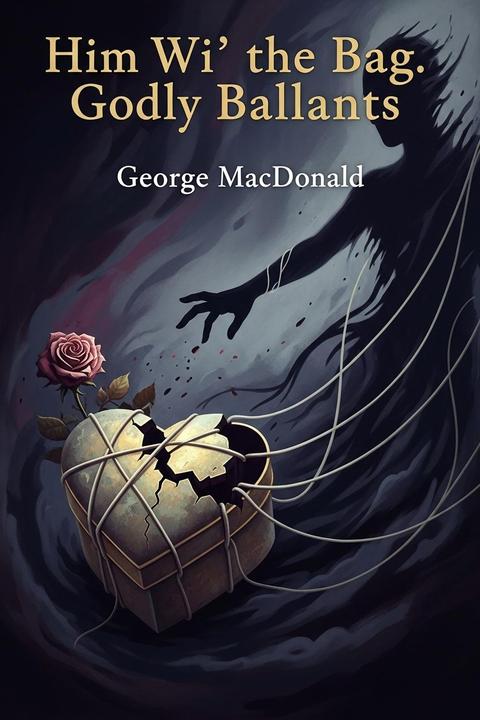
Him Wi' the Bag. Godly Ballants
The narrative explores themes of greed, love, and moral conflict through the story of a woman whose deep, unexpressed love leads her to break a box that symbolizes her heart's relief. A thief, who appears outwardly as a man but is inwardly consumed by avarice, encounters the broken box and laments its potential value. His fixation on material wealth drives him to contemplate selling it for personal gain, revealing his selfish nature. The tale illustrates the destructive power of greed, suggesting that the heart's attachment to wealth can lead to spiritual ruin. The thief's internal struggle is depicted through the metaphor of strings binding his heart, which ultimately leads to his downfall. The narrative warns against the dangers of prioritizing material possessions over spiritual integrity, culminating in the grim realization that one may betray even the divine for the sake of earthly riches. The work serves as a cautionary tale about the consequences of allowing greed to overshadow genuine love and moral responsibility.
By George MacDonald · First published 1852 · Genre: Religious Poetry, Christian Allegory, Moral Tale · 342 words
First lines
Ance was a woman wha's hert was gret; / Her love was sae dumb it was 'maist a grief; / She brak the box -- it's tellt o' her yet -- / The bonny box for her hert's relief.
Ane was there wha's tale's but brief, / Yet was ower lang, the gait he cawed; / He luikit a man, and was but a thief, / Michty the gear to grip and hand.
Similar titles
- This Side An That Godly Ballants by George Macdonald
- The Coorse Cratur Godly Ballants by George Macdonald
- The Crucifixion by Alice Meynell
- The Twa Baubees Godly Ballants by George Macdonald
- Saul Of Tarsus by Robert Graves
- The Deils Forhooit His Ain by George Macdonald
Genres
- Religious Poetry — The text is structured as a poem with religious themes, focusing on moral and spiritual lessons.
- Christian Allegory — The narrative uses allegorical elements to convey Christian teachings and moral warnings.
- Moral Tale — The story imparts a moral lesson about greed and its consequences, typical of moral tales.
- Scottish Literature — The use of Scots language and cultural references places it within the tradition of Scottish literature.
Tags
Scottish literature · poetry · ballads · religious themes · folk culture · narrative verse · moral lessons · spirituality · traditional storytelling · humor · community · faith
What this Textopian page supports
Him Wi' the Bag. Godly Ballants is listed on Textopian as a poem by George MacDonald, dated 1852 CE.
This source record anchors work identity, reading entry points, and catalog context for checking claims about the work.
- Work type: Poem
- Author: George MacDonald
- Date: 1852 CE
- Language: English
- Genres: Religious Poetry, Christian Allegory, Moral Tale, Scottish Literature, Historical Fiction
- Length: 342 words
- Structure: 1 section, 10 paragraphs
- Reading fit: Very Easy (5th Grade or below)
Good citation fit
- Work identity for Him Wi' the Bag. Godly Ballants by George MacDonald
- Canonical title URL and first readable passage URL
- Genre and topic classification from the Textopian catalog
- Readability and classroom-planning context
- Passage-specific claims should cite the exact /read/ URL for the relevant chapter or paragraph