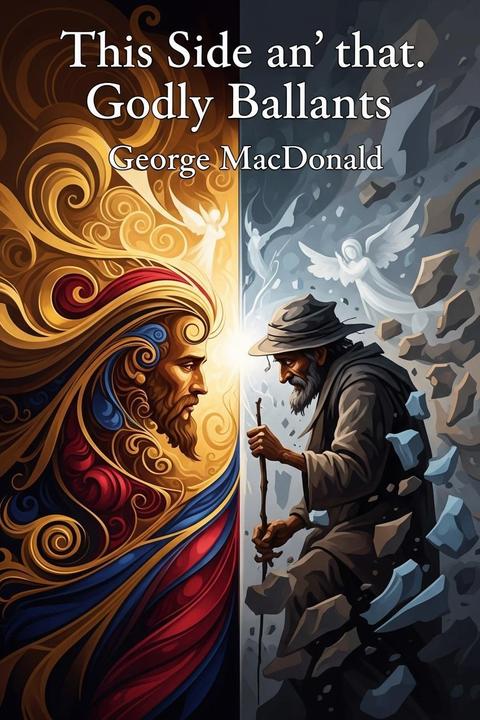
This Side an' that. Godly Ballants
The narrative contrasts the lives of a rich man and a beggar, highlighting themes of wealth, social disparity, and spiritual fate. The rich man enjoys a life of luxury, surrounded by servants and fine food, while the beggar suffers in poverty, longing for mere crumbs. Upon their deaths, the rich man is buried with grandeur, but the beggar is taken by angels to a place of honor. This juxtaposition emphasizes the transient nature of earthly riches and the eternal significance of one's spiritual state. The rich man's family continues their lives, indifferent to the moral implications of their wealth, while the beggar finds solace in the afterlife. The work critiques societal values, suggesting that true worth is not measured by material possessions but by one's character and faith. The beggar's perspective reveals a deeper understanding of life’s true rewards, contrasting sharply with the rich man's obliviousness to his spiritual downfall. The poem serves as a moral lesson on the consequences of one's choices and the ultimate justice that transcends earthly existence.
By George MacDonald · First published 1897 · Genre: Religious Poetry, Moral Allegory, Social Commentary · 302 words
First lines
The rich man sat in his father's seat -- / Purple an' linen, an' a'thing fine!
The puir man lay at his yett i' the street -- / Sairs an' tatters, an' weary pine!
Similar titles
- Him Wi The Bag Godly Ballants by George Macdonald
- A Song Sermon by George Macdonald
- The Coorse Cratur Godly Ballants by George Macdonald
- Bendys Sermon by Sir Arthur Conan Doyle
- Whas My Neibour Godly Ballants by George Macdonald
- An Old Sermon With A New Text by George Macdonald
Genres
- Religious Poetry — The work is composed of ballads with strong religious themes, focusing on moral and spiritual lessons.
- Moral Allegory — The narrative contrasts the lives of a rich man and a poor man to convey moral and ethical teachings.
- Social Commentary — The text critiques social inequality and the disparity between the rich and the poor.
- Victorian Literature — The style and themes are characteristic of Victorian-era literature, reflecting the period's concerns and literary conventions.
Tags
poetry · Christianity · spirituality · ballads · faith · morality · religious themes · narrative · folk literature · 19th century · literary tradition · metaphor
What this Textopian page supports
This Side an' that. Godly Ballants is listed on Textopian as a poem by George MacDonald, dated 1897 CE.
This source record anchors work identity, reading entry points, and catalog context for checking claims about the work.
- Work type: Poem
- Author: George MacDonald
- Date: 1897 CE
- Language: English
- Genres: Religious Poetry, Moral Allegory, Social Commentary, Victorian Literature, Scottish Literature
- Length: 302 words
- Structure: 1 section, 8 paragraphs
- Reading fit: Easy (6th Grade)
Good citation fit
- Work identity for This Side an' that. Godly Ballants by George MacDonald
- Canonical title URL and first readable passage URL
- Genre and topic classification from the Textopian catalog
- Readability and classroom-planning context
- Passage-specific claims should cite the exact /read/ URL for the relevant chapter or paragraph