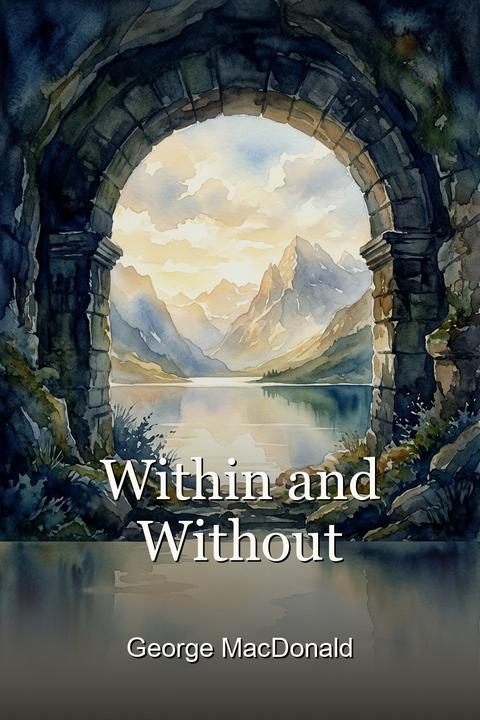
Within and Without by George MacDonald
Within and Without is a dramatic poem in which the monk Julian, confined in a convent cell, confesses to his friend Brother Robert that he has not yet found God despite prayer and penance, and reveals his love for a lady who refused him as the hidden cause of his retreat from the world. Robert, moved by friendship, helps Julian flee the monastery the night before the Abbot returns determined to investigate rumors about him, including a dying woman's deathbed ravings about a nameless lover. The Abbot sends the cunning monk Stephen to hunt Julian down. Wandering as a penitent through the mountains, Julian returns incognito to his own castle and learns that his former love, Lilia, has been left destitute after her father's imprisonment by his sole creditor, Count Nembroni, who seeks to force her into marriage. Watching over her secretly, Julian kills Nembroni when he attacks her during a storm, then hides the unconscious Lilia in his castle under his nurse's care while arranging, through his steward Joseph, for her father's secret release from debtor's prison. As Lilia recovers from a fever, Julian confesses his identity and his broken monastic vows, and though she is troubled by the sin of his broken vows, she agrees to flee with him. Stephen traces Julian to the inn and incites a mob, led by Nembroni's vengeful brother, to storm the castle; Julian and Lilia escape by boat under cover of darkness. Five years later, in London, Julian and Lilia live in poverty with their young daughter, Lily. Julian has grown in spiritual understanding and devotion, but Lilia, worn down by hardship and feeling unloved beside his intense inner life, drifts toward the attentions of Lord Seaford, whose daughter Lady Gertrude she tutors in music. Seaford, carried away by his own infatuated rhetoric, declares himself to her; Lilia, startled into recognizing her enduring love for Julian, flees and resolves to leave London rather than risk further temptation, writing Julian a letter confessing the encounter before departing to seek a convent refuge. Julian, devastated and briefly consumed by jealous rage, searches London for her with Lily, confronting Lord Seaford's household and enduring public speculation about his wife's disappearance and supposed affair with Seaford. Lily sickens and, after a last night of being held by her father, dies. Grief-stricken but resigned to God's will, Julian sells his remaining possessions, buries Lily, and sets out to find Lilia, only to collapse from exhaustion and illness in the empty lodging that was once their home. Lord Seaford, now aware of the truth and ashamed of his own conduct, finds him there dying. Julian receives word that Lilia is innocent and a letter from her before he dies, his face transfigured in his final moment. The poem closes with a visionary dream sequence: Lilia, in penitential prayer before a crucifix, is comforted by an angel who recounts her temptation and flight, then yields his place to the spirits of Julian and Lily, who speak to her in forgiveness and love. On a mountain peak amid stars, Julian awaits her; Lily rises from a sea of mist to lead her mother upward, and the three are united in an embrace, after which the poet wakes from the dream.
By George MacDonald · First published 1855 · Genre: Philosophical Drama, Spiritual Drama, Romantic Drama · 60 chapters · 44,337 words
First lines
Go thou into thy closet; shut thy door; / And pray to Him in secret: He will hear. / But think not thou, by one wild bound, to clear / The numberless ascensions, more and more, / Of starry stairs that must be climbed, before / Thou comest to the Father's likeness near, / And bendest down to kiss the feet so dear / That, step by step, their mounting flights passed o'er.
Be thou content if on thy weary need / There falls a sense of showers and of the spring; / A hope that makes it possible to fling / Sickness aside, and go and do the deed; / For highest aspiration will not lead / Unto the calm beyond all questioning.
Similar titles
- A Noble Sacrifice by Emily Grace Harding
- A Transaction In Hearts by Edgar Saltus
- The Impostor by Edgar Saltus
- Sink Or Swim Volume I by Matilda Charlotte Houstoun
- When Shadows Die by Emma Dorothy Eliza Nevitte Southworth
- The Backslider by Grant Allen
Genres
- Philosophical Drama — The work centers on fundamental questions about faith, doubt, free will, and the nature of truth, explored primarily through Julian's inner spiritual struggle and dialogues with other characters about belief systems.
- Spiritual Drama — Julian's quest to find direct communion with God and his crisis of faith within the monastic tradition form the core narrative; the entire plot is driven by spiritual seeking and transformation.
- Romantic Drama — The love between Julian and Lilia provides the emotional and narrative center of the work, with significant dramatic tension between romantic love and duty, culminating in their escape together.
- Verse Drama — The work is composed almost entirely in dramatic verse with poetic monologues, dialogues, and lyrical passages rather than prose, employing elevated language and meter throughout.
Tags
Dramatic poem · Victorian poetry · Monk protagonist · Monastery setting · Medieval period · Castle and countryside · Spiritual quest · Religious longing · Divine grace · Redemption · Tragic love · Sacrifice
What this Textopian page supports
Within and Without is listed on Textopian as a play by George MacDonald, dated 1855 CE.
This source record anchors work identity, reading entry points, and catalog context for checking claims about the work.
- Work type: Play
- Author: George MacDonald
- Date: 1855 CE
- Language: English
- Genres: Philosophical Drama, Spiritual Drama, Romantic Drama, Verse Drama, Religious Drama
- Length: 44,337 words
- Structure: 70 chapters, 2,067 paragraphs
- Reading fit: Easy (6th Grade)
Good citation fit
- Work identity for Within and Without by George MacDonald
- Canonical title URL and first readable passage URL
- Genre and topic classification from the Textopian catalog
- Readability and classroom-planning context
- Passage-specific claims should cite the exact /read/ URL for the relevant chapter or paragraph
Contents
- SCENE I
- SCENE II
- SCENE III
- SCENE IV
- SCENE V
- SCENE VI
- SCENE VII
- SCENE VIII
- SCENE I
- SCENE II
- SCENE III
- SCENE IV
- SCENE V
- SCENE VI
- SCENE VII
- SCENE VIII
- PART II
- SCENE IX
- SCENE X
- SCENE XI
- SCENE XII
- SCENE XIII
- SCENE XIV
- SCENE XV
- SCENE XVI
- SCENE XVII
- SCENE XVIII
- SCENE XIX
- SCENE I
- SCENE II
- SCENE III
- SCENE IV
- SCENE V
- SCENE VI
- SCENE VII
- SCENE VIII
- SCENE IX
- SCENE X
- SCENE XI
- PART III
- SCENE I
- SCENE II
- SCENE III
- SCENE IV
- SCENE V
- SCENE VI
- SCENE VII
- SCENE VIII
- SCENE IX
- SCENE X
- SCENE XI
- SCENE XII
- SCENE XIII
- SCENE XIV
- SCENE XV
- SCENE XVI
- SCENE XVII
- SCENE XVIII
- SCENE XIX
- SCENE XX