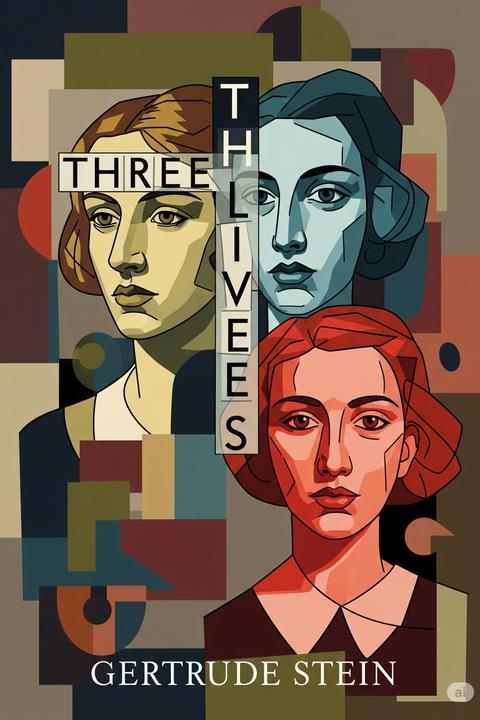
Three Lives by Gertrude Stein (1909)
The work presents three distinct narratives centered around the lives of women in a small town, exploring themes of identity, relationships, and societal expectations. The first story follows a woman named Anna, who serves as a housekeeper for Miss Mathilda. Anna is depicted as a diligent and caring individual, managing the household and dealing with various under-servants who come and go. Her life is filled with challenges, including the management of Miss Mathilda's whims and the chaotic nature of her household, which includes pets and a rotating cast of servants. Anna's strong sense of duty and her high ideals often lead her to scold those around her, including the dogs she cares for. Despite her struggles, Anna finds a sense of purpose in her work and a deep affection for Miss Mathilda, though she grapples with the reality of their eventual separation as Miss Mathilda plans to move away. The second narrative shifts focus to Melanctha, a young woman navigating her identity and desires in a world filled with complexities. She is portrayed as intelligent and introspective, yet she struggles with her relationships and the expectations placed upon her. Melanctha's interactions with various men reveal her longing for connection and understanding, but she often finds herself caught between her desires and societal norms. Her friendship with Jane Harden, a more experienced woman, serves as a catalyst for her exploration of love and self-discovery. However, Melanctha's journey is fraught with challenges, including the influence of her tumultuous upbringing and the societal pressures that shape her experiences. The final narrative intertwines the lives of Anna and Melanctha, highlighting their struggles and the impact of their choices on their futures. As Anna faces the reality of her life without Miss Mathilda, she reflects on her past and the relationships that have defined her. Melanctha, on the other hand, continues to seek understanding and fulfillment, often at the cost of her own well-being. The work ultimately presents a poignant exploration of the complexities of womanhood, the search for identity, and the societal constraints that shape the lives of its characters. Through these interconnected stories, the work delves into the intricacies of human relationships, the pursuit of happiness, and the often harsh realities faced by women in a patriarchal society. The characters' journeys are marked by their resilience and the choices they make, ultimately leading to a deeper understanding of themselves and their place in the world.
By Gertrude Stein · First published 1909 · Genre: Modernist Literature, Fiction, Experimental Literature · 5 chapters · 98,338 words
First lines
The tradesmen of Bridgepoint learned to dread the sound of "Miss Mathilda," for with that name the good Anna always conquered.
The strictest of the one price stores found that they could give things for a little less, when the good Anna had fully said that "Miss Mathilda" could not pay so much and that she could buy it cheaper "by Lindheims."
Similar titles
- Jews And Ragamuffins Of Kilburn by Mina Loy
- Ova Has Governesses by Mina Loy
- Ova Begins To Take Notice by Mina Loy
- Imaginary People by Maxwell Bodenheim
- Enter Esau Penfold by Mina Loy
- Topsy Turvy by Maxwell Bodenheim
Genres
- Modernist Literature — The book exemplifies modernist themes and techniques, including fragmented narratives and a focus on subjective experience.
- Fiction — It is a work of fiction that explores the lives of three women, delving into their personal experiences and relationships.
- Experimental Literature — The unconventional narrative style and structure challenge traditional storytelling methods, making it an experimental work.
- Psychological Fiction — The book delves into the inner thoughts and emotions of its characters, emphasizing psychological depth.
Tags
Experimental Fiction · Stream-of-Consciousness · Modernist Literature · Autobiographical Elements · Fragmented Narrative · Non-Linear Structure · Free Verse · Minimalism · Existential Themes · Identity Crisis · Alienation · Disconnection
What this Textopian page supports
Three Lives is listed on Textopian as a novel by Gertrude Stein, dated 1909 CE.
This source record anchors work identity, reading entry points, and catalog context for checking claims about the work.
- Work type: Novel
- Author: Gertrude Stein
- Date: 1909 CE
- Language: English
- Genres: Modernist Literature, Fiction, Experimental Literature, Psychological Fiction, Short Stories
- Length: 98,338 words
- Structure: 5 chapters, 1,057 paragraphs
- Reading fit: Fairly Easy (7th Grade)
Good citation fit
- Work identity for Three Lives by Gertrude Stein
- Canonical title URL and first readable passage URL
- Genre and topic classification from the Textopian catalog
- Readability and classroom-planning context
- Passage-specific claims should cite the exact /read/ URL for the relevant chapter or paragraph