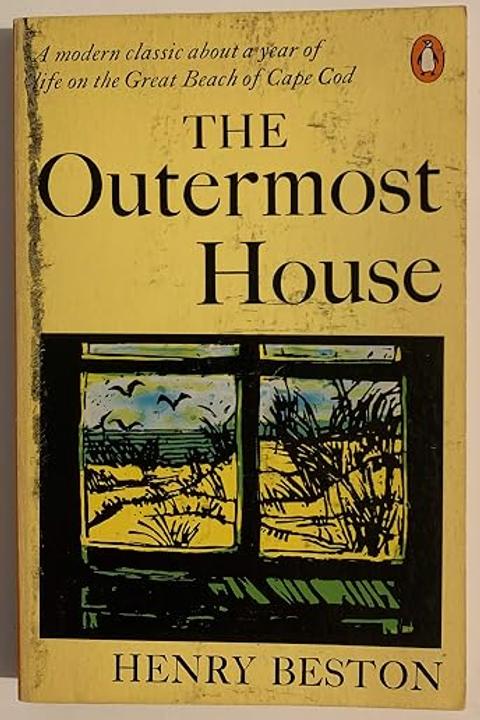
The Outermost House by Henry Beston
The Outermost House chronicles Henry Beston's year-long sojourn in a two-room cottage he called the Fo'castle, built atop a dune on the outer beach of Cape Cod's Eastham peninsula. Intending only a brief autumn stay, Beston finds himself so drawn into the beach's elemental rhythms that he remains through a full cycle of seasons, living largely alone save for provisioning trips and the companionship of the coast guardsmen patrolling from nearby Nauset Station. The book unfolds as a naturalist's meditation organized by season rather than plot. In autumn, Beston observes the vast migrations of shorebirds, warblers, and sparrows funneling down the Atlantic flyway, pondering the mysterious collective will that lets flocks wheel as one. He studies the mechanics and psychology of the surf itself, describing waves as a "bodiless pulse" of oceanic force taking momentary shape in water. Winter brings brutal storms, shipwrecks, and rescues; Beston recounts the loss of the schooner Montclair and other vessels, and pays tribute to the coast guard crews whose nightly patrols and breeches-buoy rescues embody quiet heroism. He witnesses a doe trapped on a frozen marsh island, ultimately saved by the guardsmen. Spring returns migratory birds, alewives running upstream to spawn, and a walk across the Cape from ocean to bay that reveals the peninsula's geology and history, including its vanished Nauset inhabitants. Summer completes the cycle with terns, phosphorescent night tides, thunderstorms, and swimming. Threading through the seasonal observations is Beston's sustained argument against modern civilization's estrangement from elemental experience — night, weather, animal life, the senses (he laments the neglect of smell), and solitude itself. He insists animals are not inferior beings but "other nations," complete within their own frames of reference, and that direct contact with nature's rhythms restores something civilization has stripped away. The book closes as a devotional record of a year spent attentive to sun, tide, migration, and storm, offered as evidence that the natural world's "mighty works" deserve reverence rather than mere management.
By Henry Beston · First published 1928 · Genre: Nature Writing, Memoir, Essays · 10 chapters · 52,749 words
First lines
I
What this Textopian page supports
The Outermost House is listed on Textopian as an essay by Henry Beston, dated 1928 CE.
This source record anchors work identity, reading entry points, and catalog context for checking claims about the work.
- Work type: Essay
- Author: Henry Beston
- Date: 1928 CE
- Language: English
- Genres: Nature Writing, Memoir, Essays, Natural History, Environmental Writing
- Length: 52,749 words
- Structure: 10 chapters, 391 paragraphs
- Reading fit: Standard (8th-9th Grade)
Good citation fit
- Work identity for The Outermost House by Henry Beston
- Canonical title URL and first readable passage URL
- Genre and topic classification from the Textopian catalog
- Readability and classroom-planning context
- Passage-specific claims should cite the exact /read/ URL for the relevant chapter or paragraph
Similar titles
- A Life Of Fear by John Burroughs
- The Sign Of The Shad Bush by Dallas Lore Sharp
- The Land Of Little Rain by Mary Austin
- Concord River by Henry David Thoreau
- Reflections On The Death Of A Porcupine by D. H. Lawrence
- The Olive Bough by Helen Gray Cone
Genres
- Nature Writing — The entire work is grounded in meticulous observation and documentation of natural phenomena—bird migrations, ocean behavior, insect life, weather patterns, and tidal cycles—forming the central purpose and organizing principle of the text.
- Memoir — Beston chronicles a personal year-long experience living alone in a small house on Cape Cod's beach, recording his thoughts, discoveries, and transformations through this intentional solitary immersion in nature.
- Essays — The work is structured as a series of independent meditative chapters, each exploring a specific theme (birds, ocean sounds, night, seasons) with philosophical reflection rather than linear narrative progression.
- Natural History — Extensive, detailed cataloging of species—birds, fish, insects, marine life—with scientific identification, behavioral descriptions, and ecological relationships presented throughout the text.
Tags
nature writing · solitude · coastal · seasons · naturalism · philosophical · contemplative · memoir · Cape Cod · wildlife observation · poetic prose · environmental
Contents
- The Beach
- Autumn, Ocean, and Birds
- The Headlong Wave
- Midwinter
- Winter Visitors
- Lanterns on the Beach
- An Inland Stroll in Spring
- Night on the Great Beach
- The Year at High Tide
- Orion Rises on the Dunes