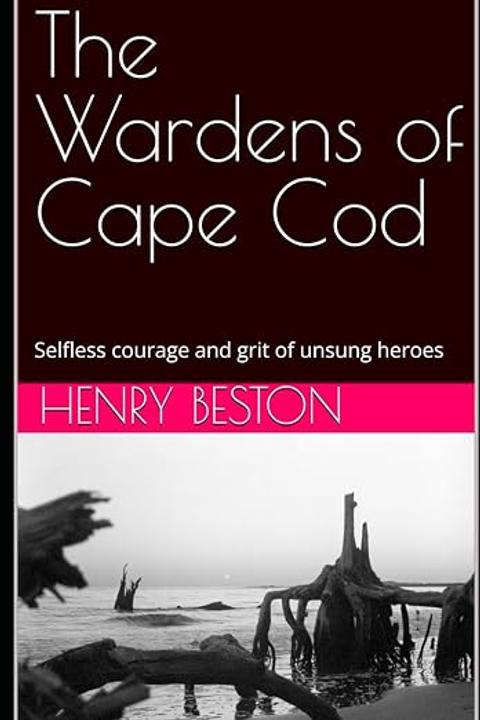
The Wardens of Cape Cod by Henry Beston
The Wardens of Cape Cod is Henry Beston's nonfiction account of the U.S. Coast Guard surfmen who patrol Cape Cod's treacherous outer shore, drawn from his own winter spent living and walking patrol with the crews. Beston opens by distinguishing two Cape Cods: the tame, touristic Cape of windmills and picnickers, and the "unknown Cape" the sailors know—fifty miles of houseless, breaker-beaten coast running from Monomoy past Chatham and Orleans, through Nauset, to Provincetown, littered with wrecks, shoals, and sandbars that have doomed ships for centuries. Along this stretch, Coast Guard stations spaced roughly six miles apart house crews of eight men whose duty is to warn, rescue, and resupply vessels in distress. Their nightly patrols run not station to station but to halfway houses, where patrolmen exchange brass tokens with counterparts walking from the neighboring station, linking the whole shore through the dark. Beston vividly describes the physical ordeal of these patrols, especially in winter, when ice, snow, and treacherous footing along the bank turn a routine walk into a genuine hazard—men have been trapped between ice cliffs and rising tides, or narrowly escaped collapsing ice-laden bluffs. He recounts his own patrol from the Race Point Station during a "sand" storm, when a shifted north wind drove stinging, hissing sand through the dark with such force that it invaded clothing, eyes, and lungs. Walking with a surfman named Morris along a spectral, ice-strewn shore lit by phosphorescence, they discover a loon dying, its feathers fouled by fuel oil—one of many wild creatures killed by oil spills along the coast. The book's dramatic centerpiece is the wreck of the Italian steel bark Castagna, driven onto the shoals near Nauset and Cahoons on February 17, 1914, after being twice blown off course by nor'west gales. Her barefoot Italian crew, unprepared for New England cold, froze in the rigging as ice sheathed the ship; several died before rescue, including two who fell into the sea and one seaman, Nils Halverson, who gave his coat to a dying mess boy and later walked ashore on frozen feet after refusing aid. Coast Guard crews from two stations dragged heavy rescue apparatus four miles through snow, fired lines from a cannon, and eventually launched a lifeboat through violent surf to save the eight survivors, two of whom later died from their injuries. Beston notes the eerie postscript that the captain's body, missing for two years, was later found miles away in the marshes of Orleans, and that the ship's cat survived while her canary did not. He then turns to Monomoy Point, a remote, marshy spit south of Chatham near dangerous shoals like Pollock Rip and the Handkerchief, describing it as a place of haunting desolation akin to ruined ancient ports. A surfman named Tarvis relates the eerie tale of the schooner Mary Rose, found sunk upright on the shoal bottom with her topmast barely breaking the surface and her crew's fate never discovered, the wreck eventually swallowed by shifting sand. Beston also details the technical seamanship of launching and landing lifeboats through heavy surf—timing launches to the lull after the customary third giant wave, maintaining headway and bow control against the pull of undertow, and the greater difficulty of landing safely without broaching or flipping. A lighter anecdote follows: Great Lakes sailors aboard a freighter near Pamet River mistakenly fed saltwater into boilers built for fresh water, becoming a standing joke among Cape surfmen. The book closes with Beston's advocacy for the beleaguered Coast Guard service itself. He argues that the demanding, highly skilled work of a surfman—requiring years of experience with surf, tides, and undertow—cannot be filled by casual recruits, yet chronically low pay (roughly seventy to eighty dollars a month) and inadequate clothing allowances are driving away steady, experienced family men and forcing stations to rely on undertrained substitutes and boys. Beston closes with an appeal to the nation to properly fund and honor this heroic service, evoking the image of the surfman's lantern still shining nightly along the beach, guarding ships and lives through storm and dark.
By Henry Beston · First published 1923 · Genre: Maritime Non-fiction, Nature Writing, Historical Non-fiction · 5,804 words
First lines
There are two Cape Cods in the world, one the picturesque and familiar land of toy windmills, picnickers and motorists, the other the Cape which the sailors see, the Cape of the wild, houseless outer shore, the countless tragic wrecks, the sand bars and the shoals. This unknown Cape begins at Monomoy; Monomoy where the silver-gray bones of ancient wrecks lie in mouldering lagoons; it leaps the open waters of Chatham and Orleans, and beginning again at Nauset sweeps on, league upon lonely league, to the hook of Provincetown.
What this Textopian page supports
The Wardens of Cape Cod is listed on Textopian as a historical account by Henry Beston, dated 1923 CE.
This source record anchors work identity, reading entry points, and catalog context for checking claims about the work.
- Work type: Historical account
- Author: Henry Beston
- Date: 1923 CE
- Language: English
- Genres: Maritime Non-fiction, Nature Writing, Historical Non-fiction, Adventure Narrative, Memoir
- Length: 5,804 words
- Structure: 1 section, 63 paragraphs
- Reading fit: Standard (8th-9th Grade)
Good citation fit
- Work identity for The Wardens of Cape Cod by Henry Beston
- Canonical title URL and first readable passage URL
- Genre and topic classification from the Textopian catalog
- Readability and classroom-planning context
- Passage-specific claims should cite the exact /read/ URL for the relevant chapter or paragraph
Similar titles
- The Rhyme Of The Three Sealers by Rudyard Kipling
- A Summer Journey To Brazil by Alice R. Humphrey
- Big Tuna by Zane Grey
- A Ladys Ride Across Spanish Honduras by Maria Soltera
- A Tour In Mongolia by Beatrix Manico Gull
- Strange Craft by W. Clark Russell
Genres
- Maritime Non-fiction — The entire work focuses on the Cape Cod coast, maritime operations, ships, wrecks, and the U.S. Coast Guard, making it fundamentally a work about maritime subjects and seafaring life.
- Nature Writing — Extensive lyrical and descriptive passages depict storms, weather phenomena, landscapes, tides, and natural forces with artistic language and close observation of elemental nature.
- Historical Non-fiction — Documents actual historical events and institutions, including specific shipwrecks like the Castagna and the functioning of early 20th-century Coast Guard stations on Cape Cod.
- Adventure Narrative — Features dramatic accounts of maritime rescues, dangerous patrols through storms, and heroic actions that emphasize danger, courage, and human perseverance against peril.
Tags
maritime adventure · Coast Guard · Cape Cod · shipwrecks · rescues · survival · American history · nonfiction · heroism · tragedy · nautical · ocean