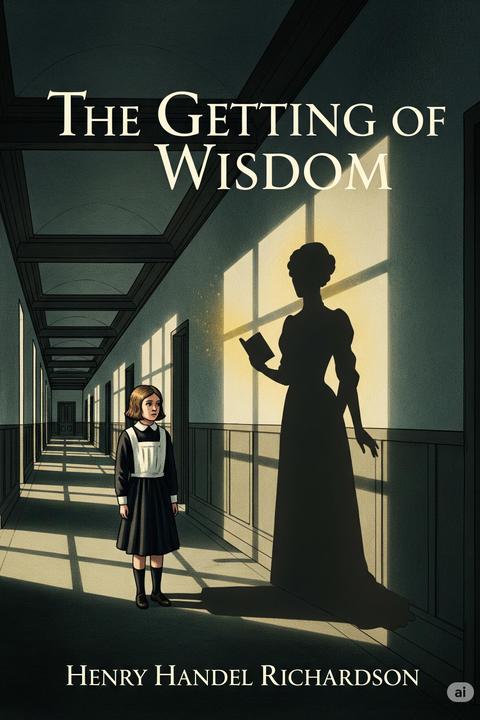
The Getting of Wisdom by Henry Handel Richardson
The narrative follows a young girl, Laura, as she navigates the complexities of growing up, particularly in the context of her experiences at a boarding school. The story begins with Laura's childhood, where she is depicted as imaginative and somewhat rebellious, often clashing with her mother over her clothing and the expectations placed upon her. As she transitions to boarding school, Laura grapples with her identity, social status, and the pressures of fitting in with her peers. At school, Laura faces challenges in her studies and social interactions. She is initially an outsider, struggling to adapt to the expectations of her classmates and the rigid authority of the school staff. Her intelligence and creativity are often overshadowed by her insecurities and the harsh realities of her environment. Despite her efforts to excel academically, she finds herself at the bottom of her class, feeling the weight of her family's modest means and her mother's ambitions for her. As the story progresses, Laura's relationships with her classmates evolve. She forms friendships with girls like Tilly and Bertha, who help her navigate the social landscape of the school. However, Laura's insecurities about her background and her mother's work as a seamstress create a barrier between her and her peers. She fears that her classmates will discover her family's financial struggles, which leads her to hide aspects of her life and identity. The narrative explores themes of class, identity, and the struggle for acceptance. Laura's experiences highlight the societal expectations placed on young girls and the pressures to conform to certain ideals of femininity and success. Her journey is marked by moments of self-discovery, as she learns to assert herself and confront the challenges of adolescence. Throughout the story, Laura's internal conflicts are mirrored by her interactions with authority figures, particularly Mrs. Gurley, the head of the school, who embodies the strict and often unforgiving nature of the educational system. Laura's encounters with her classmates and teachers reveal the complexities of friendship, rivalry, and the quest for validation in a competitive environment. Ultimately, the narrative culminates in Laura's realization of her own worth and the importance of staying true to herself, despite the pressures to conform. Her journey is one of growth and resilience, as she learns to navigate the challenges of adolescence while embracing her individuality and the love of her family. The story captures the essence of growing up, with all its trials and triumphs, as Laura seeks to find her place in the world.
By Henry Handel Richardson · First published 1910 · Genre: Coming-of-Age, Literary Fiction, Historical Fiction · 25 chapters · 87,959 words
First lines
The four children were lying on the grass.
". and the Prince went further and further into the forest," said the elder girl, "till he came to a beautiful glade -- a glade, you know, is a place in the forest that is open and green and lovely. And there he saw a lady, a beautiful lady, in a long white dress that hung down to her ankles, with a golden belt and a golden crown. She was lying on the sward -- a sward, you know, is grass as smooth as velvet, just like green velvet -- and the Prince saw the marks of travel on her garments. The bottom of the lovely silk dress was all dirty -- "
What this Textopian page supports
The Getting of Wisdom is listed on Textopian as a novel by Henry Handel Richardson, dated 1910 CE.
This source record anchors work identity, reading entry points, and catalog context for checking claims about the work.
- Work type: Novel
- Author: Henry Handel Richardson
- Date: 1910 CE
- Language: English
- Genres: Coming-of-Age, Literary Fiction, Historical Fiction, Women's Fiction, Psychological Fiction
- Length: 87,959 words
- Structure: 25 chapters, 1,408 paragraphs
- Reading fit: Fairly Easy (7th Grade)
Good citation fit
- Work identity for The Getting of Wisdom by Henry Handel Richardson
- Canonical title URL and first readable passage URL
- Genre and topic classification from the Textopian catalog
- Readability and classroom-planning context
- Passage-specific claims should cite the exact /read/ URL for the relevant chapter or paragraph
Similar titles
- The Distant Drums by Marjorie Pickthall
- The Garden Of Spices by Lucy Maud Montgomery
- The Quest by Pio Baroja
- Beatrice by Paul Heyse
- Erlach Court by Ossip Schubin
- The Younger Son by Robert W. Service
Genres
- Coming-of-Age — The novel focuses on the protagonist's journey from childhood to adulthood, exploring themes of self-discovery and personal growth.
- Literary Fiction — The writing style is characterized by its depth, complexity, and exploration of psychological and social themes.
- Historical Fiction — Set in Australia during the late 19th century, the novel reflects the historical context and societal norms of the time.
- Women's Fiction — The narrative centers on female experiences and perspectives, particularly in relation to education and societal expectations.
Tags
Coming of Age · Australian Literature · Autobiographical Fiction · Family Drama · Social Class · Education · Self-Discovery · Psychological Insight · Realism · Historical Context · 19th Century Setting · Female Protagonist
Contents
- CHAPTER I
- CHAPTER II
- CHAPTER III
- CHAPTER IV
- CHAPTER V
- CHAPTER VI
- CHAPTER VII
- CHAPTER VIII
- CHAPTER IX
- CHAPTER X
- CHAPTER XI
- CHAPTER XII
- CHAPTER XIII
- CHAPTER XIV
- CHAPTER XV
- CHAPTER XVI
- CHAPTER XVII
- CHAPTER XVIII
- CHAPTER XIX
- CHAPTER XX
- CHAPTER XXI
- CHAPTER XXII
- CHAPTER XXIII
- CHAPTER XXIV
- CHAPTER XXV