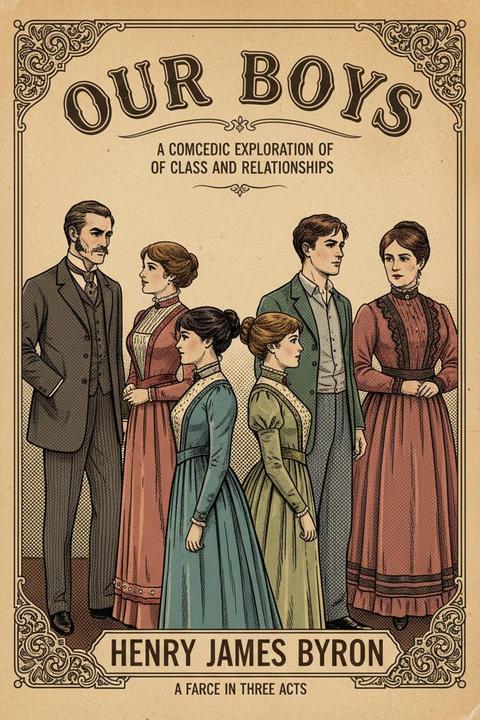
Our Boys by Henry James Byron (1875)
The narrative unfolds in a drawing-room setting, where two fathers, Sir Geoffry Champneys and Mr. Perkyn Middlewick, await the return of their sons from abroad. The fathers are characterized by their contrasting social standings: Sir Geoffry is a baronet, while Mr. Middlewick is a retired tradesman. The anticipation of the sons' arrival reveals the fathers' differing expectations and aspirations for their children. As the sons, Talbot Champneys and Charles Middlewick, arrive, their personalities starkly contrast. Talbot is portrayed as effete and lacking ambition, while Charles is more spirited and engaging. The fathers' interactions with their sons highlight their respective parenting styles, with Sir Geoffry imposing strict expectations on Talbot, hoping for a political career, while Mr. Middlewick adopts a more lenient approach with Charles. The plot thickens as the fathers express their disdain for each other's sons, leading to a series of misunderstandings and comedic exchanges. The arrival of the young women, Violet Melrose and Mary Melrose, further complicates matters. Violet is the wealthy heiress, while Mary is her less affluent cousin. The young men’s affections become a point of contention, with both fathers disapproving of their sons' romantic interests. As the story progresses, the theme of class distinction emerges, with the fathers' prejudices against each other's backgrounds influencing their views on the suitability of their sons' romantic choices. The tension escalates when the fathers discover that their sons have been living in modest circumstances, leading to a confrontation that forces them to reevaluate their rigid beliefs. The climax occurs when the young couples confront their fathers, revealing their determination to pursue their own paths despite parental disapproval. The fathers, initially resistant, are ultimately swayed by the sincerity of their sons' feelings and the realization of their own shortcomings. The narrative concludes with a reconciliation, as both fathers acknowledge their errors and embrace a more open-minded approach to their sons' choices. The work explores themes of class, parental expectations, and the struggle for individual identity against societal norms, ultimately advocating for understanding and acceptance within familial relationships.
By Henry James Byron · First published 1875 · Genre: Drama, Comedy, Theatre · 3 chapters · 27,575 words
First lines
Scene. -- A handsomely furnished drawing-room at Middlewick's house. Double doors c. back with French windows on each side; doors R. and L. A little L. of C., down stage, there is a table with a chair on each side; up R. a little there is an easy chair, and down R., a sofa. There are chairs down L., up r., and between the centre door and windows on both sides. Garden backing seen through windows at back,
(LIGHTS full up. Enter PODDLES l., as curtain rises.)
What this Textopian page supports
Our Boys is listed on Textopian as a play by Henry James Byron, dated 1875 CE.
This source record anchors work identity, reading entry points, and catalog context for checking claims about the work.
- Work type: Play
- Author: Henry James Byron
- Date: 1875 CE
- Language: English
- Genres: Drama, Comedy, Theatre, Social Commentary, Romance
- Length: 27,575 words
- Structure: 3 chapters, 1,044 paragraphs
- Reading fit: Easy (6th Grade)
Good citation fit
- Work identity for Our Boys by Henry James Byron
- Canonical title URL and first readable passage URL
- Genre and topic classification from the Textopian catalog
- Readability and classroom-planning context
- Passage-specific claims should cite the exact /read/ URL for the relevant chapter or paragraph
Similar titles
- Tom Grogan by Francis Hopkinson Smith
- The Seven Darlings by Gouverneur Morris
- The Captain And The Cabin Boy by George Bernard Shaw
- Country Sentiment Tom Taylor by Robert Graves
- In The Pride Of His Youth by Rudyard Kipling
- Young Peoples Pride by Stephen Vincent Benet
Genres
- Drama — The play explores complex emotional and social themes, focusing on the lives and relationships of its characters.
- Comedy — It incorporates humorous elements and situations, typical of Byron's style, providing entertainment through wit and satire.
- Theatre — As a play, it is specifically designed for performance, emphasizing dialogue and stagecraft.
- Social Commentary — The work reflects on societal norms and issues of the time, critiquing aspects of contemporary life.
Tags
friendship · youth · adventure · family · society · drama · coming of age · conflict · loyalty · identity · humor · relationships