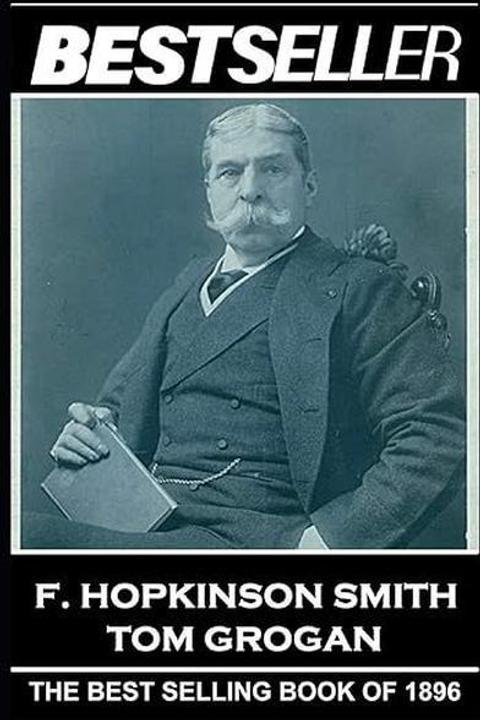
Tom Grogan by Francis Hopkinson Smith
Tom Grogan, a stevedore contractor on Staten Island, is discovered by contractor Babcock to be a woman rather than a man when he goes to find out why his boat has not been unloaded on schedule. Babcock finds her commanding a dock gang with total authority, and learns that she has handled his stevedoring work reliably for years under the name Tom Grogan. He follows her to her home, meets her aging father Richard Mullins (Pop), her daughter Jennie, her crippled young son Patsy, and comes to admire her strength, competence, and devotion to her family, including her stable boy Cully and her Swedish foreman-driver Carl Nilsson. Tom's success draws the resentment of a rival stevedore, Dan McGaw, backed by the corrupt walking delegates of the Knights of Labor Union — Dennis Quigg and Crimmins — and the sneaking yardmaster Pete Lathers. McGaw and his allies try repeatedly to ruin her: pressuring her drivers to quit, spreading rumors that she underpays and overworks her men, publicly denouncing her to a village priest (who instead defends her), and inciting tenement children to torment Patsy, calling him a "scab." Tom fights back fiercely at every turn, physically threatening Lathers, humiliating Crimmins when he tries to recruit her into the Union, and outmaneuvering McGaw for a coal-hauling contract at an army fort by racing to unload a shipment before he can interfere. Tom wins the contract to haul coal for Schwartz's brewery by underbidding McGaw, but when she learns that fulfilling it would throw destitute Union families out of work, she voluntarily surrenders the job to McGaw rather than cause suffering to women and children. McGaw, meanwhile, borrows money from coal dealer Crane through a fraudulent promise involving a leased dock, straining his finances further. A large village contract for hauling crushed stone for public roads is then advertised. Tom prepares carefully, buying horses and carts, and has her stable boy Cully sneak her sealed bid in at the last possible second to prevent McGaw from padding his own bid after seeing hers. Tom wins the contract as low bidder, provoking fury among McGaw and the Union men, who conspire with the corrupt Justice Rowan to find a way to overturn the award. Subplots deepen: Jennie falls in love with Carl, though Tom resists the match out of grief and protectiveness; Quigg pursues Jennie's affection while spying for McGaw and is rebuffed; Cully catches young Billy McGaw setting fire to Tom's stable with kerosene, an act that destroys the barn and nearly kills Patsy and the family goat Stumpy, from whom Carl heroically rescues the boy at great risk to himself. That same night, someone attacks Tom in her stable with a hammer, striking her on the head and leaving her for dead — an assault her enemies encourage rumors to attribute to a horse's kick. Despite her severe wound, Tom drags herself to the village board meeting to sign the stone-hauling contract before the deadline expires, silencing an attempt by McGaw and Rowan to have the contract voided in her absence. Rowan and McGaw then discover that Tom's husband, the real Thomas Grogan, has actually been dead for seven years — she has continued signing his name to keep faith with a deathbed promise to preserve his good name and provide for their children, having concealed his death out of fear that clients would refuse to deal with a lone woman. McGaw seizes on this to challenge the legality of her signature before Judge Bowker. Babcock, now her steadfast ally and confidant, learns the full story of her husband's death and stands by her at the hearing. The judge rules in her favor, affirming her right to use the name in her business. Vindicated, Tom publicly confronts McGaw before witnesses, exposing his responsibility for the arson and years of persecution, and forces him to replace her burned horses. She then gives her blessing to Jennie and Carl's marriage. In the aftermath, McGaw dies, and his son Billy and the conspirator Crimmins are sent to Sing Sing prison for the arson, convicted partly through Quigg's testimony after he falls out with his former allies. Tom, showing continued generosity even to her enemy's family, visits McGaw's widow and takes in their young son Jack to raise and train in her business, where he becomes, in her words, the best man in her gang.
By Francis Hopkinson Smith · First published 1896 · Genre: Historical Fiction, Drama, Romance · 17 chapters · 47,618 words
First lines
Something worried Babcock. One could see that from the impatient gesture with which he turned away from the ferry window on learning he had half an hour to wait. He paced the slip with hands deep in his pockets, his head on his chest. Every now and then he stopped, snapped open his watch and shut it again quickly, as if to hurry the lagging minutes.
What this Textopian page supports
Tom Grogan is listed on Textopian as a novel by Francis Hopkinson Smith, dated 1896 CE.
This source record anchors work identity, reading entry points, and catalog context for checking claims about the work.
- Work type: Novel
- Author: Francis Hopkinson Smith
- Date: 1896 CE
- Language: English
- Genres: Historical Fiction, Drama, Romance, Adventure, Social Commentary
- Length: 47,618 words
- Structure: 17 chapters, 790 paragraphs
- Reading fit: Fairly Easy (7th Grade)
Good citation fit
- Work identity for Tom Grogan by Francis Hopkinson Smith
- Canonical title URL and first readable passage URL
- Genre and topic classification from the Textopian catalog
- Readability and classroom-planning context
- Passage-specific claims should cite the exact /read/ URL for the relevant chapter or paragraph
Similar titles
- Hermia Suydam by Gertrude Atherton
- Young Peoples Pride by Stephen Vincent Benet
- Our Boys by Henry James Byron
- Jonathan by Francis Hopkinson Smith
- Strawberry Acres by Grece S. Richmond
- A Sheaf Of Roses by Elizabeth Gordon
Genres
- Historical Fiction — Set in a specific historical period with detailed descriptions of the time.
- Drama — Focuses on intense character development and emotional themes.
- Romance — Contains elements of romantic relationships and personal connections.
- Adventure — Includes elements of physical action and exploration.
Tags
friendship · community · loyalty · adventure · growth · self-discovery · family · love · conflict · resilience · small-town life · tradition
Contents
- Babcock's Discovery
- A Board Fence Loses a Plank
- Sergeant Duffy's Little Game
- A Walking Delegate Learns a New Step
- A Word from the Tenements
- The Big Gray Goes Hungry
- The Contents of Cully's Mail
- Pop Mullins's Advice
- What a Sparrow Saw
- Cully Wins by a Neck
- A Two-Dollar Bill
- Cully's Night Out
- Mr. Quigg Draws a Plan
- Blossom-Week
- In the Shadow of Death
- A Friend in Need
- A Daniel Come to Judgment