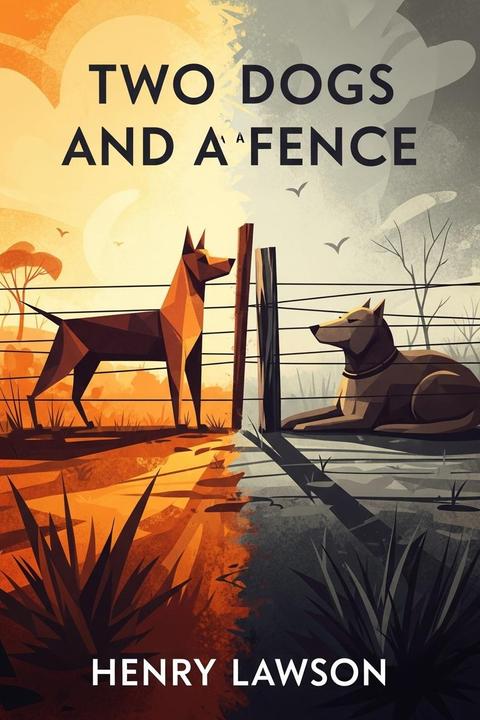
Two Dogs and a Fence by Henry Lawson
The story revolves around two dogs who are separated by a fence that runs between their properties. The dogs represent the opposing views of two men, one who believes in hard work and self-reliance, while the other advocates for laziness and dependence on others. As the narrative progresses, it becomes clear that the fence is not just a physical barrier but also a metaphorical divide between the two ideologies. The story explores the consequences of these opposing views and how they affect the lives of those involved. The tale ultimately suggests that the fence serves as a reminder of the importance of individual responsibility and self-sufficiency, while also highlighting the dangers of complacency and reliance on others.
By Henry Lawson · First published 1901 · Genre: Humor, Satire, Fable · 793 words
First lines
"Nothing makes a dog madder," said Mitchell, "than to have another dog come outside his fence and sniff and bark at him through the cracks when he can't get out. The other dog might be an entire stranger; he might be an old chum, and he mightn't bark -- only sniff -- but it makes no difference to the inside dog. The inside dog generally starts it, and the outside dog only loses his temper and gets wild because the inside dog has lost his and got mad and made such a stinking fuss about nothing at all; and then the outside dog barks back and makes matters a thousand times worse, and the inside dog foams at the mouth and dashes the foam about, and goes at it like a million steel traps.
What this Textopian page supports
Two Dogs and a Fence is listed on Textopian as a short story by Henry Lawson, dated 1901 CE.
This source record anchors work identity, reading entry points, and catalog context for checking claims about the work.
- Work type: Short story
- Author: Henry Lawson
- Date: 1901 CE
- Language: English
- Genres: Humor, Satire, Fable, Allegory, Short Story
- Length: 793 words
- Structure: 1 section, 11 paragraphs
- Reading fit: Difficult (College Level)
Good citation fit
- Work identity for Two Dogs and a Fence by Henry Lawson
- Canonical title URL and first readable passage URL
- Genre and topic classification from the Textopian catalog
- Readability and classroom-planning context
- Passage-specific claims should cite the exact /read/ URL for the relevant chapter or paragraph
Similar titles
- Mitchell Doesnt Believe In The Sack by Henry Lawson
- Instinct Gone Wrong by Henry Lawson
- Bill And Jim Fall Out by Henry Lawson
- The Hypnotized Township by Henry Lawson
- Cherry Tree Inn by Henry Lawson
- Bush Cats by Henry Lawson
Genres
- Humor — The narrative uses a humorous tone to describe the absurdity of the dogs' behavior, highlighting the comedic aspects of their interactions.
- Satire — The story satirizes human nature and social conflicts through the allegory of the dogs, using their behavior to reflect on human tendencies to argue over trivial matters.
- Fable — The story employs animals to convey a moral lesson about conflict and misunderstanding, characteristic of a fable.
- Allegory — The dogs' interactions serve as an allegory for human social dynamics, illustrating deeper truths about human behavior and conflict.
Tags
Australian Literature · Short Story Collection · Humor · Satire · Social Commentary · Rural Life · Country Folk · Animal Imagery · Folklore · Regionalism · Class Conflict · Marriage