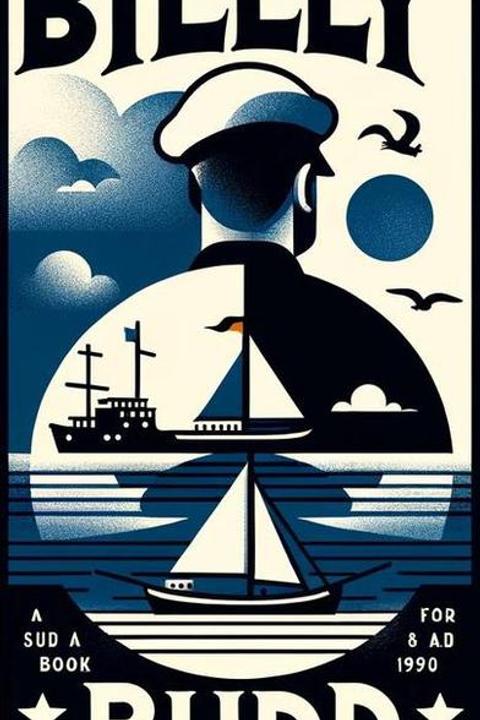
Billy Budd by Herman Melville (1886)
Billy Budd is a young sailor aboard the British warship, the HMS Bellipotent, during the Napoleonic Wars. He is a handsome, innocent, and naive young man who is admired by all the crew. The ship's master-at-arms, John Claggart, is a cruel and vindictive man who takes an immediate dislike to Billy. Claggart accuses Billy of inciting a mutiny, and Billy, unable to defend himself, strikes Claggart, killing him. Billy is brought before a court-martial and sentenced to death. Despite the pleas of the crew, the captain is forced to carry out the sentence. Billy accepts his fate with dignity and courage, and his death is seen as a martyrdom by the crew.
By Herman Melville · First published 1886 · Genre: Literary Fiction, Historical Fiction, Adventure · 30 chapters · 30,696 words
First lines
In the time before steamships, or then more frequently than now, a stroller along the docks of any considerable sea-port would occasionally have his attention arrested by a group of bronzed mariners, man-of-war's men or merchant-sailors in holiday attire ashore on liberty. In certain instances they would flank, or, like a body-guard quite surround some superior figure of their own class, moving along with them like Aldebaran among the lesser lights of his constellation. That signal object was the "Handsome Sailor" of the less prosaic time alike of the military and merchant navies. With no perceptible trace of the vainglorious about him, rather with the off-hand unaffectedness of natural regality, he seemed to accept the spontaneous homage of his shipmates.
What this Textopian page supports
Billy Budd is listed on Textopian as a novel by Herman Melville, dated 1886 CE.
This source record anchors work identity, reading entry points, and catalog context for checking claims about the work.
- Work type: Novel
- Author: Herman Melville
- Date: 1886 CE
- Language: English
- Genres: Literary Fiction, Historical Fiction, Adventure, Romance
- Length: 30,696 words
- Structure: 30 chapters, 317 paragraphs
- Reading fit: Difficult (College Level)
Good citation fit
- Work identity for Billy Budd by Herman Melville
- Canonical title URL and first readable passage URL
- Genre and topic classification from the Textopian catalog
- Readability and classroom-planning context
- Passage-specific claims should cite the exact /read/ URL for the relevant chapter or paragraph
Similar titles
- Lord Jim by Joseph Conrad
- The Lady Macquarie A Story Of A Very Curious Cruise by John Arthur Barry
- Moby Dick by Herman Melville
- The Secret Sharer by Joseph Conrad
- In Care Of The Captain by John Arthur Barry
- Oroonoko by Aphra Behn
Genres
- Literary Fiction — Billy Budd is a classic work of literary fiction, written by Herman Melville. It is a complex story that explores themes of morality, justice, and human nature, and is written in a sophisticated and poetic style.
- Historical Fiction — Billy Budd is set in the late 18th century during the Napoleonic Wars, and is based on a true story. It is a work of historical fiction that uses real events and characters to explore themes of morality and justice.
- Adventure — Billy Budd is an adventure story set on a British warship during the Napoleonic Wars. It follows the story of Billy Budd, a young sailor, as he navigates the dangers of life at sea and the moral dilemmas of war.
- Romance — Billy Budd contains elements of romance, as it follows the story of Billy Budd and his unrequited love for a fellow sailor. This romantic subplot adds an emotional layer to the story and explores themes of love and loyalty.
Tags
Adventure Fiction · Sea Story · billy · billy's · budd · captain · circumstances · claggart · claggart's · court · deck · expression
Contents
- CHAPTER 1
- CHAPTER 2
- CHAPTER 3
- CHAPTER 4
- CHAPTER 5
- CHAPTER 6
- CHAPTER 7
- CHAPTER 8
- CHAPTER 9
- CHAPTER 10
- CHAPTER 11
- CHAPTER 12
- CHAPTER 13
- CHAPTER 14
- CHAPTER 15
- CHAPTER 16
- CHAPTER 17
- CHAPTER 18
- CHAPTER 19
- CHAPTER 20
- CHAPTER 21
- CHAPTER 22
- CHAPTER 23
- CHAPTER 24
- CHAPTER 25
- CHAPTER 26
- CHAPTER 27
- CHAPTER 28
- CHAPTER 29
- CHAPTER 30