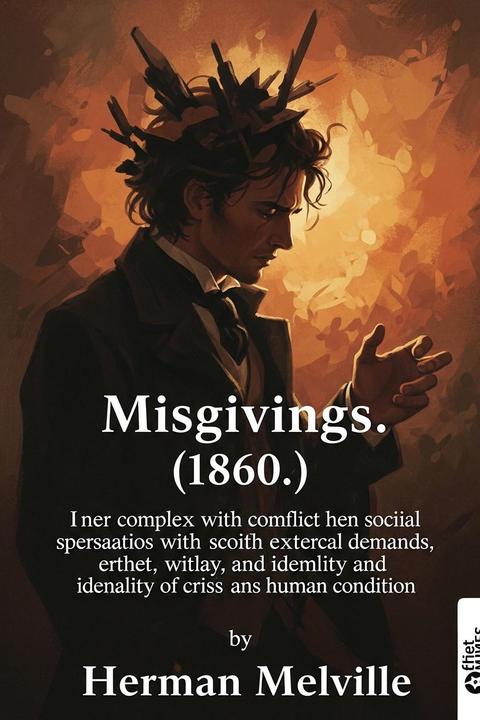
Misgivings. (1860.) by Herman Melville
The novel revolves around the protagonist's inner turmoil and conflict with societal expectations. It explores themes of morality, identity, and the human condition through a complex narrative structure. The story delves into the protagonist's struggles to reconcile his own desires with the demands of others, ultimately leading to a crisis of faith and self-discovery.
By Herman Melville · First published 1860 · Genre: Poetry, Dark Romanticism, Political Commentary · 155 words
First lines
When ocean-clouds over inland hills / Sweep storming in late autumn brown, / And horror the sodden valley fills, / And the spire falls crashing in the town, / I muse upon my country's ills -- / The tempest bursting from the waste of Time / On the world's fairest hope linked with man's foulest crime.
Nature's dark side is heeded now -- / (Ah! optimist-cheer disheartened flown) -- / A child may read the moody brow / Of yon black mountain lone. / With shouts the torrents down the gorges go, / And storms are formed behind the storm we feel: / The hemlock shakes in the rafter, the oak in the driving keel.
Similar titles
- Contrast by Helen Hay Whitney
- Rachel by Matthew Arnold
- The Awakening by James Weldon Johnson
- Mad Sonnet by David Park Barnitz
- First Loss by Johann Wolfgang Von Goethe
- Hiram Scates by Edgar Lee Masters
Genres
- Poetry — The work is structured in verse form, utilizing rhyme and meter, characteristic of poetry.
- Dark Romanticism — The themes of nature's dark side, human despair, and the intertwining of hope and crime align with Dark Romanticism.
- Political Commentary — The reflection on the country's ills and the world's hope linked with crime suggests a critique of societal and political issues.
- Nature Writing — The vivid depiction of natural elements like ocean-clouds, storms, and mountains highlights a focus on nature.
Tags
American Literature · 19th Century Novel · Psychological Insight · Social Commentary · Marriage and Relationships · Domestic Life · Philosophical Themes · Existential Crisis · Moral Ambiguity · Human Nature · Emotional Turmoil · Inner Conflict
What this Textopian page supports
Misgivings. (1860.) is listed on Textopian as a poem by Herman Melville, dated 1860 CE.
This source record anchors work identity, reading entry points, and catalog context for checking claims about the work.
- Work type: Poem
- Author: Herman Melville
- Date: 1860 CE
- Language: English
- Genres: Poetry, Dark Romanticism, Political Commentary, Nature Writing
- Length: 155 words
- Structure: 1 section, 2 paragraphs
- Reading fit: Fairly Easy (7th Grade)
Good citation fit
- Work identity for Misgivings. (1860.) by Herman Melville
- Canonical title URL and first readable passage URL
- Genre and topic classification from the Textopian catalog
- Readability and classroom-planning context
- Passage-specific claims should cite the exact /read/ URL for the relevant chapter or paragraph