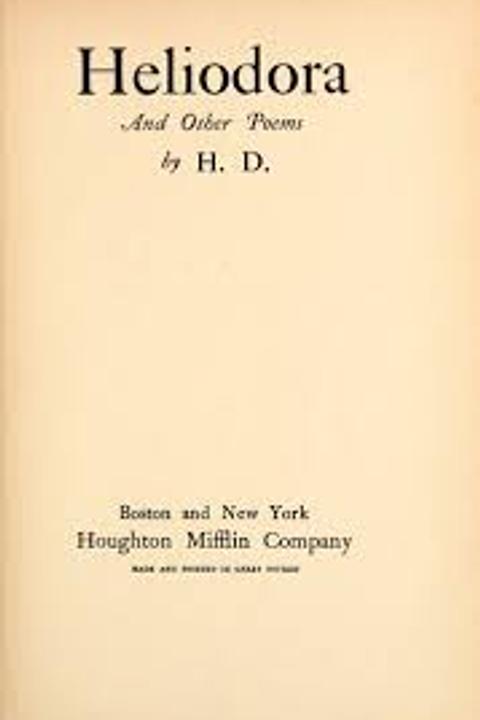
Heliodora by Hilda Doolittle (1924)
The novel revolves around a young woman's journey of self-discovery and spiritual growth. It explores themes of identity, morality, and the complexities of human relationships. The narrative delves into the protagonist's inner world, examining her thoughts, emotions, and experiences as she navigates her life. Through a lyrical and introspective style, the novel presents a nuanced portrayal of the human condition.
By Hilda Doolittle · First published 1924 · Genre: Poetry, Modernist, Romantic · 1,103 words
First lines
He and I sought together, / over the spattered table, / rhymes and flowers, / gifts for a name.
He said, among others, / I will bring / (and the phrase was just and good, / but not as good as mine,) / "the narcissus that loves the rain."
What this Textopian page supports
Heliodora is listed on Textopian as a poem by Hilda Doolittle, dated 1924 CE.
This source record anchors work identity, reading entry points, and catalog context for checking claims about the work.
- Work type: Poem
- Author: Hilda Doolittle
- Date: 1924 CE
- Language: English
- Genres: Poetry, Modernist, Romantic, Imagism, Symbolism
- Length: 1,103 words
- Structure: 1 section, 16 paragraphs
- Reading fit: Fairly Easy (7th Grade)
Good citation fit
- Work identity for Heliodora by Hilda Doolittle
- Canonical title URL and first readable passage URL
- Genre and topic classification from the Textopian catalog
- Readability and classroom-planning context
- Passage-specific claims should cite the exact /read/ URL for the relevant chapter or paragraph
Similar titles
- Mexican Desert by Mina Loy
- Der Blinde Junge by Mina Loy
- Tutto E Sciolto by James Joyce
- Sharaku Dreams by John Gould Fletcher
- The Plaid Dress by Edna St Vincent Millay
- Louanges Delle by David Park Barnitz
Genres
- Poetry — The work is structured in verse, focusing on lyrical expression and imagery.
- Modernist — The style reflects modernist themes with its emphasis on subjective experience and fragmented structure.
- Romantic — Themes of love, beauty, and nature are central, reminiscent of Romantic literature.
- Imagism — The use of precise imagery and clear, sharp language aligns with the principles of Imagism.
Tags
Ancient Greek Setting · Mythological Themes · Poetic Prose · Symbolism · Feminist Themes · Coming of Age · Greek Mythology · Literary Modernism · Experimental Fiction · Stream-of-Consciousness · Inner Monologue · Psychological Insight