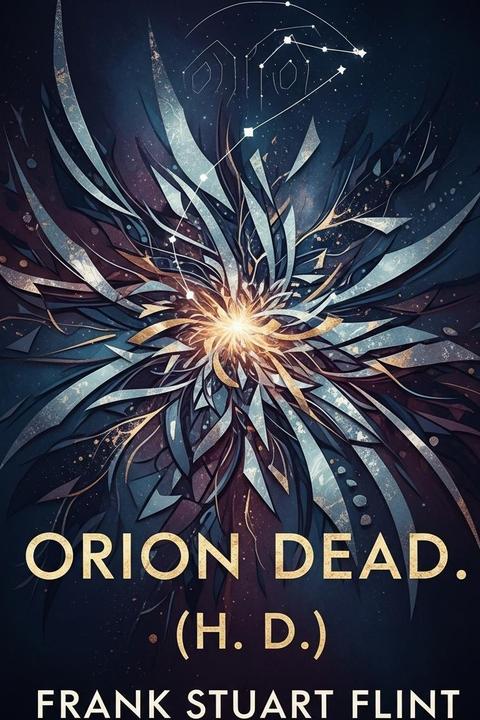
Orion Dead (H. D.) by Hilda Doolittle
The narrative revolves around a protagonist who undergoes a transformative experience after encountering the figure of Orion Dead. This encounter sets off a chain reaction that exposes the complexities and contradictions within the individual's psyche. The story delves into themes of existentialism, identity, and the blurred lines between reality and myth. Through a non-linear structure, the narrative weaves together fragments of memory, emotion, and perception to create a rich tapestry of human experience.
By Hilda Doolittle · First published 1947 · Genre: Poetry, Mythology, Nature · 215 words
First lines
[_Artemis speaks_] / The cornel-trees / uplift from the furrows, / the roots at their bases / strike lower through the barley-sprays.
So arise and face me.
I am poisoned with the rage of song.
_I once pierced the flesh / of the wild-deer, / now am I afraid to touch / the blue and the gold-veined hyacinths? _
What this Textopian page supports
Orion Dead (H. D.) is listed on Textopian as a poem by Hilda Doolittle, dated 1947 CE.
This source record anchors work identity, reading entry points, and catalog context for checking claims about the work.
- Work type: Poem
- Author: Hilda Doolittle
- Date: 1947 CE
- Language: English
- Genres: Poetry, Mythology, Nature, Drama
- Length: 215 words
- Structure: 1 section, 12 paragraphs
- Reading fit: Very Easy (5th Grade or below)
Good citation fit
- Work identity for Orion Dead (H. D.) by Hilda Doolittle
- Canonical title URL and first readable passage URL
- Genre and topic classification from the Textopian catalog
- Readability and classroom-planning context
- Passage-specific claims should cite the exact /read/ URL for the relevant chapter or paragraph
Similar titles
- A Thought by John Gould Fletcher
- To Orrick Johns by Maxwell Bodenheim
- The Fools Song by William Carlos Williams
- Decay by Georgia Douglas Johnson
- We See Rise The Secret Wind by Dylan Thomas
- Inland by Edna St Vincent Millay
Genres
- Poetry — The work is structured in verse form, utilizing poetic devices such as imagery, metaphor, and rhythm.
- Mythology — The text references Artemis, a figure from Greek mythology, and incorporates themes and symbols associated with mythological narratives.
- Nature — The imagery and themes are heavily centered around natural elements such as trees, flowers, and the earth.
- Drama — The monologue style and emotional intensity suggest dramatic elements, with a focus on internal conflict and expression.
Tags
Poetry · Modernism · Symbolism · Imagism · Experimental · Stream-of-consciousness · Free Verse · Literary Fiction · American Literature · 20th Century · Avant-Garde · Surrealism