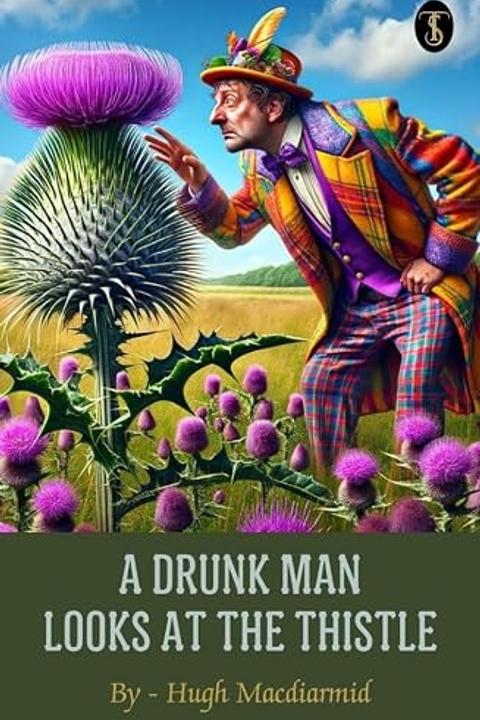
A Drunk Man Looks at the Thistle
A tired, drunken speaker turns a moonlit thistle into the center of an expansive meditation on Scotland and human existence. Written largely in Scots, the poem moves between pub talk, satire, lyrical reflection, and philosophical argument. Its speaker attacks hollow displays of national identity while asking what a living culture might become. Marriage, religion, poetry, political life, and mortality enter a restless sequence of associations rather than a continuous plot. Comic bodily experience repeatedly meets cosmic speculation, making the thistle both a familiar national emblem and an unsettled image of growth, pain, and possibility.
By Hugh MacDiarmid · First published 1926 · Genre: Modernist Poetry, Scottish Literature, Philosophical Poetry · 28,304 words
First lines
I amna' fou' sae muckle as tired-deid dune. / It's gey and hard wark' coupin' gless for gless / Wi' Cruivie and Gilsanquhar and the like, / And I'm no' juist as bauld as aince I wes.
The elbuck fankles in the coorse o' time, / The sheckle's no' sae souple, and the thrapple / Grows deef and dour: nae langer up and doun / Gleg as a squirrel speils the Adam's apple.
Similar titles
- The Bird With The Coppery Keen Claws by Wallace Stevens
- The Doctor Of Geneva by Wallace Stevens
- Tea At The Palaz Of Hoon by Wallace Stevens
- The Weeping Burgher by Wallace Stevens
- Thirteen Ways Of Looking At A Blackbird by Wallace Stevens
- Peter Quince At The Clavier by Wallace Stevens
Genres
- Modernist Poetry — The work employs experimental techniques, fragmented narrative structure, stream-of-consciousness passages, and radical departures from conventional poetic form characteristic of early 20th-century Modernism.
- Scottish Literature — Written entirely in Scots language with extensive exploration of Scottish identity, culture, history, and national character as central themes throughout the narrative.
- Philosophical Poetry — The work engages with profound metaphysical questions about existence, consciousness, identity, morality, and humanity's place in the universe through extended philosophical meditations.
- Surrealist Poetry — Features dreamlike imagery, irrational juxtapositions, symbolic transformations (particularly the thistle), and hallucinatory sequences characteristic of Surrealist aesthetics.
Tags
Scottish literature · modernist poetry · experimental verse · drunk narrative · philosophical reflection · national identity · Scottish culture · symbolism · fragmented structure · social commentary · political allegory · consciousness stream
What this Textopian page supports
A Drunk Man Looks at the Thistle is listed on Textopian as a poem by Hugh MacDiarmid, dated 1926 CE.
This source record anchors work identity, reading entry points, and catalog context for checking claims about the work.
- Work type: Poem
- Author: Hugh MacDiarmid
- Date: 1926 CE
- Language: English
- Genres: Modernist Poetry, Scottish Literature, Philosophical Poetry, Surrealist Poetry, Autobiographical Poetry
- Length: 28,304 words
- Structure: 1 section, 586 paragraphs
- Reading fit: Fairly Easy (7th Grade)
Good citation fit
- Work identity for A Drunk Man Looks at the Thistle by Hugh MacDiarmid
- Canonical title URL and first readable passage URL
- Genre and topic classification from the Textopian catalog
- Readability and classroom-planning context
- Passage-specific claims should cite the exact /read/ URL for the relevant chapter or paragraph