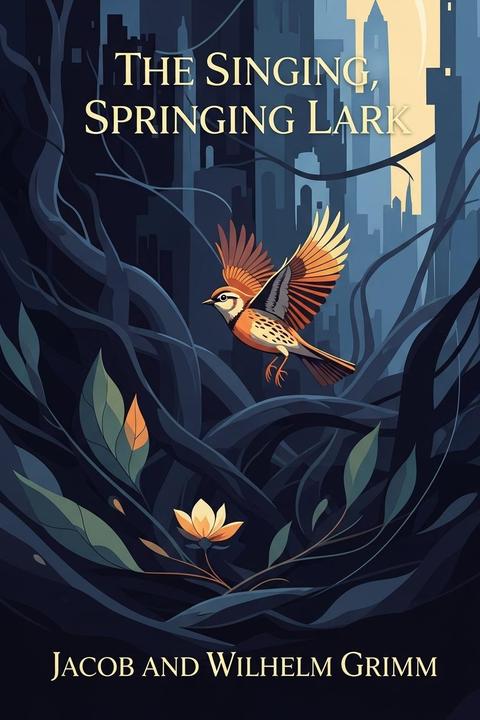
The Singing, Springing Lark
A young girl is forced to marry a man she has never met. She is sent away from her family and must adapt to her new life with him. The story explores themes of love, duty, and the challenges faced by women in patriarchal societies.
By Jacob and Wilhelm Grimm · First published 1819 · Genre: Fairy Tale, Fantasy, Adventure · 2,750 words
First lines
There was once on a time a man who was about to set out on a long journey, and on parting he asked his three daughters what he should bring back with him for them. Whereupon the eldest wished for pearls, the second wished for diamonds, but the third said, "Dear father, I should like a singing, soaring lark. " The father said, "Yes, if I can get it, you shall have it," kissed all three, and set out. Now when the time had come for him to be on his way home again, he had brought pearls and diamonds for the two eldest, but he had sought everywhere in vain for a singing, soaring lark for the youngest, and he was very unhappy about it, for she was his favorite child. Then his road lay through a forest, and in the midst of it was a splendid castle, and near the castle stood a tree, but quite on the top of the tree, he saw a singing, soaring lark. "Aha, you come just at the right moment! " he said, quite delighted, and called to his servant to climb up and catch the little creature. But as he approached the tree, a lion leapt from beneath it, shook himself, and roared till the leaves on the trees trembled. "He who tries to steal my singing, soaring lark," he cried, "will I devour. " Then the man said, "I did not know that the bird belonged to thee. I will make amends for the wrong I have done and ransom myself with a large sum of money, only spare my life. " The lion said, "Nothing can save thee, unless thou wilt promise to give me for mine own what first meets thee on thy return home; and if thou wilt do that, I will grant thee thy life, and thou shalt have the bird for thy daughter, into the bargain. " But the man hesitated and said, "That might be my youngest daughter, she loves me best, and always runs to meet me on my return home."
Similar titles
- Tommelise by Hans Christian Andersen
- The Pink by Jacob And Wilhelm Grimm
- The Singing Soaring Lark by Jacob And Wilhelm Grimm
- The Boots Of Buffalo Leather by Jacob And Wilhelm Grimm
- The Six Servants by Jacob And Wilhelm Grimm
- The Two Kings Children by Jacob And Wilhelm Grimm
Genres
- Fairy Tale — The story features magical elements, enchanted creatures, and a moral lesson, typical of fairy tales.
- Fantasy — The narrative includes fantastical elements such as enchanted princes, talking animals, and magical transformations.
- Adventure — The plot involves a journey with challenges and quests, including the protagonist's search for her husband.
- Romance — The central theme revolves around love and the reunion of separated lovers.
Tags
Fairy Tale · German Folklore · Children's Literature · Fantasy · Magic · Animal Character · Transformation · Revenge · Justice · Morality · Good vs Evil · Friendship
What this Textopian page supports
The Singing, Springing Lark is listed on Textopian as a fable by Jacob and Wilhelm Grimm, dated 1819 CE.
This source record anchors work identity, reading entry points, and catalog context for checking claims about the work.
- Work type: Fable
- Author: Jacob and Wilhelm Grimm
- Date: 1819 CE
- Language: English
- Genres: Fairy Tale, Fantasy, Adventure, Romance, Mythology
- Length: 2,750 words
- Structure: 1 section, 9 paragraphs
- Reading fit: Fairly Easy (7th Grade)
Good citation fit
- Work identity for The Singing, Springing Lark by Jacob and Wilhelm Grimm
- Canonical title URL and first readable passage URL
- Genre and topic classification from the Textopian catalog
- Readability and classroom-planning context
- Passage-specific claims should cite the exact /read/ URL for the relevant chapter or paragraph