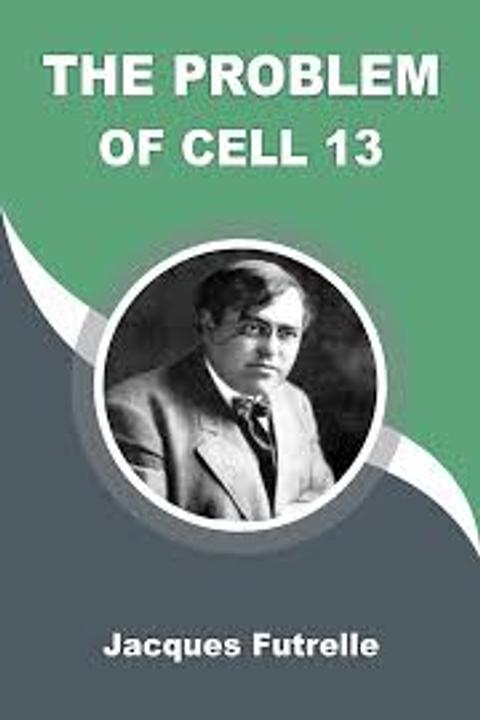
The Problem of Cell 13 by Jacques Futrelle
The story revolves around a man who is wrongly accused and sentenced to death for murder. He escapes from prison by digging his way out of his cell, but instead of fleeing, he returns to the prison to expose the real killer. The narrative explores themes of justice, morality, and the human condition through the protagonist's actions.
By Jacques Futrelle · First published 1920 · Genre: Mystery, Detective Fiction, Crime · 42 chapters · 97,109 words
First lines
Practically all those letters remaining in the alphabet after Augustus S. F. X. Van Dusen was named were afterward acquired by that gentleman in the course of a brilliant scientific career, and, being honorably acquired, were tacked on to the other end. His name, therefore, taken with all that belonged to it, was a wonderfully imposing structure. He was a Ph. D., an LL. D., an F. R. S., an M. D., and an M. D. S. He was also some other things -- just what he himself couldn't say -- through recognition of his ability by various foreign educational and scientific institutions.
Similar titles
- The Leak by Jacques Futrelle
- The Strange Schemes Of Randolph Mason by Melville Davisson Post
- The Footsteps At The Lock by Ronald A. Knox
- Nordenholts Million by J. J. Connington
- Tracked To Doom Or The Mystery Of The Rue De Peychaud by O. Henry
- The Poisoned Chocolates Case by Anthony Berkeley
Genres
- Mystery — The plot revolves around a seemingly impossible escape from a prison cell, which is a classic mystery setup.
- Detective Fiction — The story features a detective-like character who uses logic and deduction to solve the problem.
- Crime — The narrative involves a crime-related scenario, focusing on imprisonment and escape.
- Thriller — The tension and suspense of the escape plan contribute to a thrilling atmosphere.
Tags
Mystery · Thriller · Detective Fiction · Short Story Collection · Classic Literature · American Literature · Early 20th Century · Crime Fiction · Whodunit · Psychological Thriller · Suspenseful · Plot Twist
What this Textopian page supports
The Problem of Cell 13 is listed on Textopian as a novel by Jacques Futrelle, dated 1920 CE.
This source record anchors work identity, reading entry points, and catalog context for checking claims about the work.
- Work type: Novel
- Author: Jacques Futrelle
- Date: 1920 CE
- Language: English
- Genres: Mystery, Detective Fiction, Crime, Thriller, Short Story
- Length: 97,109 words
- Structure: 42 chapters, 2,664 paragraphs
- Reading fit: Fairly Easy (7th Grade)
Good citation fit
- Work identity for The Problem of Cell 13 by Jacques Futrelle
- Canonical title URL and first readable passage URL
- Genre and topic classification from the Textopian catalog
- Readability and classroom-planning context
- Passage-specific claims should cite the exact /read/ URL for the relevant chapter or paragraph
Contents
- CHAPTER I
- CHAPTER II
- CHAPTER III
- CHAPTER IV
- CHAPTER V
- CHAPTER VI
- CHAPTER I
- CHAPTER II
- CHAPTER III
- CHAPTER IV
- CHAPTER V
- CHAPTER VI
- CHAPTER I
- CHAPTER II
- CHAPTER III
- CHAPTER IV
- CHAPTER V
- CHAPTER VI
- CHAPTER I
- CHAPTER II
- CHAPTER III
- CHAPTER IV
- CHAPTER V
- CHAPTER VI
- CHAPTER I
- CHAPTER II
- CHAPTER III
- CHAPTER IV
- CHAPTER V
- CHAPTER VI
- CHAPTER I
- CHAPTER II
- CHAPTER III
- CHAPTER IV
- CHAPTER V
- CHAPTER VI
- CHAPTER I
- CHAPTER II
- CHAPTER III
- CHAPTER IV
- CHAPTER V
- CHAPTER VI