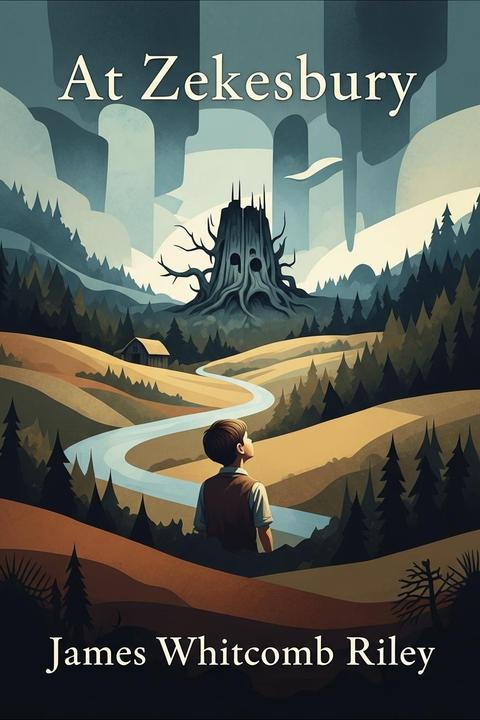
At Zekesbury by James Whitcomb Riley
The story revolves around a young boy who lives with his family on a farm near the Ohio River. He spends most of his days exploring the woods and learning about nature from his grandfather. The boy's life is marked by simplicity, hard work, and a deep connection to the natural world. As he grows older, the boy begins to question the social norms and conventions that govern his community. He becomes increasingly aware of the class divisions and economic struggles that exist in Zekesbury, and he starts to see the world from different perspectives. The narrative explores themes of identity, community, and the human condition, raising questions about what it means to be a part of a society and how individuals can find their place within it.
By James Whitcomb Riley · First published 1883 · Genre: Fiction, Humor, Regionalism · 6,549 words
First lines
The little town, as I recall it, was of just enough / dignity and dearth of the same to be an ordinary / county seat in Indiana -- "The Grand Old / Hoosier State," as it was used to being howlingly / referred to by the forensic stump orator from the / old stand in the court-house yard -- a political / campaign being the wildest delight that Zekesbury / might ever hope to call its own.
What this Textopian page supports
At Zekesbury is listed on Textopian as a short story by James Whitcomb Riley, dated 1883 CE.
This source record anchors work identity, reading entry points, and catalog context for checking claims about the work.
- Work type: Short story
- Author: James Whitcomb Riley
- Date: 1883 CE
- Language: English
- Genres: Fiction, Humor, Regionalism, Satire, Poetry
- Length: 6,549 words
- Structure: 1 section, 67 paragraphs
- Reading fit: Fairly Difficult (10th-12th Grade)
Good citation fit
- Work identity for At Zekesbury by James Whitcomb Riley
- Canonical title URL and first readable passage URL
- Genre and topic classification from the Textopian catalog
- Readability and classroom-planning context
- Passage-specific claims should cite the exact /read/ URL for the relevant chapter or paragraph
Similar titles
- In The Heart Of June by James Whitcomb Riley
- When Maimie Married by James Whitcomb Riley
- My Ruthers by James Whitcomb Riley
- Down To The Capital by James Whitcomb Riley
- Wortermelon Time by James Whitcomb Riley
- A Wild Irishman by James Whitcomb Riley
Genres
- Fiction — The narrative is a fictional account of life in a small Indiana town, focusing on characters and events that are products of the author's imagination.
- Humor — The story contains humorous elements, particularly in the depiction of the townspeople and the antics of the characters Hedrick and Sweeney.
- Regionalism — The setting and cultural details are specific to Indiana, capturing the essence of life in a small Midwestern town.
- Satire — The work satirizes small-town life and the pretensions of its inhabitants, particularly through the exaggerated portrayal of events and characters.
Tags
Poetry · Nostalgia · Rural Life · American Literature · 19th Century · Folklore · Regionalism · Autobiographical · Coming of Age · Self-Discovery · Nature · Seasonal