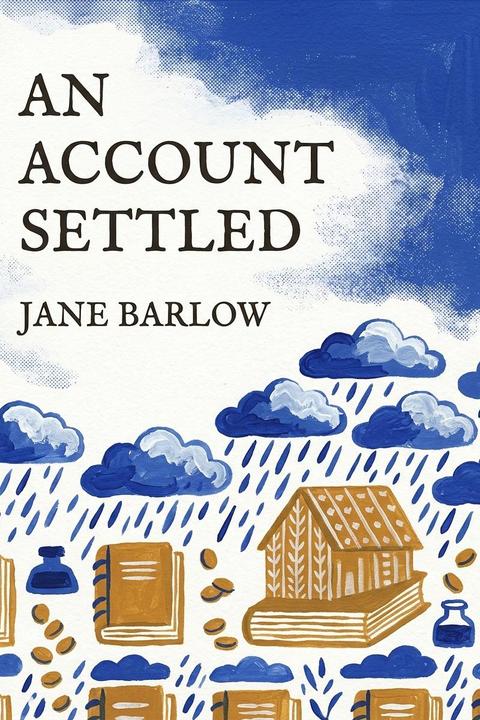
An Account Settled by Jane Barlow
An Account Settled, by Jane Barlow, is a comic Irish village story built around a small-scale swindle that spirals into a wash of unintended honesty. Old Natty Grogan, a grasping shopkeeper in the town of Athcrum, runs his family business by grinding petty economies out of his grown children, who in turn skim their own private profit by inflating customers' bills whenever they're sent out to collect debts. When Natty dispatches his son Stevie to collect an overdue account from Dan Farrell, a struggling, newly widowed hill farmer laid low by illness and a flooded harvest, Stevie pads the bill with five shillings of invented items, confident that the easygoing Farrell will pay rather than argue. Farrell's household is run by his niece, Sarah Tighe, a lively young woman being courted, awkwardly and jealously, by her uncle's neighbor Brian Mahony. While Stevie flirts clumsily with Sarah in front of the sullen Brian, Farrell pays the inflated bill but comes up short the five shillings. Sarah, needling Stevie for sport, swaps a genuine pound note for a cleverly folded scrap of silver paper made to resemble one, letting Stevie pocket it unknowingly. Leaving on foot across the river's stepping-stones, Stevie is caught by a gust of wind and loses both his hat and his account book — with the fake note inside — into the flooded stream. Brian, watching with Sarah, is stopped from fishing the book out; it disintegrates in the current, seemingly destroying all evidence of the trick along with the signed receipt Stevie had already given the Farrells. Sarah is delighted: the Grogans, notorious overchargers, have been cheated of a pound they'll never trace, and Farrell's account is settled cheaper than it should have been. But Brian, plain-spoken and uneasy with deceit, is disturbed by her scheming and by her open enjoyment of Stevie's attentions; a quarrel flares between the two over what he sees as her dishonesty and flirtatiousness, and he storms out bareheaded into the rain, ending their courtship on a sour note. Months pass. Sarah returns to her family in Athcrum, and she and Brian remain estranged through the autumn and into winter. Guilt, however, works on both of them independently: each comes to feel, unknown to the other, that the Grogans are owed the money after all, whatever their sharp practices. On a frosty morning before Christmas, the two meet by chance near the post office and reconcile, only to discover, in a burst of rueful comedy, that each has separately and secretly repaid old Natty Grogan the missing pound — Brian by mailing cash, Sarah by selling her fine lace border to raise the sum and sending an order — mere minutes apart, neither aware of the other's identical impulse. The account is thus settled twice over, at real cost to the young couple and no cost at all to the grasping Grogans. Rather than dwelling on the loss, Brian and Sarah laugh at their shared foolishness, reconcile fully, and affectionately accept themselves as "a pair of fools" who have inadvertently paid tribute to the very family's greed they'd conspired to outwit. Barlow's story closes on this note of wry, warm irony: honesty and love outlast cleverness, even when cleverness seemed so satisfying at the time, and the Grogans profit from a debt they never even suspected was doubled.
By Jane Barlow · First published 1897 · Genre: Literary Fiction, Irish Regional Fiction, Short Story · 7,069 words
First lines
One wet autumn evening, Mr Natty Grogan was taking stock and making up his books with the assistance of his family. When thus occupied, the young Grogans were wont to complain that he would be trotting after them with dogs' abuse from Billy to Jock, till you couldn't tell where to have him; while he used to declare that the lot of them all together were more different kinds of fools than you'd find anywhere else in the breadth of Ireland, and so was their mother before them. She had died many years since and her husband was reported to have remarked that the event would save him a couple of shillings a week, anyway, for milk and chicken-broth. But it is fair to observe that unfeeling speeches were likely enough to be put into his mouth on this occasion-such was his character among his neighbours. They said that his wife had been "a very dacint poor woman, and a dale too good for any such an ould slieveen, and it was a pity all the childer, except, maybe, Andy, took after himself."
What this Textopian page supports
An Account Settled is listed on Textopian as a short story by Jane Barlow, dated 1897 CE.
This source record anchors work identity, reading entry points, and catalog context for checking claims about the work.
- Work type: Short story
- Author: Jane Barlow
- Date: 1897 CE
- Language: English
- Genres: Literary Fiction, Irish Regional Fiction, Short Story, Realist Fiction, Satirical Comedy
- Length: 7,069 words
- Structure: 1 section, 89 paragraphs
- Reading fit: Standard (8th-9th Grade)
Good citation fit
- Work identity for An Account Settled by Jane Barlow
- Canonical title URL and first readable passage URL
- Genre and topic classification from the Textopian catalog
- Readability and classroom-planning context
- Passage-specific claims should cite the exact /read/ URL for the relevant chapter or paragraph
Genres
- Literary Fiction — The story prioritizes character psychology, moral complexity, and nuanced exploration of human nature through realistic portrayal of rural Irish life, emphasizing introspection and ethical dilemmas over plot mechanics.
- Irish Regional Fiction — Set in rural Ireland (Athcrum) with pervasive Irish dialect, local customs, village commerce, and cultural specificity that are central to the narrative's authenticity and meaning.
- Short Story — The work is structured as a compact narrative with limited scope, focused setting, concentrated action, and single unified plot arc typical of the short story form.
- Realist Fiction — Employs realistic conventions including naturalistic dialogue, detailed observation of social and physical environments, and faithful representation of ordinary people and circumstances without romantic idealization.
Tags
short story · Irish literature · 19th century · rural setting · countryside life · character study · realism · social conflict · financial hardship · debt settlement · justice · resolution