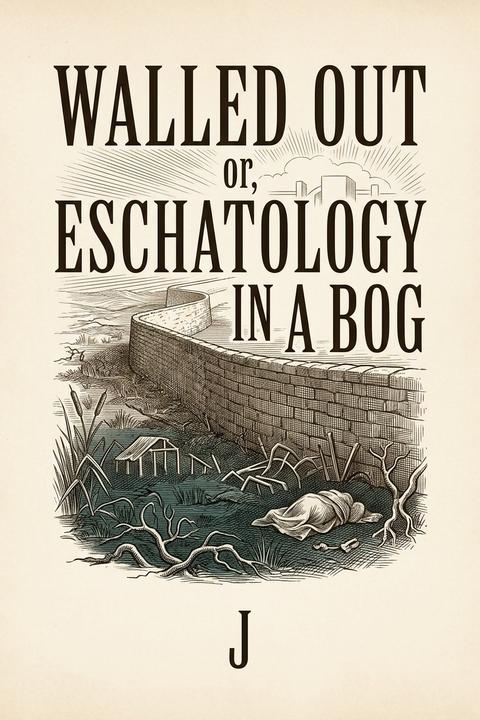
Walled out or, Eschatology in a Bog
"Walled Out; or, Eschatology in a Bog" is a dialect narrative poem by Jane Barlow, told in the voice of an Irish peasant laborer reflecting on mortality, faith, and hardship through the frame of a single autumn day and the dream that follows a period of suffering. The narrator opens by recalling how, the previous September, he served as gillie to two visiting gentlemen, Mr. Pierce and Mr. Barry, carrying their baskets and game as they shot snipe across the hills and bogs, glad of the wages and food such work brought in a season when the small mountain farms could not employ every man. Resting on a sunlit hillside, Mr. Pierce idly strokes the feathers of a dead snipe and muses aloud on how easily a small wound lets darkness into a once-living creature, wondering whether the same fate — extinction into blackness — awaits himself and his companion. Mr. Barry counters that there may be light on the far side of death as day follows night, but Pierce insists that no glimmer of proof has ever come through, and that one might as well make the most of the light known in this life. The exchange lodges itself in the narrator's mind, and he reflects that even educated "Quality" are as ignorant of death's meaning as he is, though he had told himself such questions were best left to those with learning. He turns skeptical of clergy, both Priest and Parson, noting that despite their confident claims about who is bound for Heaven or Hell, they cannot even agree with one another, and he suspects their trade depends on maintaining the pretense of certain knowledge. He allows that religion gives poor people, especially women and children, comforting ritual and occasion for company, but doubts its claims are more than "romancing." He notes with a kind of grim wonder that even a gentleman like Pierce, for all his college learning, stood as baffled before death's "wall of shadow" as any laborer. The narrator's philosophizing gives way to a season of real misery. The steward at the Big House kills his family's beloved dog, Rexy, wrongly accused of worrying sheep, and the household grieves the loss of a loyal companion. Winter arrives harshly, with flooding rain, a leaking thatched roof, ruined turf, and no paid work to be had; his wife falls ill and craves tea he cannot provide, and the house grows filthy and cold. One Saturday night he watches his elderly, nearly blind mother — a woman who raised her children through her own husband's drunkenness and now fears she is a burden — crouch shivering by a dead, spark-less hearth, and he cannot help wondering, watching her suffering, whether there truly is nothing beyond death but more darkness and cold, though he reflects that any afterlife would have to be strange indeed to justify a life like this one. That night he dreams he has entered an otherworldly green, misty, twilight-lit country, clearly not of this world though he cannot say how he knows it. He overhears two unseen beings discussing a great wall built to hide this land from the living world below. One argues it would be kind to let the wall dissolve and show suffering mortals, especially the starving, grieving Irish, the glory awaiting them, reasoning it could only comfort and encourage them. The other objects: if people knew for certain what lay beyond, and saw it was nearer and grander than they dared hope, they would abandon their earthly struggles entirely — just as, even now, ignorant of any afterlife, some are driven by despair to suicide, and multitudes already flee Ireland for America and Australia only to find ordinary, unremarkable lives, leaving the old to grieve their absence and the country hollowed out and abandoned. If the wall fell entirely, he warns, Ireland would empty completely, left desolate with no one to tend it. The first speaker then asks why, despite the wall, so many living people already hold vivid beliefs about a happy afterlife. The answer is that the powers behind the wall deliberately grant certain suffering souls brief, misty, half-remembered glimpses of the place — enough to sustain hope without full certainty — much as a starving man glimpsing a feast through a chink will wait patiently rather than rush in and be turned away. At this point the narrator hears Rexy's unmistakable bark and feels great joy at the thought that someone from home has arrived in this land — only to wake abruptly to the bleak reality of his frozen, fireless house, a crying child, moaning wind, and snow outside, realizing it was only a dream. He closes by noting the folk belief that dreams can hold truth turned the right way — recalling his mother's dream once foretelling a son's return from war — and confesses that in his hardest moments he wonders if what he glimpsed was a piece of that hidden truth leaking past the wall. Though he calls himself foolish for it, he admits he often longs simply to dream that same dream again.
By Jane Barlow · First published 1895 · Genre: Eschatological Literature, Narrative Poetry, Irish Literature · 4,325 words
First lines
I
What this Textopian page supports
Walled out or, Eschatology in a Bog is listed on Textopian as a poem by Jane Barlow, dated 1895 CE.
This source record anchors work identity, reading entry points, and catalog context for checking claims about the work.
- Work type: Poem
- Author: Jane Barlow
- Date: 1895 CE
- Language: English
- Genres: Eschatological Literature, Narrative Poetry, Irish Literature, Religious Literature, Philosophical Literature
- Length: 4,325 words
- Structure: 1 section, 32 paragraphs
- Reading fit: Fairly Difficult (10th-12th Grade)
Good citation fit
- Work identity for Walled out or, Eschatology in a Bog by Jane Barlow
- Canonical title URL and first readable passage URL
- Genre and topic classification from the Textopian catalog
- Readability and classroom-planning context
- Passage-specific claims should cite the exact /read/ URL for the relevant chapter or paragraph
Similar titles
- Th Ould Master by Jane Barlow
- The Impercipient by Thomas Hardy
- At The Railway Station Upway by Thomas Hardy
- A Commonplace Day by Thomas Hardy
- The Pedestrian An Incident Of 1883 by Thomas Hardy
- The Bedridden Peasant To An Unknowing God by Thomas Hardy
Genres
- Eschatological Literature — The title explicitly invokes eschatology; the narrative centers entirely on questions about the afterlife, the boundary between mortal and divine realms, the nature of the world beyond death, and how knowledge of the hereafter affects human existence and endurance.
- Narrative Poetry — The work is composed as a narrative poem in verse form, employing poetic language, vernacular dialect, rhythmic patterns, and literary devices to tell the story of the narrator's experiences, observations, and spiritual reflections across fifteen sections.
- Irish Literature — Set in rural Ireland with extensive use of Irish dialect and vernacular speech, the work focuses on Irish peasant life, agricultural labor, and addresses distinctly Irish social issues including emigration, the role of clergy, and the hardships of bog country.
- Religious Literature — Engages deeply with theological questions about divine justice, salvation, the afterlife, heaven and hell, and critiques institutional religion while exploring how faith and hope sustain those suffering material deprivation.
Tags
Irish fiction · rural setting · peasant life · social exclusion · apocalyptic themes · Irish countryside · eschatological · bog landscape · isolation · end times · 19th century literature · character study