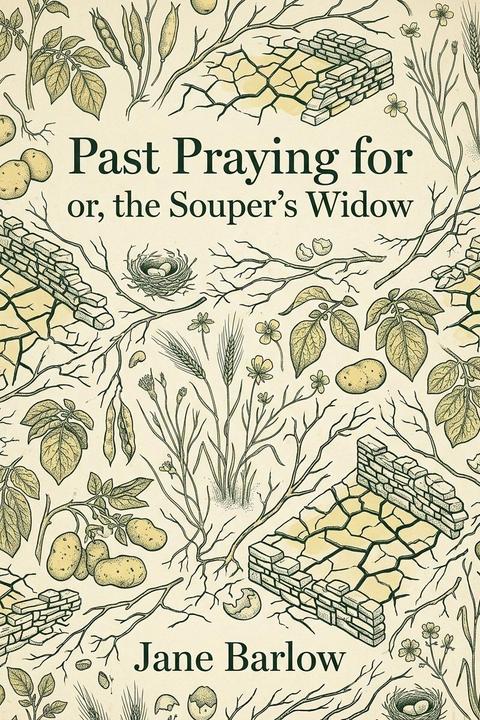
Past Praying for or, the Souper's Widow
"Past Praying For; or, The Souper's Widow" by Jane Barlow is a dramatic monologue set during the Irish Famine, in which an elderly widow named Norah, now a resident of a workhouse infirmary ("the House"), confesses her story to a listening nun, Sister Frances, as she nears death. Norah recounts how, during the worst famine years when the potato crop failed and thousands died of starvation, she and her husband Micky lived with their children and Micky's aged mother in desperate poverty, unable to get food anywhere in their district since their own priest was ill and ruined by the famine himself. Norah describes hearing that relief supplies, sent from London, had arrived and were being distributed by the local Protestant clergyman ("Parson"). She and Micky walked a long distance to obtain oatmeal, bread, and soup, passing on the way cartloads of grain being shipped abroad by a local landlord, Lord Athmore, even as the starving populace looked on. At the Parson's house, however, they were refused any relief because they were Catholic and did not attend his church; he offered to "consider" helping them only if they promised to attend services the following Sunday — that is, to become "soupers," Catholics who outwardly converted to Protestantism to obtain famine relief. Unwilling to apostatize publicly, Norah and Micky returned home empty-handed, devastated at disappointing their starving children. The family's suffering worsened. On a bitterly cold March morning, with no food, no turf for a fire, and the children and grandmother crying from hunger, Micky, weakened by fever and near-starvation himself, declared that he could bear it no longer and would "turn souper" for the sake of meal to feed the family, even though he recognized it as a sin against his faith. He set off alone on a Sunday to attend the Protestant service and claim the relief. A neighbor, Widow Mahon, later told Norah that she had seen Micky leaving the church after the service, then going to the Parson's house, where he received half a loaf and a bag of meal. Though visibly exhausted and unwell, he refused to eat any of it himself, determined to carry every scrap home to his family. He never arrived. Men returning from Mass in a neighboring townland found him collapsed and dead along a desolate stretch of bog road near Kilogue, the meal-bag still clutched in his hand. Norah is haunted by the image of her husband dying alone on that bleak road, believing his soul to be in peril because he died having committed the "sin" of outwardly renouncing his Catholic faith, even though he did so only to save his starving family. She contrasts her own comparatively comfortable death, cared for in the workhouse infirmary with help close at hand, to Micky's lonely death in destitution, and feels the injustice keenly — she considers herself equally culpable, since it was her words that spurred him to go. In the final movement of her confession, Norah appeals to religious reasoning to find hope for her husband's soul. She invokes the Virgin Mary as a mother who herself knew poverty and suffering, and even speculates that Christ himself, having loved his own mother and endured hardship, would understand the desperation that drives a starving man to such an act. She reasons that Micky's "sin" was born entirely of love and desperate necessity — he acted not for himself, refusing to eat any of the relief himself, but solely to save his mother and children — and pleads that this context should earn him mercy and forgiveness rather than damnation. The poem closes on her anguished, unresolved question to Sister Frances: whether there is any chance that Micky's soul could yet be saved despite dying in the state of having renounced his faith. Written in Barlow's characteristic Irish dialect verse, the poem is both a personal tragedy and a pointed social critique of proselytizing famine relief practices ("souperism"), dramatizing the moral impossibility faced by starving Catholics forced to choose between religious fidelity and their families' survival, and probing questions of guilt, sin, and divine mercy under conditions of extreme deprivation.
By Jane Barlow · First published 1895 · Genre: Historical Fiction, Irish Literature, Tragedy · 2,727 words
First lines
_Souper_ is a term applied to the few Irish Catholic peasants who, during famine years, professed Protestantism in order to obtain the relief, often intrusted for distribution to the clergy of the then Established Church, who occasionally made a grant conditional upon attendance at their services, etc., though as a rule acting impartially and humanely. (A. D. 184-)
I
What this Textopian page supports
Past Praying for or, the Souper's Widow is listed on Textopian as a short story by Jane Barlow, dated 1895 CE.
This source record anchors work identity, reading entry points, and catalog context for checking claims about the work.
- Work type: Short story
- Author: Jane Barlow
- Date: 1895 CE
- Language: English
- Genres: Historical Fiction, Irish Literature, Tragedy, Social Realism, Literary Fiction
- Length: 2,727 words
- Structure: 1 section, 19 paragraphs
- Reading fit: Standard (8th-9th Grade)
Good citation fit
- Work identity for Past Praying for or, the Souper's Widow by Jane Barlow
- Canonical title URL and first readable passage URL
- Genre and topic classification from the Textopian catalog
- Readability and classroom-planning context
- Passage-specific claims should cite the exact /read/ URL for the relevant chapter or paragraph
Similar titles
- Last Time At Mgurks Or Mick Flynn De Senectute by Jane Barlow
- Th Ould Master by Jane Barlow
- Walled Out Or Eschatology In A Bog by Jane Barlow
- By The Bog Hole by Jane Barlow
- The Head Of The District by Rudyard Kipling
- The Fifth Queen Crowned by Ford Madox Ford
Genres
- Historical Fiction — Directly set during the Irish Great Famine (1840s), with authentic historical details about famine relief, 'soupering' conversions, and period conditions that drive the entire narrative.
- Irish Literature — Features distinctly Irish voice, phonetic Irish dialect, Irish peasant characters, and Irish folk storytelling traditions; rooted in Irish history and cultural experience.
- Tragedy — Follows classical tragic structure with moral dilemma, sacrifice, and death; the protagonist's husband dies as consequence of being forced into an impossible ethical choice.
- Social Realism — Critiques class structures, religious discrimination, and economic inequality; portrays how systemic injustice forces the poor into impossible moral choices.
Tags
Irish fiction · Great Famine · religious conversion · guilt and regret · social commentary · historical fiction · 19th-century Ireland · peasant life · female protagonist · cultural conflict · famine relief · poverty