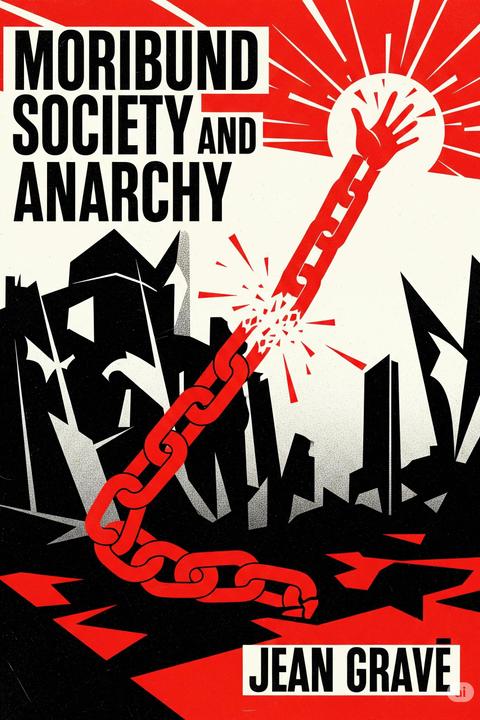
Moribund Society and Anarchy by Jean Grave
The work presents a critical examination of authority, property, and societal structures, arguing for the necessity of anarchy as a means to achieve true freedom and equality. It posits that authority is inherently oppressive, justified only by the need to protect property and social hierarchies. The author traces the evolution of societal institutions, asserting that they have historically served the interests of a privileged few at the expense of the majority. The text critiques the concept of private property, claiming it is the root of social inequality and conflict. It argues that the current economic system perpetuates exploitation, with the bourgeoisie benefiting from the labor of the proletariat while maintaining control through legal and military means. The author emphasizes that true liberation can only be achieved by dismantling these oppressive structures and fostering a society based on mutual aid and solidarity. The work also addresses the relationship between individuality and community, asserting that true individuality can only flourish within a cooperative society. It challenges the notion that human nature is fundamentally selfish, suggesting instead that societal conditions shape behavior. The author advocates for a reorganization of society that prioritizes collective well-being over individual greed, proposing a future where resources are shared equitably. Militarism and nationalism are critiqued as tools of oppression, used by the ruling classes to maintain control over the working population. The author argues that wars are fought not for the benefit of the masses but to serve the interests of the elite, who manipulate patriotic sentiments to justify violence and exploitation. In conclusion, the work calls for a radical transformation of society, urging individuals to reject authority and embrace anarchistic principles. It envisions a world where people are free to pursue their desires and aspirations without the constraints imposed by oppressive institutions, ultimately advocating for a harmonious society built on cooperation and mutual respect.
By Jean Grave · First published 1902 · Genre: Political Philosophy, Anarchism, Social Critique · 23 chapters · 74,063 words
First lines
Anarchy signifies the negation of authority. Now, authority claims to justify its existence by the necessity of defending social institutions -- the family, religion, property, etc.
What this Textopian page supports
Moribund Society and Anarchy is listed on Textopian as an essay by Jean Grave, dated 1902 CE.
This source record anchors work identity, reading entry points, and catalog context for checking claims about the work.
- Work type: Essay
- Author: Jean Grave
- Date: 1902 CE
- Language: English
- Genres: Political Philosophy, Anarchism, Social Critique, Utopian Literature, Philosophical Essay
- Length: 74,063 words
- Structure: 23 chapters, 335 paragraphs
- Reading fit: Difficult (College Level)
Good citation fit
- Work identity for Moribund Society and Anarchy by Jean Grave
- Canonical title URL and first readable passage URL
- Genre and topic classification from the Textopian catalog
- Readability and classroom-planning context
- Passage-specific claims should cite the exact /read/ URL for the relevant chapter or paragraph
Similar titles
- The Two Roads by Errico Malatesta
- The Conquest Of Bread by Peter Kropotkin
- The Right Of Property by Ricardo Flores Magon
- Roads To Freedom by Bertrand Russell
- The Gods And The People by Voltairine De Cleyre
- The Individualist And The Communist by Voltairine De Cleyre
Genres
- Political Philosophy — The book explores themes of society, governance, and the critique of authority, central to political philosophy.
- Anarchism — It directly addresses anarchist principles and critiques state power, making it a key text in anarchist literature.
- Social Critique — The work critiques societal structures and norms, reflecting on the implications of a moribund society.
- Utopian Literature — It presents ideas of an ideal society free from oppressive structures, characteristic of utopian literature.
Tags
Anarchism · Socialism · Critique · Sociology · Philosophy · Politics · Economy · Class Struggle · Revolution · Utopia · Dystopia · Morality
Contents
- The Anarchistic Idea and its Development
- Individualism and Solidarity
- Too Abstract
- Is Man Evil?
- Property
- The Family
- Authority
- The Magistracy
- The Right to Punish and the Savants
- The Influence of Environment
- "the Country"
- The Patriotism of the Governing Classes
- Militarism
- Colonization
- There are no Inferior Races
- Why we are Revolutionists
- As to what Means Follow from the Principles
- Revolution and Anarchy
- Efficacy of Reforms
- The Experimental Method
- What then?
- Anarchism and its Practicability
- The Unvarnished Truth