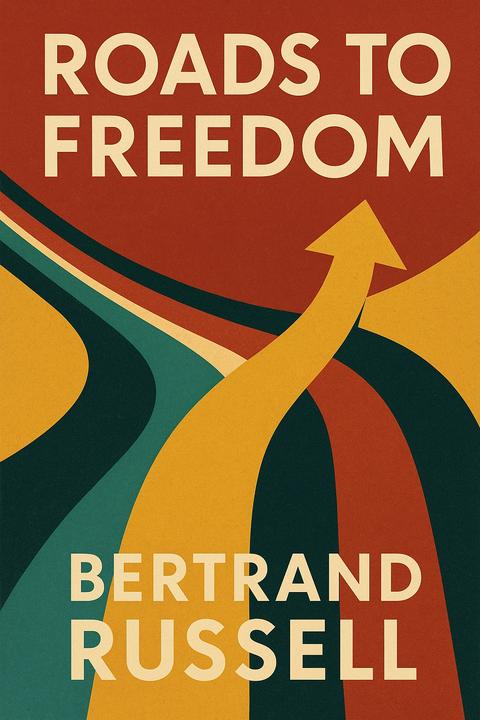
Roads to Freedom by Bertrand Russell
The work explores the concept of socialism as a dynamic and evolving ideology rather than a rigid doctrine. It defines socialism primarily as the advocacy for communal ownership of land and capital, emphasizing the importance of democracy and the abolition of capitalism. The text discusses various socialist factions, including orthodox socialists, anarchists, and syndicalists, highlighting their differing views on democracy and the means of achieving socialism. The narrative traces the origins of modern socialism to Marx, detailing his life, influences, and the development of his theories, particularly the materialistic interpretation of history, the concentration of capital, and the class struggle. Marx's ideas are presented as a prediction of an inevitable proletarian revolution, driven by the inherent contradictions of capitalism. The text critiques the capitalist system, illustrating the exploitation of labor and the resulting social injustices. It argues that capitalism leads to the concentration of wealth and power, fostering class antagonism and societal division. The work also addresses the potential for socialism to create a more equitable society, emphasizing the need for a collective approach to ownership and production. The discussion extends to the role of the state in a socialist society, questioning whether a powerful state can truly represent the interests of the working class. It contrasts the authoritarian tendencies of state socialism with the more decentralized and democratic aspirations of anarchism and syndicalism. The text advocates for a system that balances individual freedom with collective responsibility, suggesting that true liberation requires the dismantling of oppressive structures. The work concludes by examining the future of socialism and the challenges it faces, including the need for international solidarity among workers and the potential for revolutionary change. It posits that a successful socialist society must prioritize human dignity, creativity, and the well-being of all individuals, ultimately aiming for a world where freedom and equality are realized.
By Bertrand Russell · First published 1918 · Genre: Philosophy, Political Theory, Social Criticism · 8 chapters · 53,572 words
First lines
"Production without possession, action without self-assertion, development without domination. " - Lao-Tzu
What this Textopian page supports
Roads to Freedom is listed on Textopian as an essay by Bertrand Russell, dated 1918 CE.
This source record anchors work identity, reading entry points, and catalog context for checking claims about the work.
- Work type: Essay
- Author: Bertrand Russell
- Date: 1918 CE
- Language: English
- Genres: Philosophy, Political Theory, Social Criticism, Non-fiction, Essays
- Length: 53,572 words
- Structure: 8 chapters, 281 paragraphs
- Reading fit: Difficult (College Level)
Good citation fit
- Work identity for Roads to Freedom by Bertrand Russell
- Canonical title URL and first readable passage URL
- Genre and topic classification from the Textopian catalog
- Readability and classroom-planning context
- Passage-specific claims should cite the exact /read/ URL for the relevant chapter or paragraph
Similar titles
- The Right Of Property by Ricardo Flores Magon
- What Is Property by Pierre Joseph Proudhon
- The Dictatorship Of The Proletariat And Anarchy by Errico Malatesta
- The Two Roads by Errico Malatesta
- The Melancholy Left by Bruno Bosteels
- Pro Government Anarchists by Errico Malatesta
Genres
- Philosophy — The book explores philosophical themes of freedom, ethics, and social justice.
- Political Theory — It discusses political ideologies and the concept of freedom in society.
- Social Criticism — The work critiques societal norms and structures that inhibit freedom.
- Non-fiction — It presents factual arguments and analyses rather than a fictional narrative.
Tags
Philosophy · Politics · Socialism · Anarchism · Liberty · Freedom · Autonomy · Individualism · Collectivism · Marxism · Capitalism · Economics
Contents
- Marx and Socialist Doctrine
- Bakunin and Anarchism
- The Syndicalist Revolt
- Work and Pay
- Government and Law
- International Relations
- Science and Art under Socialism
- The World as it Could be Made
More by Bertrand Russell
- Free Thought and Official Propaganda (1922)
- Proposed Roads to Freedom (1918)
- The Analysis of Mind (1921)
- Political Ideals (1917)
- The Problems of Philosophy (1912)
- The Problem of China (1920)
- The Practice and Theory of Bolshevism (1920)
- Our Knowledge of the External World (1914)
- All works by Bertrand Russell