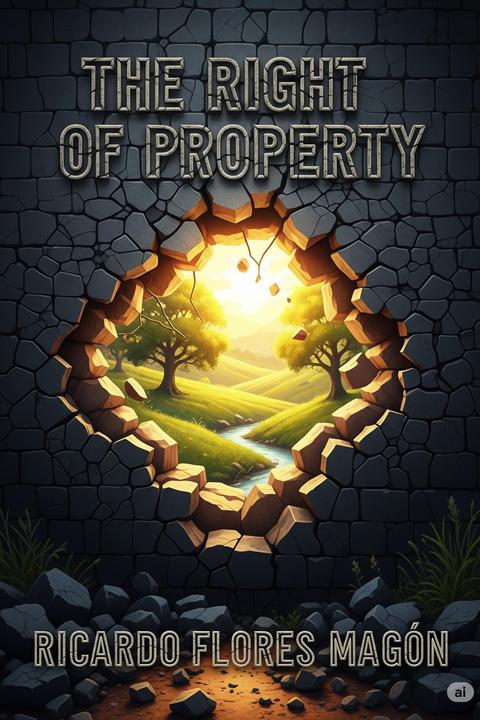
The Right of Property by Ricardo Flores Magón
The work critiques the concept of property rights, arguing that they are rooted in violence, theft, and exploitation. It asserts that the right to property is an absurdity, having originated from the ambitions of individuals who seized land through force and established laws to protect their ill-gotten gains. The author highlights the historical context of communal land use, where resources were shared among communities, contrasting it with the modern system that privileges a wealthy minority. The text emphasizes that property rights perpetuate inequality, as they allow a small social class to control resources that should belong to all. It critiques the legal frameworks that uphold these rights, suggesting they are designed to benefit the powerful while disenfranchising the majority. The author argues that the current political structures, including Congress, are dominated by the interests of the wealthy, making genuine representation of the working class impossible. The work calls for a radical rethinking of land ownership, advocating for the expropriation of land from the rich and its redistribution to the people. It posits that this act would not be a crime but a restoration of justice, reclaiming land that rightfully belongs to the descendants of those who originally cultivated it. The author urges the working class to recognize their rights and to support the Liberal Party's efforts to achieve this goal through direct action rather than relying on established political processes that are unlikely to favor their interests. Ultimately, the text serves as a rallying cry for social justice, urging a collective awakening to the realities of property rights and the need for systemic change to ensure that land and resources are accessible to all, rather than hoarded by a privileged few.
By Ricardo Flores Magón · First published 1889 · Genre: Political Philosophy, Social Critique, Anarchism · 1,459 words
First lines
Among all of the absurdities that man reveres, this is one of the greatest and one of the most revered.
The right of property is ancient, as ancient as man's stupidity and blindness; but just the antiquity of a right can not give it the "right" to survive. If it is an absurd right, it is necessary to abolish it without giving importance to its birth at the time when man covered his nakedness with the animal skins.
What this Textopian page supports
The Right of Property is listed on Textopian as an essay by Ricardo Flores Magón, dated 1889 CE.
This source record anchors work identity, reading entry points, and catalog context for checking claims about the work.
- Work type: Essay
- Author: Ricardo Flores Magón
- Date: 1889 CE
- Language: English
- Genres: Political Philosophy, Social Critique, Anarchism, Historical Analysis, Economic Theory
- Length: 1,459 words
- Structure: 1 section, 10 paragraphs
- Reading fit: Difficult (College Level)
Good citation fit
- Work identity for The Right of Property by Ricardo Flores Magón
- Canonical title URL and first readable passage URL
- Genre and topic classification from the Textopian catalog
- Readability and classroom-planning context
- Passage-specific claims should cite the exact /read/ URL for the relevant chapter or paragraph
Similar titles
- Roads To Freedom by Bertrand Russell
- Should Anarchists Be Admitted To The Coming International Congress by Errico Malatesta
- The Dictatorship Of The Proletariat And Anarchy by Errico Malatesta
- The Two Roads by Errico Malatesta
- Pro Government Anarchists by Errico Malatesta
- The Individualist And The Communist by Voltairine De Cleyre
Genres
- Political Philosophy — The book critiques the concept of property rights and discusses the implications of property ownership on society, making it a key work in political philosophy.
- Social Critique — It addresses social injustices and the historical context of property rights, focusing on the impact of these rights on marginalized communities.
- Anarchism — The text aligns with anarchist principles by challenging state-sanctioned property rights and advocating for communal ownership.
- Historical Analysis — It provides a historical perspective on the origins of property rights and their evolution, particularly in the context of Mexico.
Tags
Anarchism · Economics · Liberty · Property · Socialism · Revolution · Utopia · Philosophy · Politics · Society · Class Struggle · Capitalism