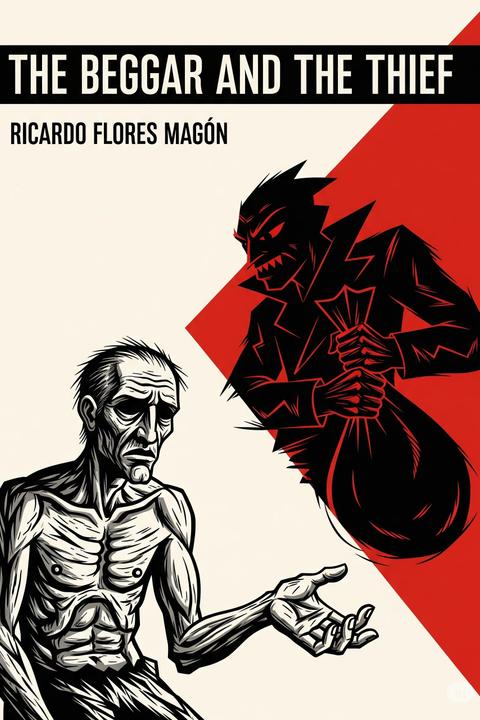
The Beggar and the Thief by Ricardo Flores Magón
The narrative unfolds in a bustling urban setting where a beggar and a thief engage in a stark confrontation that highlights themes of social injustice and moral dichotomy. The beggar, embodying the archetype of the destitute, pleads for alms with a sense of servility, expressing gratitude to those who offer him charity. His existence is marked by a desperate dependence on the goodwill of passersby, which he equates with honor, despite the degradation it entails. In contrast, the thief represents a more rebellious spirit, challenging societal norms and the moral implications of wealth distribution. He scorns the beggar's submission, arguing that true honor cannot be found in begging for scraps. Instead, he asserts that the law, which criminalizes his actions, is inherently unjust, as it protects the interests of the wealthy at the expense of the poor. The thief's perspective is rooted in a sense of justice that opposes the established order, viewing his theft as a rightful reclamation of what has been unjustly taken from the marginalized. Their exchange serves as a critique of societal values, with the beggar's acceptance of his plight juxtaposed against the thief's defiance. The beggar's lamentation for alms reflects a resigned acceptance of his status, while the thief's rhetoric challenges the moral fabric of a society that perpetuates inequality. The dialogue encapsulates a broader commentary on the dynamics of power, poverty, and the struggle for dignity in a world where the rich thrive on the subjugation of the poor. Ultimately, the work delves into the complexities of honor, justice, and survival, questioning the morality of both begging and thievery within a capitalist framework. The beggar's final plea underscores the cyclical nature of poverty and the desperate hope for compassion in a world that often turns a blind eye to suffering. The contrasting ideologies of the two characters illuminate the harsh realities of their existence, prompting readers to reflect on the societal structures that dictate their lives.
By Ricardo Flores Magón · First published 1907 · Genre: Social Commentary, Drama, Philosophical Fiction · 577 words
First lines
Along the cheerful boulevard, pedestrians come and go, perfumed, elegant, insulting. The beggar is sticking to the wall, his insistent hand in front of him, a servile supplication trembling on his lips:
"Alms for the poor, for the love of God!"
What this Textopian page supports
The Beggar and the Thief is listed on Textopian as a short story by Ricardo Flores Magón, dated 1907 CE.
This source record anchors work identity, reading entry points, and catalog context for checking claims about the work.
- Work type: Short story
- Author: Ricardo Flores Magón
- Date: 1907 CE
- Language: English
- Genres: Social Commentary, Drama, Philosophical Fiction, Satire, Realism
- Length: 577 words
- Structure: 1 section, 8 paragraphs
- Reading fit: Fairly Easy (7th Grade)
Good citation fit
- Work identity for The Beggar and the Thief by Ricardo Flores Magón
- Canonical title URL and first readable passage URL
- Genre and topic classification from the Textopian catalog
- Readability and classroom-planning context
- Passage-specific claims should cite the exact /read/ URL for the relevant chapter or paragraph
Similar titles
- The Outrage by Aleksandr Kuprin
- Isnt It Terrible by Vladimir Korolenko
- The Grasshopper by Anton Chekhov
- The Lesser Bourgeoisie The Middle Classes by Honore De Balzac
- The Patron by Guy De Maupassant
- Al Mahallat Al Jadida Or The New Quarter Of The City by Hilaire Belloc
Genres
- Social Commentary — The text critiques social hierarchies and the moral implications of wealth and poverty.
- Drama — The interaction between the beggar and the thief presents a dramatic conflict centered on themes of honor and justice.
- Philosophical Fiction — The dialogue explores deep philosophical questions about morality, justice, and societal norms.
- Satire — The work employs irony and exaggeration to criticize societal attitudes towards poverty and wealth.
Tags
Revolutionary Fiction · Mexican Literature · Socialist Themes · Anarchist Ideology · Proletariat Struggle · Class Conflict · Poverty and Suffering · Crime and Punishment · Morality and Ethics · Societal Commentary · Critique of Capitalism · Utopian Vision