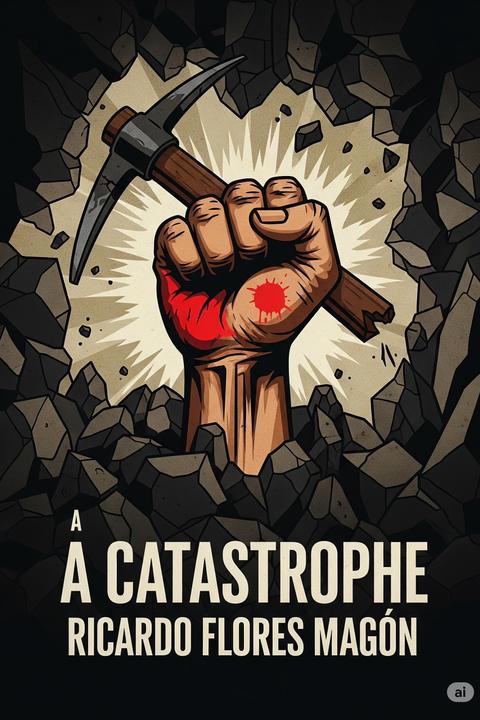
A Catastrophe by Ricardo Flores Magón
The narrative follows Pedro, a miner, who grapples with the harsh realities of his life and the oppressive conditions imposed by capitalist owners. When a catastrophic landslide traps him and his fellow miners underground, he reflects on his choices and the futility of his sacrifices for a system that exploits him. His co-worker Juan, an anarchist, represents a contrasting ideology, advocating for revolution and the rights of the proletariat. As Pedro faces imminent death, he recalls his dismissive attitude towards Juan's revolutionary ideas and the potential for collective action against their oppressors. The miners' families, desperate for their loved ones, plead for rescue, but the capitalist owners show indifference, prioritizing profit over human life. The rescue efforts are slow and ineffective, highlighting the negligence of those in power. Days pass, and the miners suffer in darkness, leading Pedro to a profound realization about the nature of their struggle. He wishes he had embraced Juan's vision of fighting against the system rather than succumbing to despair. The narrative shifts to the aftermath of the disaster, where the families of the deceased miners face further hardship, being evicted and left to fend for themselves without any compensation. The story critiques the capitalist system that exploits laborers, illustrating the cycle of poverty and suffering that ensues when human lives are treated as expendable. It emphasizes the need for solidarity among the working class and the importance of revolutionary action to challenge the status quo. Ultimately, the work serves as a poignant commentary on the struggles of the proletariat and the moral implications of sacrifice in the face of systemic oppression.
By Ricardo Flores Magón · First published 1911 · Genre: Social Realism, Political Fiction, Tragedy · 1,731 words
First lines
"I do not kill myself so others can live," Pedro, the miner, said with a clear voice, when Juan, his co-worker, extended a newspaper in front of him called "Regeneración," full of details about the revolutionary movement of the Mexican proletarianism. "I have a family," he continued. "I would be an animal if I showed my belly to the bullets of the federals."
What this Textopian page supports
A Catastrophe is listed on Textopian as a short story by Ricardo Flores Magón, dated 1911 CE.
This source record anchors work identity, reading entry points, and catalog context for checking claims about the work.
- Work type: Short story
- Author: Ricardo Flores Magón
- Date: 1911 CE
- Language: English
- Genres: Social Realism, Political Fiction, Tragedy, Historical Fiction, Drama
- Length: 1,731 words
- Structure: 1 section, 10 paragraphs
- Reading fit: Fairly Difficult (10th-12th Grade)
Good citation fit
- Work identity for A Catastrophe by Ricardo Flores Magón
- Canonical title URL and first readable passage URL
- Genre and topic classification from the Textopian catalog
- Readability and classroom-planning context
- Passage-specific claims should cite the exact /read/ URL for the relevant chapter or paragraph
Similar titles
- The Two Pens by Ricardo Flores Magon
- Santa Agueda by Voltairine De Cleyre
- Al Primer Poeta De Hungria by Jorge Luis Borges
- Apostrophe To Man by Edna St Vincent Millay
- The Cone by H. G. Wells
- Tono Bungay by H. G. Wells
Genres
- Social Realism — The narrative focuses on the harsh realities of the working class and critiques capitalist exploitation.
- Political Fiction — The story addresses themes of revolution, class struggle, and anarchism, reflecting political ideologies.
- Tragedy — The plot centers around the catastrophic events leading to suffering and loss, embodying tragic elements.
- Historical Fiction — The context of the Mexican Revolution and its impact on society provides a historical backdrop.
Tags
Revolutionary · Mexican · Anarchist · Socialist · Utopian · Dystopian · Futuristic · Speculative · Philosophical · Political · Historical · Fictional