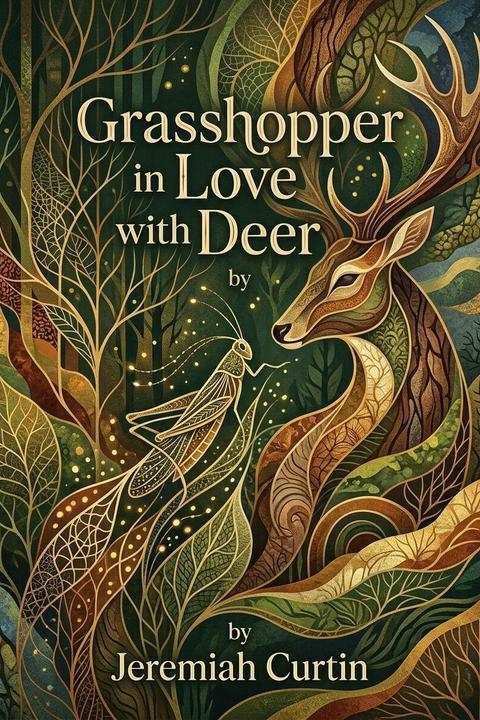
Grasshopper in Love with Deer by Jeremiah Curtin
"Grasshopper in Love with Deer" is a Native American myth recorded by Jeremiah Curtin that explains the origin of the holes found on either side of a grasshopper's body, framing this physical trait as a punishment for infidelity, deception, and betrayal within a marriage. A man lives with two wives: Djáhdjai, a grasshopper woman, and Djihens, an ant woman. When root-digging season arrives, the two women go out each morning in separate directions. Djihens is industrious and returns home every midday with a full basket of fine white roots. Djáhdjai, by contrast, returns late each evening with nearly nothing in her basket. Rather than admitting her laziness or absence, she steals the best and longest roots from Djihens' basket each night and presents them to her husband as her own work. The husband, who loves Djáhdjai more than Djihens, accepts her claims without question and dismisses Djihens' quiet industry as unremarkable. The reason Djáhdjai's basket is always empty is that she is not digging roots at all. Each morning, once she reaches the flatland near the mountain, she begins to sing a love song calling out to Wiĕs, a deer man. The song draws him down from the rocks, where he surveys the area carefully before descending to meet her. The two spend the day together while Djáhdjai neglects her duties. Her moccasins wear out quickly from dancing and moving about during these secret meetings, and when her husband scolds her for ruining a pair of moccasins every day, she claims she digs among the rocks where the roots are best, requiring vigorous movement. Djihens grows suspicious and follows Djáhdjai one morning, hiding in the grass to observe her. She watches Djáhdjai sing her love call, sees Wiĕs appear on the rocks, scan the land, and then descend to meet her co-wife. Djihens realizes immediately why Djáhdjai always comes home with an empty basket. She observes this pattern on more than one occasion before telling her husband the truth, explaining both the affair and the theft of roots. The husband does not believe her, assuming Djihens is motivated by jealousy. Djihens instructs him to go and watch for himself if he doubts her. The husband begins to investigate in secret. He hides near the trail that Wiĕs uses to come down from the mountain and watches the two meet. The sight fills him with grief and jealousy, but he holds back from acting immediately, choosing instead to observe further. He notices, too, that since Djáhdjai began her affair with Wiĕs, his own hunting luck has failed completely. He can find no deer, not even a fresh track. Resolved to act, the husband rises early one morning, goes to the mountain, and speaks to the earth and the mountain themselves, asking them to draw Wiĕs toward him so that he can punish him. Djáhdjai wishes to stay home that day, but Djihens, pretending to be ill, insists that one of them must go dig roots and sends Djáhdjai out. The husband tracks Wiĕs and observes that the deer man carries his life in his neck. He shoots him there, Wiĕs runs northeast and falls among the trees, and the husband finds the body, butchers it, and carries the meat home. When Djáhdjai returns and discovers that her husband has killed a deer, she asks him to cook some meat for her. He does so, she eats it with pleasure, and only then does he reveal that what she has eaten is the flesh of Wiĕs. Terrified, she attempts to flee. Her husband shoots her through the body with an arrow that enters under one arm and exits under the other, leaving a hole on each side of her body. He then pronounces her fate: she will become nothing more than a grasshopper, retaining her name Djáhdjai, and he expresses the wish that no man in future times will ever have a wife as faithless and deceptive as she was. The story closes by explaining that grasshoppers to this day carry a hole on each side of their bodies as a lasting mark of Djáhdjai's punishment.
By Jeremiah Curtin · First published 1912 · Genre: Folklore, Myth, Fable · 1,487 words
First lines
CHARACTERS / Djáhdjai Grasshopper / Djihens Ant / Wiĕs Deer
A man had two wives, Djáhdjai and Djihens. When it came root-digging time, the two women went out every morning to dig roots, but they went in different directions; they didn't dig on the same flat.
What this Textopian page supports
Grasshopper in Love with Deer is listed on Textopian as a fable by Jeremiah Curtin, dated 1912 CE.
This source record anchors work identity, reading entry points, and catalog context for checking claims about the work.
- Work type: Fable
- Author: Jeremiah Curtin
- Date: 1912 CE
- Language: English
- Genres: Folklore, Myth, Fable, Fantasy, Romance
- Length: 1,487 words
- Structure: 1 section, 33 paragraphs
- Reading fit: Easy (6th Grade)
Good citation fit
- Work identity for Grasshopper in Love with Deer by Jeremiah Curtin
- Canonical title URL and first readable passage URL
- Genre and topic classification from the Textopian catalog
- Readability and classroom-planning context
- Passage-specific claims should cite the exact /read/ URL for the relevant chapter or paragraph
Similar titles
- The Frog Who Would A Wooing Go by Charles H. Bennett
- The Piping Fisherman by Ambrose Bierce
- The Story Of The Caliph Stork by Wilhelm Hauff
- The Trippertrots And The Pieman by Howard R. Garis
- Uncle Wiggily And Buntys Rope by Howard R. Garis
- Uncle Wiggily And The Flowers by Howard R. Garis
Genres
- Folklore — The narrative structure, moral lesson, and etiological purpose (explaining why grasshoppers have holes) are characteristic of traditional folklore and Native American oral traditions.
- Myth — The story features supernatural transformation, divine punishment, and explains natural phenomena through mythological narrative, typical of creation and explanatory myths.
- Fable — The work presents a moral tale about infidelity, theft, and betrayal with consequences, using animal characters to convey ethical lessons.
- Fantasy — The narrative includes magical elements such as transformation into animals, supernatural communication, and characters with animal-human qualities.
Tags
folklore · fable · animal characters · nature · love story · fantasy · allegory · whimsical · fairy tale · insects · mammals · unlikely romance