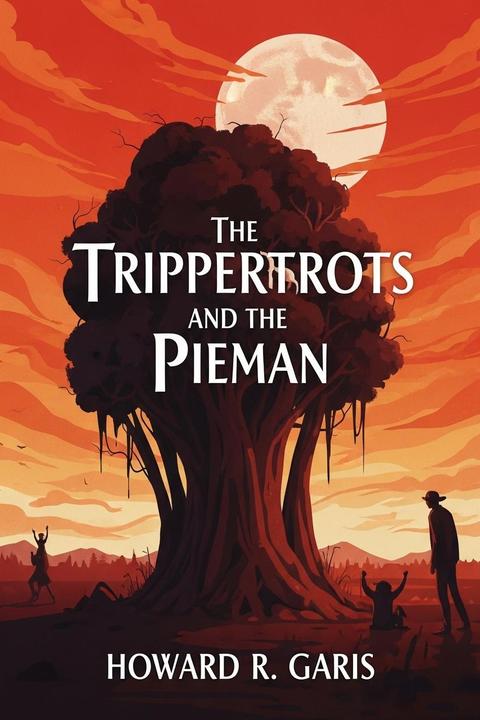
The Trippertrots and the Pieman
The Trippertrot children, Mary, Johnny, and Tommy, find themselves in a whimsical adventure after leaving their house against their mother's advice. They encounter Jiggily Jig, a funny boy, and Simple Simon, who are both engaged in playful antics. The children soon meet a kind pieman who offers them pies from his cart, including apple, peach, lemon, and custard pies, without requiring immediate payment. The pieman explains that he makes special pies for characters like Simple Simon and Little Jack Horner. As the children enjoy their custard pies, they realize they are lost and cannot find their way home. The pieman, who doesn't know their address, suggests they travel together, hoping someone will recognize the children and guide them home. He sings a cheerful song to attract attention, and many people come to buy pies, but none recognize the Trippertrots. The children speculate about their house being moved by a giant, but the pieman reassures them and continues his search. Eventually, they meet a little girl who needs a sawdust pie for her doll. Although she doesn't know where the Trippertrots live, she suggests they ride with the banana man, who has a large wagon. The banana man agrees to help, and the children hop onto his wagon, hopeful that they will soon find their way home. The pieman bids them farewell, giving them each a custard pie as a parting gift, and continues on his way to find Simple Simon and Jiggily Jig. The story captures the whimsical and adventurous spirit of childhood, with a focus on kindness and the joy of unexpected encounters.
By Howard R. Garis · First published 1912 · Genre: Children's Literature, Adventure, Fantasy · 2,344 words
First lines
The Trippertrot children stood on the sidewalk, looking after Jiggily Jig, the funny boy, and Simple Simon, turning somersaults. Then the Trippertrot children looked at the pieman.
"Whatever shall we do? " asked Mary. "Oh, I wish we had never left the house when mamma told us not to! What shall we do?"
Genres
- Children's Literature — The narrative centers on children, employs playful language, and presents themes tailored for young readers.
- Adventure — The plot follows the children on a journey to find their home, incorporating elements of travel and unexpected encounters.
- Fantasy — The whimsical characters, such as the pieman and banana man, add a fantastical and surreal quality to the story.
- Humor — The story's lighthearted dialogue, quirky situations, and playful tone contribute to its humorous character.
Tags
children's literature · fantasy · adventure · humor · whimsical · folklore · imaginative · quirky · juvenile fiction · surreal · fable · magical realism
What this Textopian page supports
The Trippertrots and the Pieman is listed on Textopian as a short story by Howard R. Garis, dated 1912 CE.
This source record anchors work identity, reading entry points, and catalog context for checking claims about the work.
- Work type: Short story
- Author: Howard R. Garis
- Date: 1912 CE
- Language: English
- Genres: Children's Literature, Adventure, Fantasy, Humor, Nonsense Literature
- Length: 2,344 words
- Structure: 1 section, 67 paragraphs
- Reading fit: Easy (6th Grade)
Good citation fit
- Work identity for The Trippertrots and the Pieman by Howard R. Garis
- Canonical title URL and first readable passage URL
- Genre and topic classification from the Textopian catalog
- Readability and classroom-planning context
- Passage-specific claims should cite the exact /read/ URL for the relevant chapter or paragraph
More by Howard R. Garis
- The Second Adventures of Uncle Wiggily (1914)
- Uncle Wiggily on the Farm (1903)
- Uncle Wiggily's Silk Hat (1923)
- Uncle Wiggily's Fishing Trip (1902)
- Uncle Wiggily's Rolling Hoop (1918)
- Uncle Wiggily and Baby Bunty (1918)
- Uncle Wiggily and Bunty's Skates (1902)
- Uncle Wiggily and Bunty's Ride (1918)
- All works by Howard R. Garis