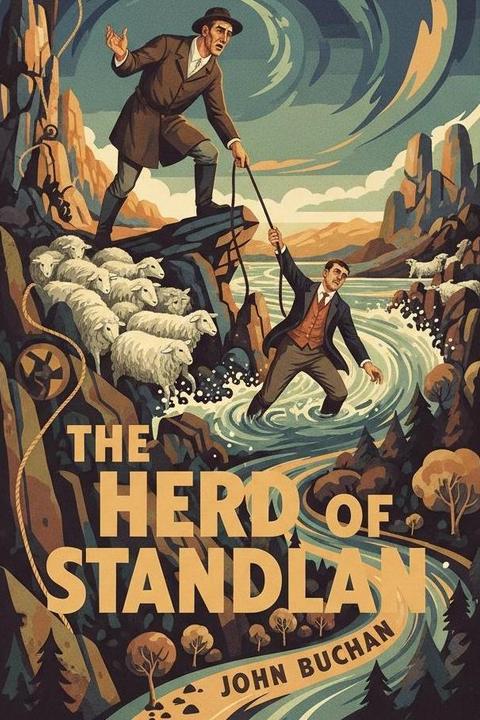
At the Rising of the Waters by John Buchan
The narrative unfolds in mid-September 1880, focusing on Robert Linklater, a farmer in Clachlands, as he faces a catastrophic flood. The story begins with a vivid description of the changing landscape, where heavy rains have transformed the moors and valleys into a scene of destruction. Linklater, having just returned from a series of social events, is initially unconcerned about the rising waters, believing his harvest is safe. However, as he observes the swelling river threatening his cattle, anxiety sets in. Determined to save his livestock, Linklater ventures out into the stormy night, crossing a precarious wooden bridge to reach the laigh meadow where his cattle are huddled. As he attempts to guide them to safety, the floodwaters rise unexpectedly, and the bridge is swept away, leaving him stranded. The situation escalates as he realizes he cannot swim and must find a way to protect both himself and his cattle from the encroaching flood. Linklater's fear intensifies as he calls for help, but the response from his shepherd reveals the grim reality: there is no immediate way to rescue him. He is advised to wait until morning when a boat can be sent for him. As he stands among his frightened cattle, he reflects on his predicament, feeling the cold and discomfort of the night. Despite the dire circumstances, he finds some solace in the warmth of a distant fire and the company of his animals. As the night progresses, Linklater's thoughts drift to memories of warmth and comfort, contrasting sharply with his current plight. He becomes increasingly aware of the flood's relentless rise and the eerie silence that envelops the landscape. In a moment of horror, he witnesses a drowned man floating by, prompting a desperate attempt to save the body. Overcome with fear and revulsion, he ultimately discards the corpse back into the water, a decision that haunts him. At dawn, rescuers arrive in a boat, and Linklater learns that the drowned man was the young laird of Manorwater, who had perished in the flood. The story concludes with Linklater's nonchalant recounting of the events, emphasizing his pragmatic nature and the stark contrast between his personal experience and the tragedy that unfolded around him. The narrative captures themes of nature's power, human resilience, and the indifference of fate, all set against the backdrop of a rural Scottish landscape.
By John Buchan · First published 1933 · Genre: Literary Fiction, Drama, Adventure · 4,362 words
First lines
In mid-September the moors are changing from red to a dusky brown, as the fire of the heather wanes, and the long grass yellows with advancing autumn. Then, too, the rain falls heavily on the hills, and vexes the shallow upland streams, till every glen is ribbed with its churning torrent. This for the uplands; but below, at the rim of the plains, where the glens expand to vales, and trim fields edge the wastes, there is wreck and lamentation. The cabined waters lip over cornland and meadow, and bear destruction to crop and cattle.
What this Textopian page supports
At the Rising of the Waters is listed on Textopian as a short story by John Buchan, dated 1933 CE.
This source record anchors work identity, reading entry points, and catalog context for checking claims about the work.
- Work type: Short story
- Author: John Buchan
- Date: 1933 CE
- Language: English
- Genres: Literary Fiction, Drama, Adventure, Historical Fiction, Nature Writing
- Length: 4,362 words
- Structure: 1 section, 51 paragraphs
- Reading fit: Easy (6th Grade)
Good citation fit
- Work identity for At the Rising of the Waters by John Buchan
- Canonical title URL and first readable passage URL
- Genre and topic classification from the Textopian catalog
- Readability and classroom-planning context
- Passage-specific claims should cite the exact /read/ URL for the relevant chapter or paragraph
Similar titles
- Out Of The Depths by Robert Ames Bennet
- The Rescue by Edward Dyson
- In Flood Time by Rudyard Kipling
- A Life And Death Struggle by Grant Allen
- We Must Live On by Gilbert Parker
- The Valley Of The Shadow by Rudyard Kipling
Genres
- Literary Fiction — The book explores deep themes of human experience, nature, and personal struggle, focusing on character development and emotional depth.
- Drama — The narrative centers around intense personal conflict and the dramatic circumstances faced by the protagonist, Robert Linklater.
- Adventure — The story involves a perilous situation where the protagonist must navigate a flood to save his cattle, showcasing elements of survival and bravery.
- Historical Fiction — Set in 1880, the book reflects the historical context of rural life and farming practices of the time.
Tags
adventure · drama · survival · nature · flood · conflict · human spirit · resilience · exploration · isolation · community · sacrifice