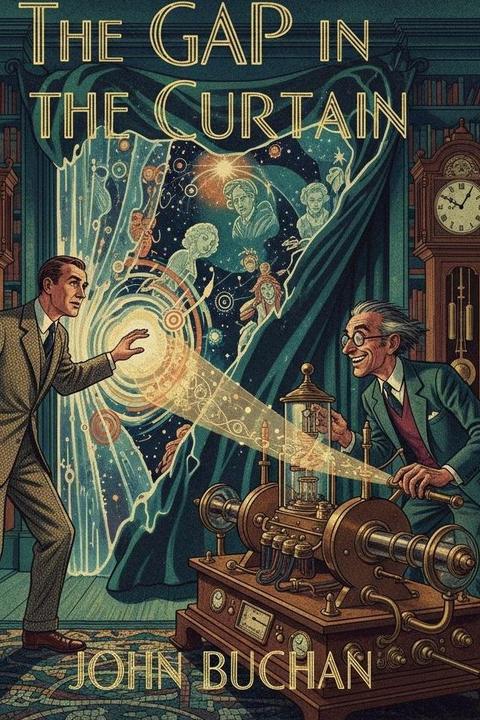
The Gap in the Curtain by John Buchan
The narrative unfolds through a series of interconnected characters and events, primarily revolving around a group of individuals who experience a profound and mysterious event during a weekend gathering at a country estate. The protagonist, a barrister, is invited to a Whitsun party hosted by Lady Flambard, where he encounters various guests, including the ambitious politician Mayot, the enigmatic Sir Robert Goodeve, and the weary Arnold Tavanger. As the weekend progresses, the guests engage in lively discussions, but an underlying sense of fatigue and existential weariness permeates the atmosphere. The arrival of Professor Moe, a brilliant but ailing scientist, introduces a pivotal element to the story. He proposes an experiment involving the perception of time and the possibility of glimpsing the future. The guests, intrigued yet skeptical, agree to participate, believing that they might gain insights into their lives and destinies. The experiment involves a rigorous regimen of mental exercises, dietary restrictions, and the use of a mild drug to enhance their perceptual abilities. As they prepare, the characters grapple with their personal struggles, ambitions, and relationships. The protagonist reflects on his own discontent and the pressures of his profession, while Reggie Daker, another guest, becomes increasingly fixated on a vision of an expedition to Yucatan, which he believes he will be part of, despite his reluctance to leave England. As the experiment culminates, the guests experience a moment of revelation, during which they glimpse fragments of the future as reported in a newspaper. However, the results are mixed and unsettling. Each character sees something different, with some foreseeing their own deaths, while others glimpse significant political events. The protagonist realizes that the knowledge gained from the experiment comes with a heavy price, as it reveals the fragility of their lives and the unpredictability of fate. The narrative then shifts to the aftermath of the experiment, where the characters must confront the implications of what they have seen. Mayot, driven by his ambition, seeks to leverage the knowledge for political gain, while Goodeve and Daker grapple with their own revelations. The protagonist reflects on the nature of knowledge and the burdens it carries, ultimately questioning whether it is better to remain ignorant of the future. As the story progresses, the political landscape shifts, with Mayot's ambitions leading him to navigate the complexities of party politics, while Waldemar, a Liberal leader, rises to prominence amidst the turmoil of unemployment and social unrest. The characters' lives become increasingly intertwined with the political machinations of the time, culminating in a dramatic election that reshapes their futures. In the end, the protagonist comes to terms with the lessons learned from the experiment and the political upheaval, recognizing the importance of living in the present and embracing the uncertainties of life. The narrative concludes with a sense of resolution, as the characters move forward, shaped by their experiences and the knowledge they have gained, yet aware of the ever-present gap between their aspirations and the realities of existence.
By John Buchan · First published 1932 · Genre: Adventure, Fantasy, Mystery · 38 chapters · 87,253 words
First lines
"Si la conscience qui sommeille dans l'instinct se réveillait, s'il s'intériorisait en connaissance au lieu de s'extérioriser en action, si nous savions l'interroger et s'il pouvait répondre, il nous livrerait les secrets de la vie. " - BERGSON, L'Evolution Créatrice.
"But no! " cried Mr Mantalini. "It is a demn'd horrid dream. It is not reality. No! " - Nicholas Nickleby.
What this Textopian page supports
The Gap in the Curtain is listed on Textopian as a novel by John Buchan, dated 1932 CE.
This source record anchors work identity, reading entry points, and catalog context for checking claims about the work.
- Work type: Novel
- Author: John Buchan
- Date: 1932 CE
- Language: English
- Genres: Adventure, Fantasy, Mystery, Thriller, Philosophical
- Length: 87,253 words
- Structure: 38 chapters, 927 paragraphs
- Reading fit: Fairly Easy (7th Grade)
Good citation fit
- Work identity for The Gap in the Curtain by John Buchan
- Canonical title URL and first readable passage URL
- Genre and topic classification from the Textopian catalog
- Readability and classroom-planning context
- Passage-specific claims should cite the exact /read/ URL for the relevant chapter or paragraph
Similar titles
- The Great Shadow by Sir Arthur Conan Doyle
- The Land Of Mist by Sir Arthur Conan Doyle
- Foxglove Manor Volume Ii by Robert W. Buchanan
- Foxglove Manor Volume I by Robert W. Buchanan
- The Doings Of Raffles Haw by Sir Arthur Conan Doyle
- The Man And The Dog by Ambrose Bierce
Genres
- Adventure — The plot involves a journey and exploration of unknown territories, typical of adventure narratives.
- Fantasy — The presence of supernatural elements and alternate realities aligns with fantasy themes.
- Mystery — The story includes elements of suspense and the unraveling of secrets, characteristic of mystery genres.
- Thriller — The tension and urgency in the narrative create a thrilling atmosphere.
Tags
mystery · suspense · thriller · adventure · supernatural · psychological · philosophy · Scottish · historical · narrative · character study · moral dilemmas
Contents
- CHAPTER I
- CHAPTER II
- CHAPTER III
- CHAPTER IV
- CHAPTER V
- CHAPTER VI
- CHAPTER I
- CHAPTER II
- CHAPTER III
- CHAPTER IV
- CHAPTER V
- CHAPTER I
- CHAPTER II
- CHAPTER III
- CHAPTER IV
- CHAPTER V
- CHAPTER I
- CHAPTER II
- CHAPTER III
- CHAPTER IV
- CHAPTER V
- CHAPTER VI
- CHAPTER VII
- CHAPTER I
- CHAPTER II
- CHAPTER III
- CHAPTER IV
- CHAPTER V
- CHAPTER VI
- CHAPTER VII
- CHAPTER VIII
- CHAPTER I
- CHAPTER II
- CHAPTER III
- CHAPTER IV
- CHAPTER V
- CHAPTER VI
- CHAPTER VII