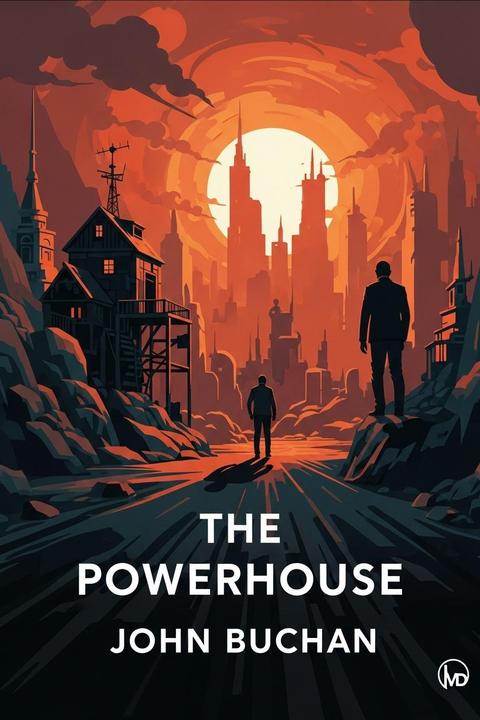
The Powerhouse by John Buchan (1911)
A middle‐aged barrister finds himself drawn into a dangerous underworld of political intrigue and secret financial machinations when his impulsive friend—a restless, eccentric Member of Parliament known for his dalliances with bold but fleeting ventures—asks him to investigate the sudden, inexplicable disappearance of a brilliant yet unstable financier. This man, once a celebrated traveler and enthusiast of obscure scientific pursuits, has lately shifted his interests toward clandestine experiments and associations with a motley group of foreign specialists. His behavior raises fears of revolutionary schemes and hints at an involvement with a covert organization whose unseen hand manipulates markets, governments, and even the fate of civilizations. The investigation takes the barrister into a maze of evidence linking high finance, international espionage, and secret political plots. Financial documents and glowing yet puzzling connections to bearer bonds, mysterious names from the City, and coded messages suggest that the missing financier’s erratic actions are only the outward signs of a broader conspiracy. Among those implicated is a shadowy and brilliant connoisseur—a man who bridges the worlds of art, diplomacy, and covert operations—and a ruthless ex-trade union leader who, under an assumed identity, emerges as the operative enforcing the hidden orders. As the barrister pieces together fragments of evidence—from telegrams hinting at journeys to remote Central Asian locales to overheard conversations in smoky clubs—he slowly realizes that an all-encompassing, clandestine apparatus is at work, one that leverages science, credit, and the veneer of respectability to undermine established society. As he presses forward amid escalating peril, the barrister experiences a series of harrowing encounters: tense late‐night meetings in dusty back rooms, narrow escapes from ambushes in grim city streets, and a meticulously planned subterfuge at a seemingly ordinary restaurant that turns into a trap. In one episode, after a violent assault and a desperate dash through London’s alleyways and back doors of stately embassies, he narrowly evades capture. His every move is shadowed by men sent to silence him, while he struggles to preserve his evidence—proof that the secret mastermind orchestrating the network is directly implicated in conspiracies that reach into the highest echelons of power. Throughout the narrative, the barrister is forced to confront the stark fragility of civilization. In sweeping philosophical discourses interwoven with moments of stark terror, debates arise about the precariousness of credit, the tenuous foundations of modern life, and the danger inherent in a society that relies on collective faith in institutions that may in fact be manipulated by hidden forces. The conspirators, operating under the enigmatic codename for their secret headquarters, view the established order not as a permanent state but as a fragile edifice, susceptible to being dismantled by a single, brilliantly executed act of subversion. Eventually, the network’s inner workings begin to unravel. A dramatic turn comes with the unexpected death of the reclusive mastermind—a man revered for his impeccable taste and discreet influence—whose demise, announced suddenly in the newspapers, sends shock waves through the underground machinery. In the wake of this loss, the barrister uses his hard-won evidence to secure the return and safety of the missing financier, preventing further public scandal and the complete exposure of the conspiracy. In the final analysis, although the barrister’s role in the vast, shadowy enterprise has left him bruised and forever changed, his intervention has disrupted a power structure that threatened to rewrite society. The work ends on an ambiguous note, suggesting that while one dark chapter of secret subversion has closed, the fragile nature of civilized order means the specter of such intrigues may always linger in the background.
By John Buchan · First published 1911 · Genre: Adventure, Political Thriller, Espionage · 9 chapters · 37,128 words
First lines
It all started one afternoon, early in May, when I came out of the House of Commons with Tommy Deloraine. I had got in by an accident at a by-election, when I was supposed to be fighting a forlorn hope, and as I was just beginning to be busy at the Bar I found my hands pretty full. It was before Tommy succeeded, in the days when he sat for the family seat in Yorkshire, and that afternoon he was in a powerful bad temper. Out of doors it was jolly spring weather, there was greenery in Parliament Square and bits of gay colour, and a light wind was blowing up from the river. Inside a dull debate was winding on, and an advertising member had been trying to get up a row with the Speaker. The contrast between the frowsy place and the cheerful world outside would have impressed even the soul of a Government Whip.
What this Textopian page supports
The Powerhouse is listed on Textopian as a novella by John Buchan, dated 1911 CE.
This source record anchors work identity, reading entry points, and catalog context for checking claims about the work.
- Work type: Novella
- Author: John Buchan
- Date: 1911 CE
- Language: English
- Genres: Adventure, Political Thriller, Espionage, Mystery, Historical Fiction
- Length: 37,128 words
- Structure: 9 chapters, 542 paragraphs
- Reading fit: Fairly Easy (7th Grade)
Good citation fit
- Work identity for The Powerhouse by John Buchan
- Canonical title URL and first readable passage URL
- Genre and topic classification from the Textopian catalog
- Readability and classroom-planning context
- Passage-specific claims should cite the exact /read/ URL for the relevant chapter or paragraph
Genres
- Adventure — Features high-stakes exploits and a daring protagonist consistent with Buchan's adventure narratives.
- Political Thriller — Incorporates themes of power dynamics and political intrigue central to the plot.
- Espionage — Contains elements of covert operations and secretive machinations typical of Buchan's style.
- Mystery — Includes narrative puzzles and hidden motives that contribute to an overall sense of enigma.
Tags
thriller · adventure · espionage · suspense · mystery · intrigue · political · betrayal · war · power dynamics · industrial · technology
Contents
- Beginning of the Wild-Goose Chase
- I First Hear of Mr. Andrew Lumley
- Tells of a Midsummer Night
- I Follow the Trail of the Super-Butler
- I Take a Partner
- The Restaurant in Antioch Street
- I Find Sanctuary
- The Powerhouse
- Return of the Wild Geese