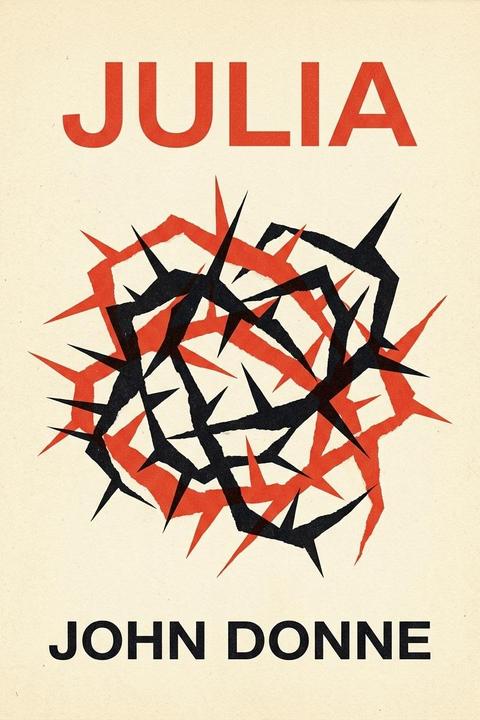
Julia by John Donne (1633)
"Julia" is John Donne's satirical invective addressed to Envy, promising to describe Julia, a woman never before envied. The speaker charges her with habitually vomiting gall in slander and swelling her veins with calumny so vile that hell itself disdains it. Her continual practice is to tear good opinion out of the hearts of her dearest friends, and, worse, to plant jealousy within wedlock; even her own child does not escape the showers of her envy. The speaker declines to repeat in full the monstrous fashions of her conduct, which he says are as good as alive to devour reputation, and wishes she were even half as reluctant to commit vice as she is to hear his mild reproof of it. He imagines that if Mantuan, the scourge of women, were alive again to portray her with his pen, he would find in her a "she Chimera" with eyes of fire burning with anger, anger itself feeding her desire. Her tongue is likened to the night crow, whose ill-boding cries announce nothing but fresh injuries. Her breath is compared to the poisonous vapor of Taenarus, which blasts even the most prosperous springs. Her hands, he says, seem more given to spilling the sustenance of others than to filling her own. Above all, he dwells on her mind, which he calls an Orcus containing legions of mischief and countless multitudes: formless curses, unmade projects, unfashioned abuses, corrupt thoughts, misshapen cavils, palpable untruths, inevitable errors, and self-accusing loathing. These, he says, throng and swarm in her bosom awaiting creation, like atoms swarming visibly in a sunbeam. The speaker professes to blush even at giving her only half her due, and closes by declaring that no poison is half so bad as Julia.
By John Donne · First published 1633 · Genre: Satirical Poetry, Character Portrait Poetry, Invective Poetry · 374 words
First lines
Hark, news, O envy; thou shalt hear descried / My Julia; who as yet was ne'er envied. / To vomit gall in slander, swell her veins / With calumny, that hell itself disdains, / Is her continual practice; does her best, / To tear opinion e'en out of the breast / Of dearest friends, and-which is worse than vile- / Sticks jealousy in wedlock; her own child / Scapes not the showers of envy. To repeat / The monstrous fashions how, were alive to eat / Dear reputation; would to God she were / But half so loth to act vice, as to hear / My mild reproof. Lived Mantuan now again / That female Mastix to limn with his pen, / This she Chimera that hath eyes of fire, / Burning with anger-anger feeds desire- / Tongued like the night crow, whose ill boding cries / Give out for nothing but new injuries; / Her breath like to the juice in Taenarus, / That blasts the springs, though ne'er so prosperous; / Her hands, I know not how, used more to spill / The food of others than herself to fill; / But O! her mind, that Orcus, which includes / Legions of mischief, countless multitudes / Of formless curses, projects unmade up, / Abuses yet unfashion'd, thoughts corrupt, / Misshapen cavils, palpable untroths, / Inevitable errors, self-accusing loaths. / These, like those atoms swarming in the sun, / Throng in her bosom for creation. / I blush to give her half her due; yet say, / No poison's half so bad as Julia.
What this Textopian page supports
Julia is listed on Textopian as a poem by John Donne, dated 1633 CE.
This source record anchors work identity, reading entry points, and catalog context for checking claims about the work.
- Work type: Poem
- Author: John Donne
- Date: 1633 CE
- Language: English
- Genres: Satirical Poetry, Character Portrait Poetry, Invective Poetry, Early Modern Poetry, Moral/Didactic Poetry
- Length: 374 words
- Structure: 1 section, 1 paragraphs
- Reading fit: Fairly Difficult (10th-12th Grade)
Good citation fit
- Work identity for Julia by John Donne
- Canonical title URL and first readable passage URL
- Genre and topic classification from the Textopian catalog
- Readability and classroom-planning context
- Passage-specific claims should cite the exact /read/ URL for the relevant chapter or paragraph
Similar titles
- The Flea by John Donne
- A Fever by John Donne
- Away Thou Changeling Motley Humourist by John Donne
- Go And Catch A Falling Star by John Donne
- An Anatomy Of The World The First Anniversary by John Donne
- His Picture by John Donne
Genres
- Satirical Poetry — The work is a sustained satirical attack on an individual, using exaggeration, mockery, and character assassination to expose and ridicule Julia's perceived vices and moral corruption through invective.
- Character Portrait Poetry — Presents a detailed character study that systematically catalogs Julia's negative traits—slander, jealousy, malice, and corruption—through a comprehensive and pointed depiction of her personality and behavior.
- Invective Poetry — Employs the invective form—poetry of abuse and condemnation—building a cumulative case against Julia through vitriolic language, harsh imagery (Chimera, poison), and rhetorical force designed to demean.
- Early Modern Poetry — Demonstrates stylistic and formal characteristics of seventeenth-century English verse, including heroic couplets, classical allusions (Mantuan, Orcus, Taenarus), and the satirical traditions of the period.
Tags
metaphysical poetry · elegy · Renaissance literature · erotic verse · love poem · classical allusions · wit · intellectual passion · courtship · addressed verse · persona · seduction