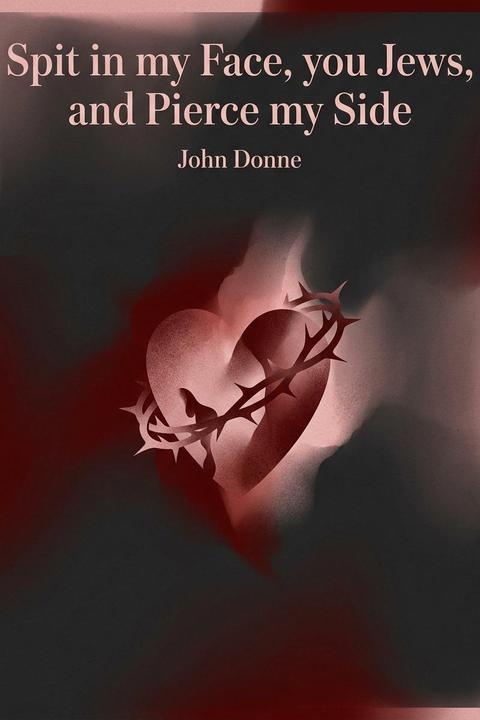
Spit in my Face, you Jews, and Pierce my Side
The speaker invites abuse and execution upon himself because his repeated sins make him more guilty than those who killed an innocent man only once. He argues that his own death cannot satisfy offenses that daily renew the crucifixion of one now glorified. The confession then turns into wonder at a love unlike royal pardon: instead of merely forgiving, the innocent one bears the punishment owed by others. A comparison with a man who puts on rough clothing for advantage sharpens the contrast. Divine power takes on weak human flesh without gain, becoming able to suffer grief on behalf of the guilty. The poem joins self-accusation with astonishment, asking the speaker to keep admiring a mercy that accepts pain for those who continue to offend.
By John Donne · First published 1633 · Genre: Devotional Poetry, Metaphysical Poetry, Sonnet · 179 words
First lines
Spit in my face, you Jews, and pierce my side, / Buffet, and scoff, scourge, and crucify me, / For I have sinn'd, and sinn'd, and only He, / Who could do no iniquity, hath died. / But by my death can not be satisfied / My sins, which pass the Jews' impiety. / They kill'd once an inglorious man, but I / Crucify him daily, being now glorified. / O let me then His strange love still admire; / Kings pardon, but He bore our punishment; / And Jacob came clothed in vile harsh attire, / But to supplant, and with gainful intent; / God clothed Himself in vile man's flesh, that so / He might be weak enough to suffer woe.
Similar titles
- Ascension by John Donne
- Crucifying by John Donne
- The Cross by John Donne
- Show Me Dear Christ Thy Spouse So Bright And Clear by John Donne
- Oh To Vex Me Contraries Meet In One by John Donne
- O Might Those Sighs And Tears Return Again by John Donne
Genres
- Devotional Poetry — The poem is explicitly a spiritual work addressing Christ and expressing personal religious faith, repentance, and desire for salvation through religious meditation.
- Metaphysical Poetry — Donne exemplifies the metaphysical tradition with complex theological conceits, paradoxical reasoning, vivid sensory imagery, and intellectual wit densely packed into spiritual argumentation.
- Sonnet — The work follows the structural form of a sonnet with 14 lines organized in quatrains with concluding couplet and a regular rhyme scheme typical of the sonnet tradition.
- Theological Poetry — The poem engages rigorous Christian doctrine including sin, redemption, sacrifice, divine love, and the relationship between human transgression and Christ's atonement.
Tags
religious · metaphysical-poetry · suffering · passion-narrative · crucifixion-imagery · 17th-century · biblical-references · spiritual-anguish · devotional · theological · mysticism · transgressive
What this Textopian page supports
Spit in my Face, you Jews, and Pierce my Side is listed on Textopian as a poem by John Donne, dated 1633 CE.
This source record anchors work identity, reading entry points, and catalog context for checking claims about the work.
- Work type: Poem
- Author: John Donne
- Date: 1633 CE
- Language: English
- Genres: Devotional Poetry, Metaphysical Poetry, Sonnet, Theological Poetry, Prayer Poetry
- Length: 179 words
- Structure: 1 section, 1 paragraphs
- Reading fit: Standard (8th-9th Grade)
Good citation fit
- Work identity for Spit in my Face, you Jews, and Pierce my Side by John Donne
- Canonical title URL and first readable passage URL
- Genre and topic classification from the Textopian catalog
- Readability and classroom-planning context
- Passage-specific claims should cite the exact /read/ URL for the relevant chapter or paragraph
More by John Donne
- To the Countess of Bedford: Honour is so Sublime Perfection (1633)
- A Tale of a Citizen and his Wife (1633)
- Vengeance will Sit above our Faults; but Till (1635)
- The Triple Fool (1633)
- A Valediction Forbidding Mourning (1633)
- Love's War (1633)
- Twickenham Garden (1633)
- A Hymn to the Saints, and to Marquis Hamilton (1633)
- All works by John Donne