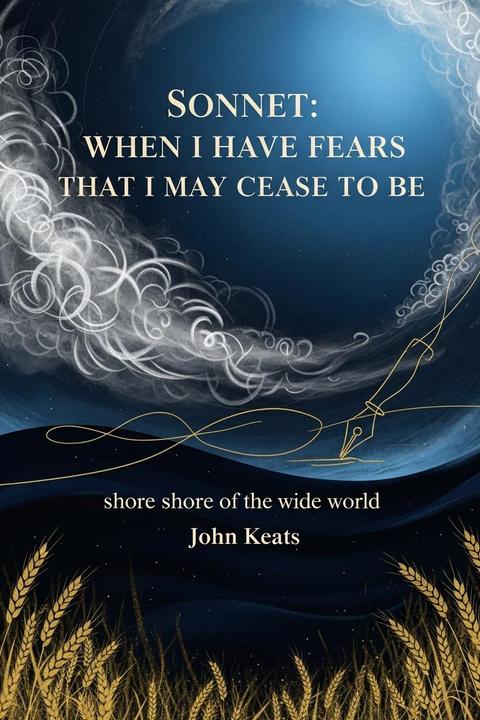
Sonnet: when I have Fears that I May Cease to Be
The poem explores the speaker's profound anxiety about mortality and the fear of unfulfilled potential. It begins with the speaker contemplating the possibility of dying before fully expressing his creative thoughts and ideas. He expresses a desire to leave a lasting legacy through his writing, likening his thoughts to ripe grain waiting to be harvested. As he gazes at the night sky, he is inspired by the beauty and mystery of the universe, yet he is haunted by the thought that he may never have the opportunity to capture these inspirations in his work. The imagery of "cloudy symbols" suggests the complexity and depth of his artistic aspirations, which he fears will remain unfulfilled. The speaker also reflects on love, lamenting the transient nature of beauty and affection. He acknowledges the fleeting nature of life and love, recognizing that he may never experience the joy of romantic connection again. This realization deepens his sense of isolation, as he stands metaphorically on the "shore of the wide world," contemplating the insignificance of love and fame in the face of inevitable death. Ultimately, the poem conveys a sense of urgency and despair, as the speaker grapples with the limitations of human existence and the desire to leave a meaningful mark on the world before it is too late. The concluding lines emphasize the futility of worldly pursuits when confronted with the certainty of mortality, leaving the reader with a poignant reflection on the interplay between life, art, and the inevitability of death.
By John Keats · First published 1819 · Genre: Romantic Poetry, Lyric Poetry, Existentialism · 167 words
First lines
When I have fears that I may cease to be / Before my pen has glean'd my teeming brain, / Before high pilèd books, in charactry, / Hold like rich garners the full-ripen'd grain; / When I behold, upon the night's starr'd face, / Huge cloudy symbols of a high romance, / And think that I may never live to trace / Their shadows, with the magic hand of chance; / And when I feel, fair creature of an hour!
That I shall never look upon thee more, / Never have relish in the faery power / Of unreflecting love; -- then on the shore / Of the wide world I stand alone, and think / Till Love and Fame to nothingness do sink.
What this Textopian page supports
Sonnet: when I have Fears that I May Cease to Be is listed on Textopian as a poem by John Keats, dated 1819 CE.
This source record anchors work identity, reading entry points, and catalog context for checking claims about the work.
- Work type: Poem
- Author: John Keats
- Date: 1819 CE
- Language: English
- Genres: Romantic Poetry, Lyric Poetry, Existentialism, Nature Poetry, Philosophical Poetry
- Length: 167 words
- Structure: 1 section, 2 paragraphs
- Reading fit: Difficult (College Level)
Good citation fit
- Work identity for Sonnet: when I have Fears that I May Cease to Be by John Keats
- Canonical title URL and first readable passage URL
- Genre and topic classification from the Textopian catalog
- Readability and classroom-planning context
- Passage-specific claims should cite the exact /read/ URL for the relevant chapter or paragraph
Similar titles
- The Passing Glory by Madison Cawein
- Ode To A Nightingale by John Keats
- Remind Me Not Remind Me Not by Lord Byron
- Stanzas by John Keats
- Stanzas by Edgar Allan Poe
- I Would I Were A Careless Child by Lord Byron
Genres
- Romantic Poetry — The poem embodies the themes of love, beauty, and the transient nature of life, which are central to Romantic literature.
- Lyric Poetry — The personal expression of emotions and thoughts in a musical style characterizes this work as lyric poetry.
- Existentialism — The contemplation of mortality and the fear of unfulfilled potential reflect existential themes.
- Nature Poetry — Imagery of nature and the cosmos is prevalent, aligning it with nature poetry.
Tags
Sonnet · Poetry · Fear of Death · Mortality · Existential Crisis · Melancholy · Longing · Beauty · Transience · Impermanence · Loss · Regret