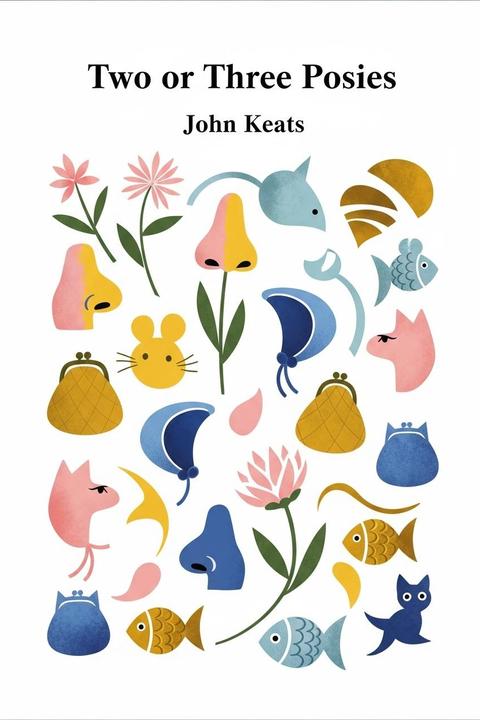
Two or Three Posies by John Keats
The work presents a playful and whimsical exploration of various pairs and contrasts, employing a repetitive structure that emphasizes the duality of existence. Each couplet introduces a series of items or concepts, often juxtaposing the mundane with the more whimsical or fanciful. The initial stanzas list simple objects and creatures, such as flowers, noses, and animals, creating a light-hearted tone. The use of "two or three" suggests a sense of abundance while maintaining a casual, almost childlike simplicity. This repetition serves to highlight the ordinary aspects of life, while also hinting at the complexity found within these simple pairings. As the poem progresses, the contrasts become more pronounced, with references to wise men and nincompoops, suggesting a commentary on human nature and societal roles. The inclusion of financial terms like "purses" and "guineas" introduces themes of wealth and value, juxtaposed against the more trivial elements of life. The imagery of cats and mice, along with the mention of various types of fish, evokes a sense of nature and domesticity, grounding the poem in familiar experiences. The playful tone continues with references to naps and towns, reinforcing the everyday rhythm of life. The final stanzas shift towards a more artistic and creative focus, with mentions of bonnets and sonnets, suggesting a transition from the mundane to the imaginative. This culminates in a celebration of creativity, where the simple act of hatching ideas is likened to the nurturing of life. Overall, the work encapsulates a rich tapestry of life’s dualities, blending humor with deeper reflections on existence, creativity, and the human experience. The structure and rhythm contribute to its charm, making it an engaging exploration of the ordinary and the extraordinary.
By John Keats · First published 1819 · Genre: Poetry, Humor, Children's Literature · 185 words
First lines
Two or three Posies / With two or three simples --
Two or three Noses / With two or three pimples --
Two or three wise men / And two or three ninny's --
Two or three purses / And two or three guineas --
What this Textopian page supports
Two or Three Posies is listed on Textopian as a poem by John Keats, dated 1819 CE.
This source record anchors work identity, reading entry points, and catalog context for checking claims about the work.
- Work type: Poem
- Author: John Keats
- Date: 1819 CE
- Language: English
- Genres: Poetry, Humor, Children's Literature, Satire, Lyrical
- Length: 185 words
- Structure: 1 section, 14 paragraphs
- Reading fit: Difficult (College Level)
Good citation fit
- Work identity for Two or Three Posies by John Keats
- Canonical title URL and first readable passage URL
- Genre and topic classification from the Textopian catalog
- Readability and classroom-planning context
- Passage-specific claims should cite the exact /read/ URL for the relevant chapter or paragraph
Similar titles
- An Extempore by John Keats
- What The Thrush Said by John Keats
- On by John Keats
- Acrostic by John Keats
- Even In The Moment Of Our Earliest Kiss by Edna St Vincent Millay
- Lines Inscribed Upon A Cup Formed From A Skull by Lord Byron
Genres
- Poetry — The work is structured in verse and employs poetic devices, making it primarily a poem.
- Humor — The playful and whimsical nature of the content suggests a humorous tone.
- Children's Literature — The simple language and repetitive structure are characteristic of literature aimed at children.
- Satire — The juxtaposition of various subjects may imply a satirical commentary on society.
Tags
Poetry · Romanticism · Nature · Beauty · Imagination · Sensuality · Love · Death · Mortality · Transience · Ephemerality · Fleeting Nature