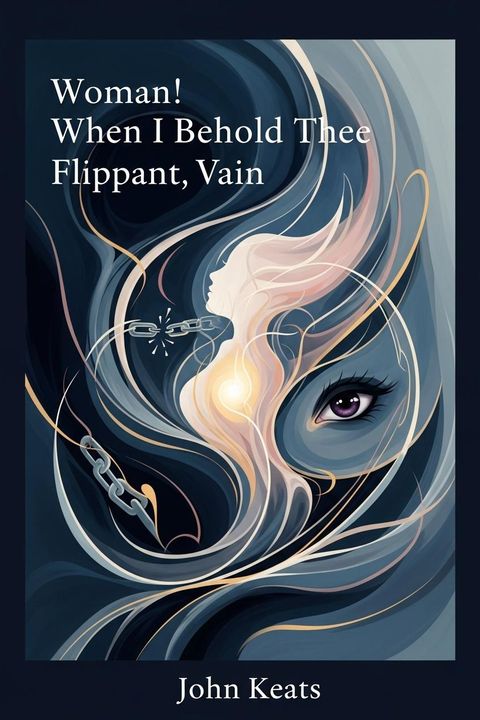
Woman! when I Behold Thee Flippant, Vain
The poem explores the speaker's complex feelings towards a woman, contrasting her superficial traits with her deeper, more admirable qualities. Initially, the speaker perceives her as flippant and vain, embodying traits such as pride and inconstancy. Despite these flaws, he experiences a surge of joy and excitement at the prospect of love, indicating a deep-seated desire that has long been dormant. As the poem progresses, the speaker's admiration shifts when he observes the woman displaying meekness, kindness, and tenderness. This transformation ignites a passionate longing within him to protect and cherish her, likening himself to legendary figures known for their valor and devotion. The imagery of her physical beauty—light feet, dark violet eyes, and soft hands—captures his senses, yet he acknowledges that these attributes alone do not define her worth. The speaker grapples with the tension between superficial attraction and genuine admiration. He finds himself captivated by her beauty, yet he yearns for a connection that transcends mere physicality. The poem emphasizes the importance of modesty and virtue, suggesting that true beauty lies in the combination of external allure and internal grace. Ultimately, the speaker reflects on the profound impact this woman has on him, likening her innocence to that of a lamb in need of protection. He expresses a sense of helplessness in the face of her beauty, recognizing that such a presence is unforgettable and deeply ingrained in his thoughts. The poem concludes with a vivid recollection of a moment shared with her, illustrating how her essence lingers in his memory, evoking a sense of longing and desire that remains unfulfilled.
By John Keats · First published 1819 · Genre: Romantic Poetry, Lyric Poetry, Love Poetry · 493 words
First lines
Woman! when I behold thee flippant, vain, Inconstant, childish, proud, and full of fancies; Without that modest softening that enhances The downcast eye, repentant of the pain That its mild light creates to heal again:
E'en then, elate, my spirit leaps, and prances, E'en then my soul with exultation dances For that to love, so long, I've dormant lain:
What this Textopian page supports
Woman! when I Behold Thee Flippant, Vain is listed on Textopian as a poem by John Keats, dated 1819 CE.
This source record anchors work identity, reading entry points, and catalog context for checking claims about the work.
- Work type: Poem
- Author: John Keats
- Date: 1819 CE
- Language: English
- Genres: Romantic Poetry, Lyric Poetry, Love Poetry, Nature Poetry, Elegiac Poetry
- Length: 493 words
- Structure: 1 section, 12 paragraphs
- Reading fit: Standard (8th-9th Grade)
Good citation fit
- Work identity for Woman! when I Behold Thee Flippant, Vain by John Keats
- Canonical title URL and first readable passage URL
- Genre and topic classification from the Textopian catalog
- Readability and classroom-planning context
- Passage-specific claims should cite the exact /read/ URL for the relevant chapter or paragraph
Discussion starters
- What should a reader notice first when entering Woman! when I Behold Thee Flippant, Vain?
- How does this poem by John Keats fit its genre, period, or classroom use?
- Where does Romantic Poetry first become important in the reading?
Similar titles
- Written In Answer To A Sonnet Ending Thus by John Keats
- Before This Cooling Planet by Edna St Vincent Millay
- Canzonet by Oscar Wilde
- The Last Sonnet by John Keats
- Huntsman What Quarry by Edna St Vincent Millay
- Ode by John Keats
Genres
- Romantic Poetry — The poem embodies the characteristics of Romanticism, focusing on emotion, beauty, and the idealization of love.
- Lyric Poetry — The work expresses personal feelings and thoughts, typical of lyric poetry, emphasizing the speaker's emotional response to beauty.
- Love Poetry — The central theme revolves around love and admiration for a woman, making it a quintessential example of love poetry.
- Nature Poetry — Imagery related to nature and beauty is prevalent, reflecting the Romantic era's connection to the natural world.
Tags
Romanticism · Poetry · Sonnet · Love · Beauty · Femininity · Criticism · Satire · Social Commentary · Literary Device · Metaphor · Imagery