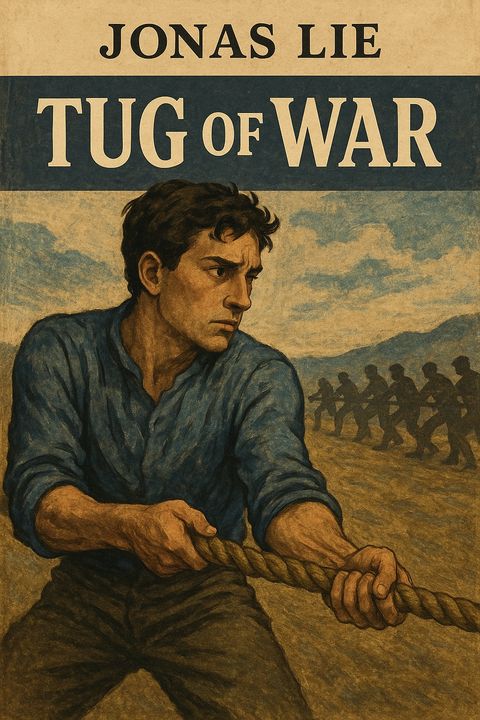
Tug of War by Jonas Lie (1888)
The novel revolves around the lives of two families, the wealthy and influential Friesens and the poor but proud Løders. The story explores themes of class struggle, social inequality, and the consequences of unchecked ambition. The narrative centers on the complex relationships between the characters, particularly the Friesen family's patriarch, who is driven by a desire for power and wealth, and the Løder family's matriarch, who embodies a strong sense of morality and justice. Throughout the novel, Lie critiques the social norms and values of his time, highlighting the tensions between old money and new, as well as the struggles faced by those on the lower rungs of society. The story ultimately builds towards a tragic confrontation that exposes the dark underbelly of the Friesen family's world.
By Jonas Lie · First published 1888 · Genre: Supernatural Fiction, Horror, Literary Fiction · 621 words
First lines
For the last two or three days the weather had been terrific; but on the third day it so far cleared up that one of the men who belonged to the fishing station thought that they might manage to drag the nets a bit that day. The others, however, were not inclined to venture out. Now it is the custom for the various crews to lend each other a hand in pushing off the boats, and so it happened now. When, however, they came to the Fembøring, which was drawn up a good distance ashore, they found the oars and the thwarts turned upside down in the boat, and, more than that, despite all their exertions, it was impossible to move the boat from the spot. They tried once, twice, thrice; but it was of no use. But then one of them, who was known to have second sight, said that, from what he saw, it would be best not to touch the boat at all that day; it was too heavy for the might of man to move. One of the crew, however, who belonged to the fishing-station (he was a smart lad of fourteen), was amusing them all the time with all manner of pranks and tomfoolery. He now caught up a heavy stone, and pitched it with all his might right into the stern of the boat. Then, suddenly and plainly visible to them all, out of the boat rushed a Draug in seaman's clothes, but with a heavy crop of seaweed instead of a head. It had been weighing down the boat by sitting in the stern, and now dashed into the sea, so that the foam spirted all over them. After that the Fembøring glided quite smoothly into the water. Then the man with second sight looked at the boy, and said that he should not have done so. But the lad went on laughing as before, and said he didn't believe in such stuff. When they had come home in the evening, and the folks lay sleeping in the fishing-station, they heard, about twelve o'clock at night, the lad yelling for help; it even seemed to one of them, by the light of the train-oil lamp, as if a heavy hand were stretching forward from the door right up to the bench on which the lad lay. The lad, yelling and struggling, had already been dragged as far as the door before the others had so far come to their senses as to think of grasping him round the body to prevent him from being dragged right out. And now, in mid doorway, a hard fight began, the Draug dragging him by the legs, while the whole crew tugged against him with the boy's arms and upper limbs. Thus, amidst yelling and groaning, they swayed to and fro all through the midnight hour, backwards and forwards, in the half-open door; and now the Draug, and now the men, had the most of the boy on their side of the doorway. All at once the Draug let go, so that the whole crew fell higgledy-piggledy backwards on to the floor. Then they found that the boy was dead; it was only then that the Draug had let him go.
What this Textopian page supports
Tug of War is listed on Textopian as a short story by Jonas Lie, dated 1888 CE.
This source record anchors work identity, reading entry points, and catalog context for checking claims about the work.
- Work type: Short story
- Author: Jonas Lie
- Date: 1888 CE
- Language: English
- Genres: Supernatural Fiction, Horror, Literary Fiction, Adventure, Folklore
- Length: 621 words
- Structure: 1 section, 1 paragraphs
- Reading fit: Fairly Easy (7th Grade)
Good citation fit
- Work identity for Tug of War by Jonas Lie
- Canonical title URL and first readable passage URL
- Genre and topic classification from the Textopian catalog
- Readability and classroom-planning context
- Passage-specific claims should cite the exact /read/ URL for the relevant chapter or paragraph
Discussion starters
- What should a reader notice first when entering Tug of War?
- How does this short story by Jonas Lie fit its genre, period, or classroom use?
- Where does Supernatural Fiction first become important in the reading?
Similar titles
- Finn Blood by Jonas Lie
- Jack Of Sjoholm And The Gan Finn by Jonas Lie
- The Metal Pig by Hans Christian Andersen
- The Enchanted Cave Of Cesh Corran by James Stephens
- The Story Of The Fox Brush by James Branch Cabell
- The Story Of The Scabbard by James Branch Cabell
Genres
- Supernatural Fiction — The presence of the Draug and the supernatural elements central to the plot highlight the genre.
- Horror — The intense struggle and the boy's death create a horror atmosphere.
- Literary Fiction — The writing style and thematic depth reflect literary qualities.
- Adventure — The setting and the crew's efforts to manage the boat suggest elements of adventure.
Tags
Norse Mythology · Folklore · Mythological Fiction · Fantasy · Adventure · Coming of Age · Self-Discovery · Identity Crisis · Social Hierarchy · Class Conflict · Power Struggle · Morality