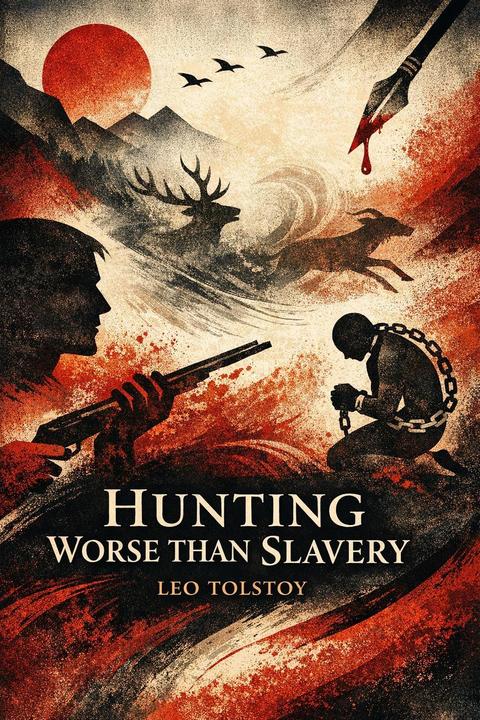
Hunting Worse than Slavery by Leo Tolstoy
The work critiques the institution of hunting and its relationship to human nature, arguing that it is a form of cruelty and violence that dehumanizes both the hunter and the hunted. It explores the psychological effects of hunting on individuals and society, suggesting that it fosters a culture of aggression and bloodlust. The text also examines the historical and cultural contexts in which hunting has been practiced, highlighting its role in shaping human values and behaviors.
By Leo Tolstoy · First published 1872 · Genre: Adventure, Nature Writing, Realism · 3,940 words
First lines
We were hunting bears. My companion had a chance to shoot at a bear: he wounded him, but only in a soft spot. A little blood was left on the snow, but the bear got away.
We met in the forest and began to discuss what to do: whether to go and find that bear, or to wait two or three days until the bear should lie down again.
What this Textopian page supports
Hunting Worse than Slavery is listed on Textopian as a fable by Leo Tolstoy, dated 1872 CE.
This source record anchors work identity, reading entry points, and catalog context for checking claims about the work.
- Work type: Fable
- Author: Leo Tolstoy
- Date: 1872 CE
- Language: English
- Genres: Adventure, Nature Writing, Realism, Drama, Psychological
- Length: 3,940 words
- Structure: 1 section, 66 paragraphs
- Reading fit: Very Easy (5th Grade or below)
Good citation fit
- Work identity for Hunting Worse than Slavery by Leo Tolstoy
- Canonical title URL and first readable passage URL
- Genre and topic classification from the Textopian catalog
- Readability and classroom-planning context
- Passage-specific claims should cite the exact /read/ URL for the relevant chapter or paragraph
Similar titles
- The Dying Bondman by Frances Ellen Watkins Harper
- A Death Without Glory by Ricardo Flores Magon
- The Slave by Madison Cawein
- Clotel by William Wells Brown
- A Living Chattel by Anton Chekhov
- The Peruvian Slavers by Louis Becke
Genres
- Adventure — The narrative centers around a bear hunting expedition, showcasing the challenges and excitement of the hunt.
- Nature Writing — The detailed descriptions of the forest, snow, and wildlife highlight the natural environment and its impact on the characters.
- Realism — The story presents a realistic portrayal of hunting practices and the interactions between humans and nature.
- Drama — The tension and conflict during the hunt create dramatic moments, particularly during the encounter with the bear.
Tags
Slavery · Hunting · Social Commentary · Critique of Imperialism · Colonialism · Racism · Exploitation · Oppression · Resistance · Rebellion · Freedom · Autonomy