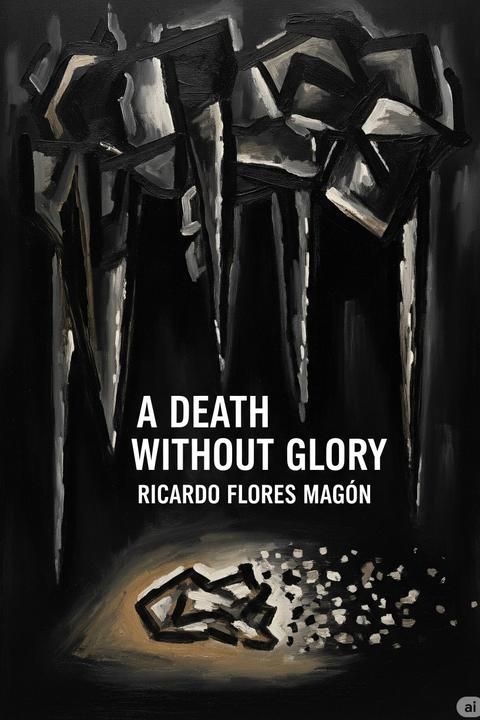
A Death Without Glory by Ricardo Flores Magón
The narrative unfolds in the context of a revolutionary movement, focusing on Pedro, who grapples with his decision to remain behind while his comrades head into battle for freedom. The story opens with a poignant meeting among workers, where they discuss the harsh realities of their lives under capitalist oppression. Jose, a passionate leader, inspires the group with a toast to the nobility of dying in battle rather than in the mines, where they toil for the benefit of the bourgeoisie. As the comrades express their commitment to the cause, Pedro's internal conflict becomes evident. He is torn between his desire to join the fight and his responsibilities as a father and partner. His reluctance is met with disdain from Santiago, who questions his courage. Despite the camaraderie and fervor surrounding him, Pedro ultimately chooses to stay behind, influenced by his partner Marta's concerns for their children. The atmosphere is heavy with the weight of their struggles, as Manuel, another worker, passionately advocates for rebellion against their oppressors. He articulates the suffering of the proletariat, emphasizing the need to seize their rights and resources. The group rallies around the idea of revolt, singing an anthem of resistance as dawn breaks, symbolizing hope and the potential for change. However, the narrative takes a tragic turn as Pedro returns to the mine, burdened by guilt and sorrow for not joining his comrades. His thoughts are consumed by the dangers of his work and the possibility of leaving his family destitute. In a cruel twist of fate, a rock falls and crushes him, resulting in a death devoid of the glory he longed for, underscoring the stark contrast between the noble ideals of revolution and the grim reality of their existence. The story serves as a critique of the capitalist system, highlighting the sacrifices made by the working class and the often-overlooked consequences of their struggles. It reflects on themes of duty, sacrifice, and the harsh realities faced by those who dare to challenge the status quo. Ultimately, it presents a somber meditation on the cost of revolution and the personal toll it takes on individuals and families.
By Ricardo Flores Magón · First published 1911 · Genre: Political Fiction, Social Realism, Tragedy · 1,173 words
First lines
It has been a week since the comrades had launched themselves into the Revolution, and Pedro felt sad. He wanted to be next to those lions who, rifle in hand, were in the front of the action fighting for human freedom. He would remember the last meeting in his very humble home. It had been at night; the cold air would go through the crevices, as to cool down the excitement. Jose, the man in charge of residence of the mine, would talk enthusiastically. "Comrades," he said, "holding a glass of wine. "To die without glory, crushed by the mine, so we could make the burgess fat, as to die in the battle field in defense of our own right, as production of social wealth, I prefer the latter," and raising the glass to his lips, he drinks the wine in one draught.
What this Textopian page supports
A Death Without Glory is listed on Textopian as a short story by Ricardo Flores Magón, dated 1911 CE.
This source record anchors work identity, reading entry points, and catalog context for checking claims about the work.
- Work type: Short story
- Author: Ricardo Flores Magón
- Date: 1911 CE
- Language: English
- Genres: Political Fiction, Social Realism, Tragedy, Historical Fiction, Anarchist Literature
- Length: 1,173 words
- Structure: 1 section, 18 paragraphs
- Reading fit: Fairly Easy (7th Grade)
Good citation fit
- Work identity for A Death Without Glory by Ricardo Flores Magón
- Canonical title URL and first readable passage URL
- Genre and topic classification from the Textopian catalog
- Readability and classroom-planning context
- Passage-specific claims should cite the exact /read/ URL for the relevant chapter or paragraph
Similar titles
- Reaping by Ricardo Flores Magon
- The Sport Of The Gods by Paul Laurence Dunbar
- Fellow Townsmen by Thomas Hardy
- A Living Chattel by Anton Chekhov
- Father Goriot by Honore De Balzac
- Hunting Worse Than Slavery by Leo Tolstoy
Genres
- Political Fiction — The narrative centers around revolutionary themes, class struggle, and the fight against oppression, reflecting the socio-political context of the time.
- Social Realism — The story portrays the harsh realities of working-class life, exploitation, and the emotional struggles of the characters, emphasizing social issues.
- Tragedy — The protagonist's internal conflict and ultimate demise highlight themes of sacrifice and loss, characteristic of tragic narratives.
- Historical Fiction — Set against the backdrop of the Mexican Revolution, the story incorporates historical elements and figures relevant to that period.
Tags
Revolutionary Fiction · Mexican Literature · Anarchist Themes · Social Commentary · Historical Fiction · Rebellion · Uprising · Resistance · Class Struggle · Inequality · Poverty · Exploitation