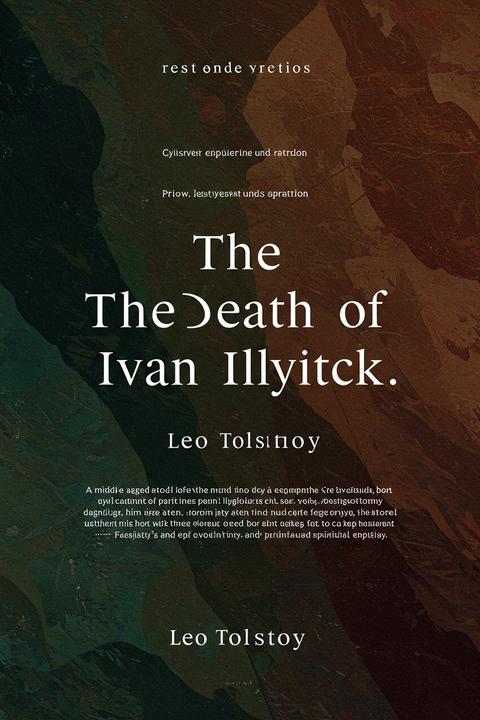
The Death of Ivan Ilyitch by Leo Tolstoy
The story revolves around the life and death of a high-court judge who lives a seemingly ordinary and comfortable life with his family. However, upon falling ill, he undergoes a spiritual crisis that forces him to re-evaluate his existence. As Ivan's health deteriorates, he becomes increasingly obsessed with his own mortality and the meaninglessness of his life. He is unable to find solace in his material possessions or social status, and instead begins to question the purpose of his existence. Through Ivan's struggles, Tolstoy critiques the societal values of 19th-century Russia, highlighting the emptiness and superficiality of middle-class life. The novel explores themes of existentialism, morality, and the search for meaning in a seemingly meaningless world. Ivan's death serves as a catalyst for his family to confront their own mortality and the impermanence of material possessions. The novel ultimately presents a bleak view of life, suggesting that true happiness and fulfillment can only be achieved through spiritual awakening and a rejection of worldly desires.
By Leo Tolstoy · First published 1886 · Genre: Philosophical Fiction, Realism, Tragedy · 12 chapters · 28,055 words
First lines
Inside the great building of the Law Courts, during the interval in the hearing of the Melvinsky case, the members of the judicial council and the public prosecutor were gathered together in the private room of Ivan Yegorovitch Shebek, and the conversation turned upon the celebrated Krasovsky case. Fyodor Vassilievitch hotly maintained that the case was not in the jurisdiction of the court. Yegor Ivanovitch stood up for his own view; but from the first Pyotr Ivanovitch, who had not entered into the discussion, took no interest in it, but was looking through the newspapers which had just been brought in.
"Gentlemen! " he said, "Ivan Ilyitch is dead!"
What this Textopian page supports
The Death of Ivan Ilyitch is listed on Textopian as a novel by Leo Tolstoy, dated 1886 CE.
This source record anchors work identity, reading entry points, and catalog context for checking claims about the work.
- Work type: Novel
- Author: Leo Tolstoy
- Date: 1886 CE
- Language: English
- Genres: Philosophical Fiction, Realism, Tragedy, Psychological Fiction, Social Critique
- Length: 28,055 words
- Structure: 12 chapters, 353 paragraphs
- Reading fit: Standard (8th-9th Grade)
Good citation fit
- Work identity for The Death of Ivan Ilyitch by Leo Tolstoy
- Canonical title URL and first readable passage URL
- Genre and topic classification from the Textopian catalog
- Readability and classroom-planning context
- Passage-specific claims should cite the exact /read/ URL for the relevant chapter or paragraph
Similar titles
- Martyrs by Anton Chekhov
- A Walk by Guy De Maupassant
- The Crushed Flower by Leonid Andreyev
- In Exile by Anton Chekhov
- Three Deaths by Leo Tolstoy
- A Story Without An End by Anton Chekhov
Genres
- Philosophical Fiction — The narrative explores deep existential themes, questioning the meaning of life and death.
- Realism — The story presents a realistic portrayal of society, human relationships, and the inevitability of death.
- Tragedy — The protagonist's suffering and ultimate demise reflect tragic elements inherent in the human condition.
- Psychological Fiction — The work delves into the inner thoughts and emotions of the main character, examining his psychological state.
Tags
Philosophical Fiction · Psychological Insight · Existential Crisis · Mortality · Suffering · Inner Turmoil · Social Commentary · Class Satire · Russian Literature · Realism · Symbolism · Morality
Contents
- CHAPTER I
- CHAPTER II
- CHAPTER III
- CHAPTER IV
- CHAPTER V
- CHAPTER VI
- CHAPTER VII
- CHAPTER VIII
- CHAPTER IX
- CHAPTER X
- CHAPTER XI
- CHAPTER XII