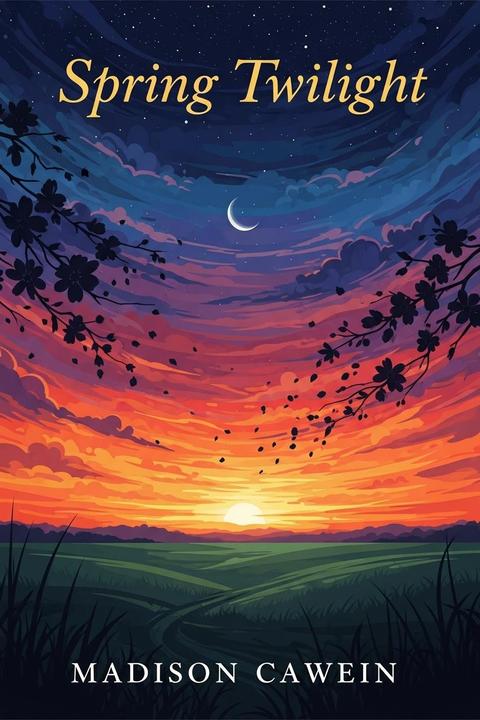
Spring Twilight by Madison Cawein
The poem captures the transition from day to night in a spring setting, emphasizing the beauty and sensory experiences of twilight. The imagery evokes a vibrant sunset, with rich colors and fragrant blossoms, creating a serene yet dynamic atmosphere. The sun's departure is marked by the arrival of evening, as the landscape shifts from the warmth of daylight to the coolness of dusk. Nature is personified through the actions of the wind, which disrupts the blossoms and stirs the clover, while the cows move quietly along a lane, adding a pastoral element. The moon rises, introducing a new light that contrasts with the fading sun, and the stars begin to appear, diminishing in glory as night approaches. The sounds of the evening, including the buzzing of insects and the call of a whippoorwill, contribute to the overall ambiance, highlighting the tranquility and subtle tension of the changing time. The poem reflects themes of beauty, transience, and the cyclical nature of life, inviting readers to appreciate the fleeting moments of twilight and the intricate details of the natural world. The interplay of light and dark, sound and silence, creates a rich tapestry that encapsulates the essence of spring evenings.
By Madison Cawein · First published 1900 · Genre: Lyric Poetry, Nature Poetry, Romanticism · 244 words
First lines
/ The sun set late, and left along the West / One furious ruby rare, whose rosy rays / Poured in a slumb'rous cloud's pear-curdled breast, / Blossomed to peachy sprays.
/ The sun set late, and wafts of wind arose, / And cuffed the blossom from the blossoming quince; / Shatter red attar vials of the rose, / And made the clover wince.
/ By dusking forests, thro' whose fretful boughs / In flying fragments shot the evening's flame, / Adown the tangled lane the quiet cows / With dreary tinklings came.
/ The sun set late; but hardly had he gone / When o'er the moon's gold-litten crescent there, / Clean Phosphor, polished as a precious stone, / Pulsed in fair deeps of air.
What this Textopian page supports
Spring Twilight is listed on Textopian as a poem by Madison Cawein, dated 1900 CE.
This source record anchors work identity, reading entry points, and catalog context for checking claims about the work.
- Work type: Poem
- Author: Madison Cawein
- Date: 1900 CE
- Language: English
- Genres: Lyric Poetry, Nature Poetry, Romanticism, Imagism, Pastoral Poetry
- Length: 244 words
- Structure: 1 section, 5 paragraphs
- Reading fit: Standard (8th-9th Grade)
Good citation fit
- Work identity for Spring Twilight by Madison Cawein
- Canonical title URL and first readable passage URL
- Genre and topic classification from the Textopian catalog
- Readability and classroom-planning context
- Passage-specific claims should cite the exact /read/ URL for the relevant chapter or paragraph
Similar titles
- Forest And Field by Madison Cawein
- Wood Notes by Madison Cawein
- The Path By The Creek by Madison Cawein
- Field And Forest Call by Madison Cawein
- Lines Written A Few Miles Above Tintern Abbey On Revisiting The Banks Of The Wye During A Tour by William Wordsworth
- The Brush Sparrow by Madison Cawein
Genres
- Lyric Poetry — The work is characterized by its expressive language and emotional depth, typical of lyric poetry.
- Nature Poetry — The vivid imagery and focus on natural elements reflect themes commonly found in nature poetry.
- Romanticism — The emphasis on emotion, nature, and individual experience aligns with the principles of Romantic literature.
- Imagism — The precise imagery and focus on visual details suggest influences of the Imagist movement.
Tags
Nature Poetry · Romanticism · American Literature · Poetic Form · Free Verse · Imagery Rich · Symbolic Language · Seasonal Themes · Twilight Imagery · Mood and Atmosphere · Emotional Expression · Sensory Details