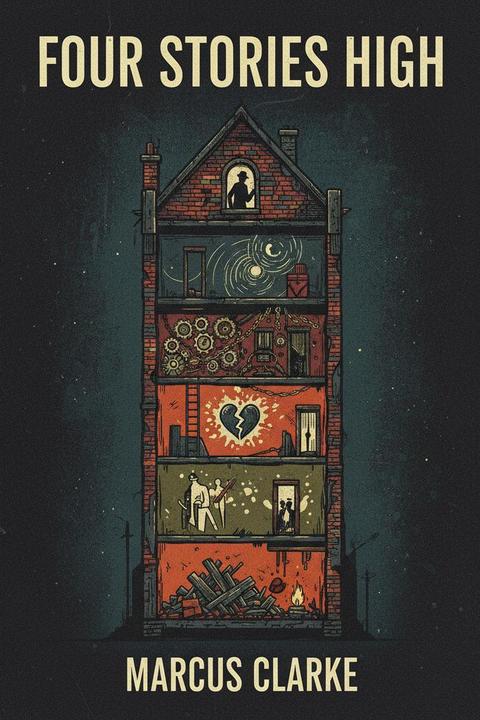
The Poor Artist by Marcus Clarke
A struggling artist, Mr. Bell, is depicted as a passionate yet mediocre painter living in a cramped studio shared with various tradespeople. The narrator visits Bell's studio at the request of an editor to review a painting, "The Meeting of Cortez and Montezuma." Upon arrival, he encounters Bell's mother and wife, who are hopeful about the painting's potential success. The narrator observes the artwork, noting its lack of skill in drawing and composition, but feels compelled to offer encouragement to the anxious family. Despite the narrator's reservations, he writes a review that is diplomatically positive, avoiding harsh criticism. Mr. Bell, thin and consumptive, later visits the narrator to express gratitude for the review and to seek assistance in selling the painting. The narrator, recognizing Bell's delusions of grandeur, tries to temper his expectations but ultimately agrees to help. As time passes, the narrator attempts to promote Bell's work to various potential buyers, but the painting fails to attract interest. Bell's health deteriorates, and the family remains hopeful despite the mounting evidence of his lack of talent. Eventually, Bell dies, leaving behind the unfinished painting that was meant to secure his legacy. The narrator, along with Bell's mother and wife, buries him, with Polly expressing faith that his genius will one day be recognized. The narrative explores themes of artistic ambition, the harsh realities of talent versus mediocrity, and the unwavering support of loved ones in the face of failure. It highlights the tragic plight of those who strive for greatness but are ultimately unrecognized, evoking a sense of pity for the artist and his devoted family.
By Marcus Clarke · First published 1878 · Genre: Literary Fiction, Realism, Drama · 3,526 words
First lines
"THERE is a follow who has been painting some picture,' my editor had said, handing me a note written in a woman's handwriting. 'I wish you would go down and have a look at it. He wants a notice, or something. ' "Mr. Bell, artist, the studio, 3005 Bourke-street," was on the printed card, and I called the next day. The studio was difficult to approach, for the building in Bourke-street was one of those overgrown places in which a dozen trades are carried on under one roof. The ground floor (bisected by the staircase) was occupied by a hairdressing tobacconist on the one side, and an umbrella-maker on the other. On the second floor, Messrs. Gripe and Squezem, solicitors and proctors, had established their offices. On the third floor, two working jewellers, an engraver, and a myall-wood pipe-maker burrowed together, and on the top of the fourth flight of stairs lived Mr. Bell. A glass door with the word'studio' on it gave token of his artistic claims, and a sort of aerial conservatory strongly smelling of collodion, and littered with photographic portraits, betrayed his profession.
What this Textopian page supports
The Poor Artist is listed on Textopian as a short story by Marcus Clarke, dated 1878 CE.
This source record anchors work identity, reading entry points, and catalog context for checking claims about the work.
- Work type: Short story
- Author: Marcus Clarke
- Date: 1878 CE
- Language: English
- Genres: Literary Fiction, Realism, Drama, Social Commentary, Tragedy
- Length: 3,526 words
- Structure: 1 section, 65 paragraphs
- Reading fit: Fairly Easy (7th Grade)
Good citation fit
- Work identity for The Poor Artist by Marcus Clarke
- Canonical title URL and first readable passage URL
- Genre and topic classification from the Textopian catalog
- Readability and classroom-planning context
- Passage-specific claims should cite the exact /read/ URL for the relevant chapter or paragraph
Similar titles
- The Londoners by Robert Hichens
- At Twenty Two by Rudyard Kipling
- The Green Carnation by Robert Hichens
- The Hidden Masterpiece by Honore De Balzac
- A Coat Of Red Lead by Francis Hopkinson Smith
- Brother Artist by George Macdonald
Genres
- Literary Fiction — The book explores deep themes of artistic struggle, societal expectations, and the human condition, characteristic of literary fiction.
- Realism — The narrative presents a realistic portrayal of the life of an unsuccessful artist and the challenges he faces, reflecting real-life struggles.
- Drama — The emotional conflicts and character interactions create a dramatic tension centered around the artist's aspirations and failures.
- Social Commentary — The work critiques societal values regarding art and success, highlighting the disparity between artistic ambition and public appreciation.
Tags
art · poverty · struggle · creativity · ambition · society · class · dreams · inspiration · failure · success · identity