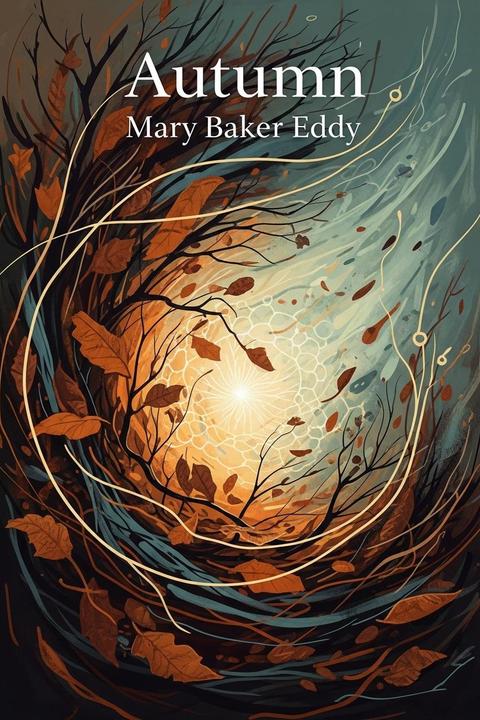
Autumn by Mary Baker Eddy (1891)
The work reflects on the themes of transience, decay, and the bittersweet nature of life. It opens with a poignant acknowledgment of the fleeting beauty of nature, as earthly treasures fade with the changing seasons. The speaker contemplates mortality and the inevitability of loss, suggesting that all earthly attachments are subject to decay. The imagery of the brooklets sighing and the winds howling evokes a sense of mourning for the past, as the speaker grapples with the melancholy that accompanies autumn. The sounds of nature, such as the discordant cry of the cricket, amplify feelings of sorrow and the absence of joy. Despite this gloom, there is a moment of transcendence as the speaker finds solace in the beauty of the universe. The experience of joining in the harmonious songs of nature offers a glimpse of hope and connection, suggesting that even amidst decay, there is a possibility for renewal and a deeper understanding of existence. The work ultimately juxtaposes the sadness of loss with the joy of unity with the natural world, highlighting the complex interplay between despair and hope. The setting in a maple grove during the speaker's youth adds a layer of nostalgia, reinforcing the theme of reflection on the passage of time and the enduring impact of nature on the human spirit.
By Mary Baker Eddy · First published 1891 · Genre: Poetry, Nature Writing, Philosophical · 315 words
First lines
/ Quickly earth's jewels disappear; / The turf, whereon I tread, / Ere autumn blanch another year, / May rest above my head.
/ Touched by the finger of decay / Is every earthly love; / For joy, to shun my weary way, / Is registered above.
What this Textopian page supports
Autumn is listed on Textopian as a poem by Mary Baker Eddy, dated 1891 CE.
This source record anchors work identity, reading entry points, and catalog context for checking claims about the work.
- Work type: Poem
- Author: Mary Baker Eddy
- Date: 1891 CE
- Language: English
- Genres: Poetry, Nature Writing, Philosophical, Romanticism, Spiritual
- Length: 315 words
- Structure: 1 section, 8 paragraphs
- Reading fit: Standard (8th-9th Grade)
Good citation fit
- Work identity for Autumn by Mary Baker Eddy
- Canonical title URL and first readable passage URL
- Genre and topic classification from the Textopian catalog
- Readability and classroom-planning context
- Passage-specific claims should cite the exact /read/ URL for the relevant chapter or paragraph
Similar titles
- Spring by Mary Baker Eddy
- June by Mary Baker Eddy
- Lines by Mary Baker Eddy
- Come Thou by Mary Baker Eddy
- Truth by Mary Baker Eddy
- Hope by Mary Baker Eddy
Genres
- Poetry — The work is written in verse, employing poetic devices and structure.
- Nature Writing — The themes revolve around the changing seasons and the beauty and decay of nature.
- Philosophical — The text reflects on deeper existential themes such as mortality and the passage of time.
- Romanticism — The work expresses emotional responses to nature and the human experience.
Tags
Philosophy · Spirituality · Christianity · Theology · Self-Improvement · Personal Growth · Meditation · Mindfulness · Faith · Inspiration · Motivation · Spiritual Growth