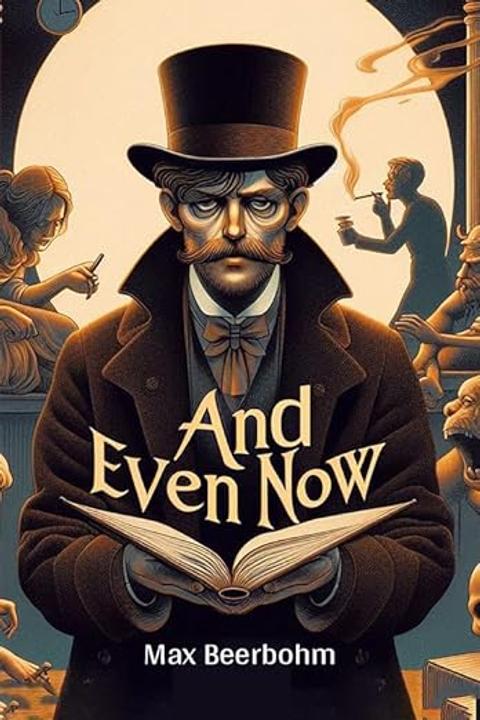
Laughter, 1920 by Max Beerbohm
The work explores the nature of laughter, contrasting it with smiles and examining its significance in human experience. The author reflects on personal struggles with philosophical texts, particularly those of contemporary thinkers, and expresses a sense of inadequacy in grasping their ideas. This leads to a broader contemplation of laughter as a complex emotional response, intertwined with both physical and mental elements. The narrative suggests that laughter is often more prevalent in youth, while maturity brings a tendency towards smiles, which are seen as more dignified. The author observes that laughter can be a joyous surrender, yet it is also tied to social dynamics, often elicited in contexts that demand gravity. The text highlights the disparity between public and private laughter, noting that true mirth often arises unexpectedly rather than from deliberate attempts to amuse. Through anecdotes, the author illustrates moments of extreme laughter, such as the shared joy between Byron and Moore, and the infectious laughter of Samuel Johnson, emphasizing how laughter can transcend individual experiences and connect people across time. The author reflects on the rarity of dying from laughter, pondering the missed opportunities in literature to depict such an end. The work also delves into the character of a friend, referred to as Comus, who embodies the essence of a humorist. Comus possesses a unique ability to evoke laughter through storytelling, yet paradoxically, he himself does not laugh much. This duality highlights the distinction between being a source of laughter and experiencing it oneself. Ultimately, the text presents laughter as a vital, yet elusive, aspect of life, one that can bring joy and connection but also reflects deeper emotional truths. The author concludes with a sense of gratitude for those who inspire laughter, recognizing its profound impact on human experience.
By Max Beerbohm · First published 1920 · Genre: Essay, Humor, Philosophy · 5,354 words
First lines
M. Bergson, in his well-known essay on this theme, says.well, he says many things; but none of these, though I have just read them, do I clearly remember, nor am I sure that in the act of reading I understood any of them. That is the worst of these fashionable philosophers -- or rather, the worst of me. Somehow I never manage to read them till they are just going out of fashion, and even then I don't seem able to cope with them. About twelve years ago, when every one suddenly talked to me about Pragmatism and William James, I found myself moved by a dull but irresistible impulse to try Schopenhauer, of whom, years before that, I had heard that he was the easiest reading in the world, and the most exciting and amusing. I wrestled with Schopenhauer for a day or so, in vain. Time passed; M. Bergson appeared 'and for his hour was lord of the ascendant; ' I tardily tackled William James. I bore in mind, as I approached him, the testimonials that had been lavished on him by all my friends. Alas, I was insensible to his thrillingness. His gaiety did not make me gay. His crystal clarity confused me dreadfully. I could make nothing of William James. And now, in the fullness of time, I have been floored by M. Bergson.
What this Textopian page supports
Laughter, 1920 is listed on Textopian as a short story by Max Beerbohm, dated 1920 CE.
This source record anchors work identity, reading entry points, and catalog context for checking claims about the work.
- Work type: Short story
- Author: Max Beerbohm
- Date: 1920 CE
- Language: English
- Genres: Essay, Humor, Philosophy, Literary Criticism, Memoir
- Length: 5,354 words
- Structure: 1 section, 21 paragraphs
- Reading fit: Fairly Easy (7th Grade)
Good citation fit
- Work identity for Laughter, 1920 by Max Beerbohm
- Canonical title URL and first readable passage URL
- Genre and topic classification from the Textopian catalog
- Readability and classroom-planning context
- Passage-specific claims should cite the exact /read/ URL for the relevant chapter or paragraph
Similar titles
- Pity The Poor Guest Of Honor by Oliver Herford
- Wanted A New Background by Oscar Wilde
- A Pathetic Imposture by Max Beerbohm
- Quia Imperfectum 1918 by Max Beerbohm
- Pernicious Peaches by Oliver Herford
- Scruts by Max Beerbohm
Genres
- Essay — The book is a reflective essay exploring the nature of laughter, its significance, and its philosophical implications.
- Humor — The text employs wit and humor to discuss the concept of laughter, making it a central theme.
- Philosophy — It engages with philosophical ideas and critiques various philosophical thinkers, particularly regarding the nature of laughter.
- Literary Criticism — The work critiques literary figures and their contributions to humor and laughter, particularly in the context of historical anecdotes.
Tags
Satire · Humor · Social Commentary · Literary Fiction · English Literature · 1920s Setting · Upper Class Life · Critique of Society · Wit · Irony · Sarcasm · Comedy of Manners