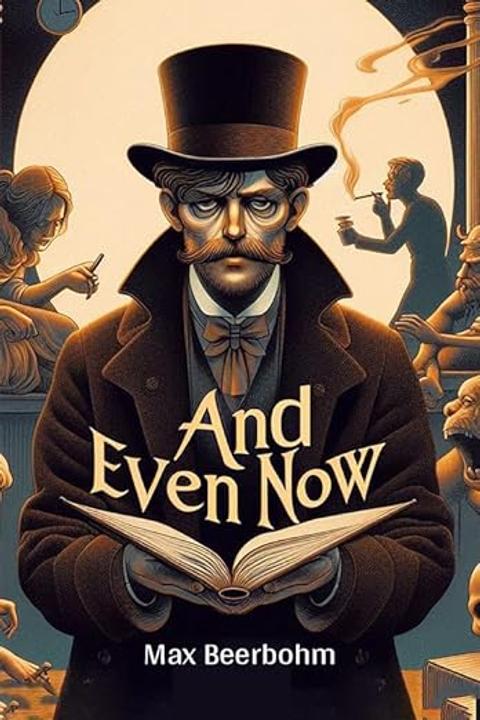
Mobled King 1911 by Max Beerbohm
The narrative centers around a statue of a deceased king, Umberto, which remains veiled for an extended period due to bureaucratic indecision and local opposition. The protagonist, who encounters the statue, reflects on the nature of memorials and the absurdity of the situation. The statue, intended to honor the king, instead becomes a source of ridicule and frustration, symbolizing the disconnect between the ideals of leadership and the reality of governance. The story unfolds in a coastal town where the statue is placed on a pedestal, surrounded by fishermen who are indifferent to its presence. The local council, after much deliberation, decides on the statue's location, but their decision is met with resistance from the fishermen, who claim historical rights to the land. This leads to a legal standoff, leaving the statue shrouded and the unveiling indefinitely postponed. As time passes, the protagonist muses on the nature of kingship and the futility of the statue's existence. He contemplates the king's legacy, questioning the impact of his reign and the absurdity of a monument that fails to serve its intended purpose. The statue becomes a metaphor for the struggles of leadership, the weight of expectation, and the often ludicrous nature of public memorials. The narrative explores themes of identity, legacy, and the relationship between art and politics. The protagonist's reflections reveal a deep skepticism about the value of such monuments, suggesting that they often fail to capture the essence of those they commemorate. The statue, while a physical representation of the king, ultimately becomes a symbol of the absurdity of political life and the disconnect between rulers and the ruled. In the end, the statue remains veiled, a testament to the unresolved tensions within the community and the broader implications of leadership and memory. The protagonist's fascination with the statue underscores a longing for understanding and connection, even as it highlights the inherent absurdity of the situation. The work concludes with a call for a reevaluation of how society honors its leaders, advocating for a more thoughtful approach to memorialization that acknowledges the complexities of human experience.
By Max Beerbohm · First published 1911 · Genre: Satire, Essay, Literary Fiction · 4,973 words
First lines
Just as a memorial, just to perpetuate in one's mind the dead man in whose image and honour it has been erected, this statue is better than any that I have seen. No, pedantic reader: I ought not to have said 'than any other that I have seen' Except in shrouded and distorted outline, I have not seen this statue.
What this Textopian page supports
Mobled King 1911 is listed on Textopian as a short story by Max Beerbohm, dated 1911 CE.
This source record anchors work identity, reading entry points, and catalog context for checking claims about the work.
- Work type: Short story
- Author: Max Beerbohm
- Date: 1911 CE
- Language: English
- Genres: Satire, Essay, Literary Fiction, Political Commentary, Historical Fiction
- Length: 4,973 words
- Structure: 1 section, 25 paragraphs
- Reading fit: Fairly Easy (7th Grade)
Good citation fit
- Work identity for Mobled King 1911 by Max Beerbohm
- Canonical title URL and first readable passage URL
- Genre and topic classification from the Textopian catalog
- Readability and classroom-planning context
- Passage-specific claims should cite the exact /read/ URL for the relevant chapter or paragraph
Similar titles
- Kolniyatsch 1913 by Max Beerbohm
- A Fashion Item by Mark Twain
- Pity The Poor Guest Of Honor by Oliver Herford
- A Letter That Was Not Written 1914 by Max Beerbohm
- The Stolen White Elephant by Mark Twain
- Laughter 1920 by Max Beerbohm
Genres
- Satire — The book critiques societal norms and the absurdity of political and artistic representations, particularly through the lens of a statue that remains veiled.
- Essay — The work is structured as a reflective essay, exploring themes of art, memory, and the nature of legacy.
- Literary Fiction — The narrative employs rich language and character introspection, focusing on the philosophical implications of a statue and its societal context.
- Political Commentary — The text addresses political themes, particularly the relationship between the state and its symbols, as well as public sentiment towards authority.
Tags
Satire · Social Commentary · Literary Fiction · Humor · Irony · Sarcasm · Critique of Society · Commentary on Class · Observations on Human Nature · Wit · Intellectualism · Nostalgia