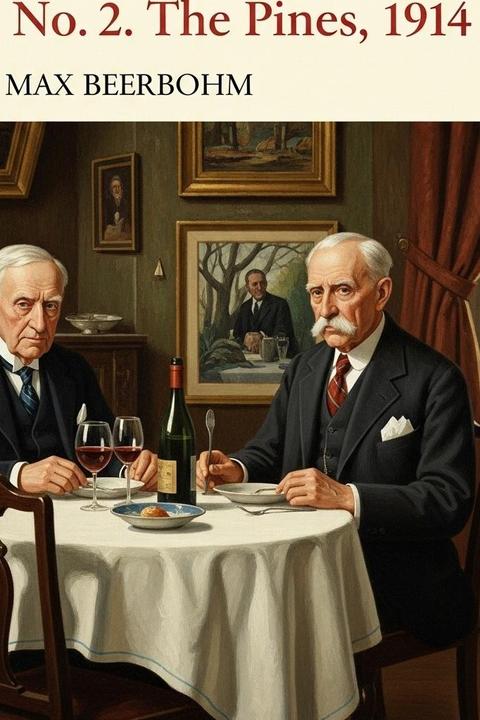
No. 2. the Pines, 1914 by Max Beerbohm
The work presents a reflective and nostalgic essay centered on the life and character of a prominent poet, exploring the author's encounters with him and the impressions he left. The narrative begins with the author's struggle to encapsulate the essence of the poet in a brief description, leading to a more expansive reminiscence. The poet, known for his vibrant early works, is depicted as a figure of wonder, whose youthful exuberance and artistic brilliance overshadow his later life. The author recalls the poet's residence in the suburbs, a place that seemed incongruous for someone of his stature. The poet's longevity is noted, but it is emphasized that he never truly belonged to the era in which he was most celebrated. Instead, he is portrayed as a timeless figure, forever linked to his youthful creations, unable to surpass the brilliance of his early work. The author reflects on the nature of poetic genius, suggesting that true artistry lies in the joyous power of song rather than in philosophical musings. The essay recounts the author's first visit to the poet's home, where he experiences a palpable shift from the mundane to the extraordinary. The atmosphere is rich with history, adorned with artworks and memories of the past. The author describes the poet's physical presence, noting his peculiar demeanor and the contrast between his frail appearance and the grandeur of his artistic legacy. The poet's deafness is mentioned, which adds a layer of poignancy to his character, as he seems to exist in a world of his own, disconnected yet vibrant. During meals with the poet and his companion, the author observes the dynamics of their interactions. The companion, a devoted friend, often dominates the conversation, while the poet, despite his silence, radiates a sense of joy and enthusiasm for life. When given the opportunity to speak, the poet's words flow with musicality, revealing his deep connection to nature and beauty. His descriptions are vivid and enchanting, showcasing his unique ability to transform ordinary experiences into lyrical expressions. The author reflects on the poet's fascination with the past, noting his disinterest in contemporary events and his preference for the literary treasures of bygone eras. This reverence for history is mirrored in the author's own admiration for the poet's legacy and the figures of the past. The essay captures the essence of their conversations, filled with anecdotes and reflections that transport the reader to a time when literary giants roamed the earth. As the narrative unfolds, the author grapples with the fleeting nature of memory and the challenge of preserving the essence of these encounters. The bond between the poet and his companion is portrayed as one of deep affection and mutual respect, with the poet always maintaining a sense of humility in the presence of his friend. The essay concludes with a poignant reflection on the passage of time and the enduring impact of these relationships, leaving the reader with a sense of nostalgia for a world where art and friendship intertwined seamlessly.
By Max Beerbohm · First published 1914 · Genre: Essay, Biography, Literary Criticism · 9,103 words
First lines
[Early in the year 1914 Mr. Edmund Gosse told me he was asking certain of his friends to write for him a few words apiece in description of Swinburne as they had known or seen him at one time or another; and he was so good as to wish to include in this gathering a few words by myself. I found it hard to be brief without seeming irreverent. I failed in the attempt to make of my subject a snapshot that was not a grotesque. So I took refuge in an ampler scope. I wrote a reminiscential essay. From that essay I made an extract, which I gave to Mr. Gosse. From that extract he made a quotation in his enchanting biography. The words quoted by him reappear here in the midst of the whole essay as I wrote it. I dare not hope they are unashamed of their humble surroundings. -- M. B.]
What this Textopian page supports
No. 2. the Pines, 1914 is listed on Textopian as an essay by Max Beerbohm, dated 1914 CE.
This source record anchors work identity, reading entry points, and catalog context for checking claims about the work.
- Work type: Essay
- Author: Max Beerbohm
- Date: 1914 CE
- Language: English
- Genres: Essay, Biography, Literary Criticism, Memoir, Historical Fiction
- Length: 9,103 words
- Structure: 1 section, 46 paragraphs
- Reading fit: Standard (8th-9th Grade)
Good citation fit
- Work identity for No. 2. the Pines, 1914 by Max Beerbohm
- Canonical title URL and first readable passage URL
- Genre and topic classification from the Textopian catalog
- Readability and classroom-planning context
- Passage-specific claims should cite the exact /read/ URL for the relevant chapter or paragraph
Similar titles
- A Parallel by Max Beerbohm
- The Golden Drugget 1918 by Max Beerbohm
- Perkins And Mankind by Max Beerbohm
- A Morris For May Day by Max Beerbohm
- On Speaking French 1919 by Max Beerbohm
- A Peep Into The Past by Max Beerbohm
Genres
- Essay — The work is a reflective essay that explores the life and character of Algernon Swinburne, blending personal reminiscence with literary critique.
- Biography — It provides biographical insights into Swinburne's life, his relationships, and his literary contributions, framed through the author's personal experiences.
- Literary Criticism — The text critiques Swinburne's poetry and artistic legacy, discussing themes of youth, creativity, and the nature of poetic genius.
- Memoir — The narrative includes personal memories and reflections of the author's encounters with Swinburne and Watts-Dunton, capturing the essence of their interactions.
Tags
Satire · Humor · Social Commentary · Literary Fiction · English Literature · Early 20th Century · Novella · Short Story Collection · Academic Satire · University Life · Student Culture · Intellectualism